E540F08E41B0
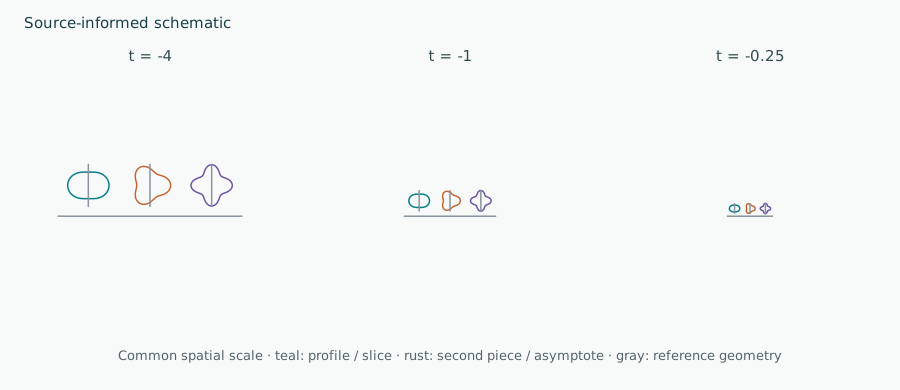
For every integer $g\ge 1$, Yamamoto constructs a real six-dimensional toric Calabi–Yau cone $C(S)=M_ g$ and a compact Lagrangian shrinking immersion with parameter manifold $\Sigma _ g\times S^1$, where $\Sigma _ g$ is a closed orientable surface of genus $g$. The submanifold has real dimension three and codimension three. This is not a genus-$g$ surface in Euclidean three-space, nor a construction in the flat space $\mathbb C^3$. The construction uses the real form, moment-map level sets and torus action of the chosen toric cone, followed by the radial/phase ODE in Theorem 7.1. For the cone metric $dr^2+r^2g_ S$, write $D_ a(s,r)=(s,ar)$ and $R=r\partial _ r$. After normalizing $\mathbf H=-R^\perp /2$, the flow is $D_{\sqrt{-t}}(L)$ for $t<0$. Compactness of the parameter manifold gives completeness and properness of the immersion; a general embedding assertion is not recorded. The cone vertex is outside the smooth ambient manifold and is approached only at the singular endpoint. The figure is a radial and topology diagram, not a Euclidean isometric rendering of the Calabi–Yau metric.
Sources: [Yamamoto2012].
Comments
Comments are not enabled yet.