9F3C76F8391F
For every integer $n\geq 2$, the weighted half-plane $\{ (r,x):r>0\} $ with metric
contains a simple closed geodesic $\gamma _ n=(r,x)$ whose weighted length satisfies
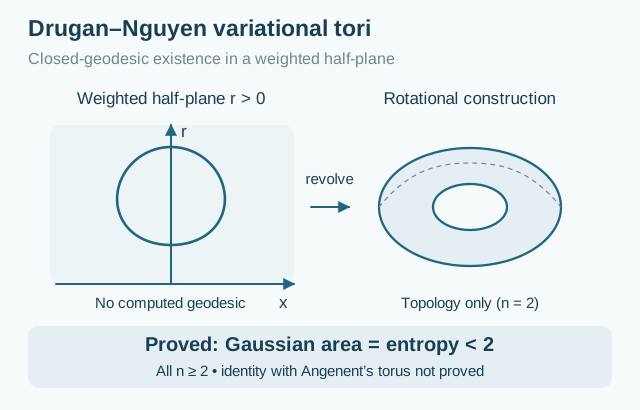
Revolving this curve gives a normalized self-shrinker
The profile is obtained by a variational and modified curve-flow argument, not by a closed formula. The smooth MCF is $\sqrt{-t}\, X$, $t<0$.
This is a compact embedded hypersurface of dimension $n$ in $\mathbb R^{n+1}$, with topology $S^1\times S^{n-1}$ and rotational $O(n)$ symmetry. It is complete, proper, boundaryless and has no ends. For $n=2$ it is an embedded genus-one torus in $\mathbb R^3$.
The rotational Gaussian integral and the length bound give
\[ \lambda (\mathcal T_ n)=F_{0,1}(\mathcal T_ n) =(4\pi )^{-n/2}|S^{n-1}(1)|L_{g_ n}(\gamma _ n)<2. \]Thus this family has a proved entropy upper bound in every stated dimension. The theorem does not provide an exact entropy value.
In dimension two, this is the shrinking doughnut $\mathcal T$ used by [ChuSun2025], Theorem 1.3 and Corollary 1.7, to produce genus-one singularities and an embedded genus-one shrinker of strictly lower entropy. That conclusion does not identify the lower-entropy model with a particular previously constructed family.
The asserted bound is attached to this variationally constructed torus. A numerical value for the Angenent shooting profile is a different type of evidence and does not establish that the profiles coincide.
The illustration shows the weighted half-plane construction and a clearly labelled torus topology schematic. Reusing a numerical Angenent mesh as an exact model of this construction would assume the unproved identification.
Comments
Comments are not enabled yet.