D20709465D01
Let $n\geq 2$ and $1\leq k<n$. In $\mathbb R^{k+1}\times \mathbb R^{n-k}=\mathbb R^{n+1}$ the exact flow is
Equivalently, $(\omega ,z)\mapsto (\sqrt{2k(-t)}\, \omega ,z)$, with $\omega \in S^ k(1)$ and $z\in \mathbb R^{n-k}$, is a normal parametrization of the flow.
These are complete, proper, noncompact embedded hypersurfaces without boundary, with topology $S^ k\times \mathbb R^{n-k}$ and polynomial area growth. Their symmetries include $O(k+1)$ on the spherical factor and all Euclidean isometries in the axial factor.
There are $k$ positive principal curvatures $1/\sqrt{2k(-t)}$ and $n-k$ zero principal curvatures. Hence they are mean convex and weakly convex, and $|A|^2=1/(2(-t))$. At time zero the spherical factor collapses onto the axial subspace.
Topologically there are two ends if $n-k=1$, and one end if $n-k\geq 2$. Each end has exactly the displayed product geometry.
They are entropy stable among the complete embedded hypersurfaces considered by [CM12], but are not $F$-stable when $1\leq k<n$; see Theorems 0.12 and 0.16. The Euclidean factor leaves entropy unchanged: $\lambda (M_{-1})=\lambda (S^ k(\sqrt{2k}))$. For the round cylinder in $\mathbb R^3$, this is $\sqrt{2\pi /e}$.
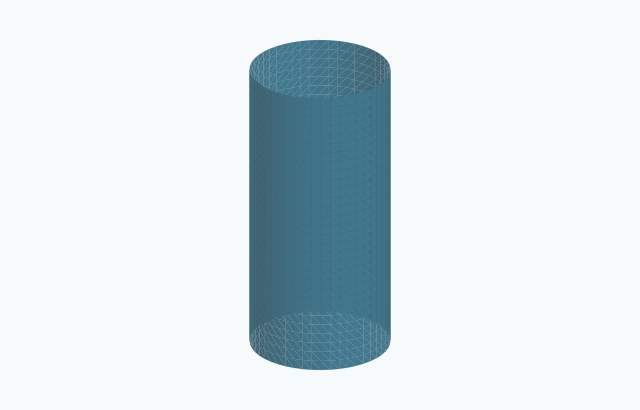
For $n=2$, $k=1$, an interactive picture displays an exact finite window of the infinite cylinder. End caps are not part of the solution.
Comments
Comments are not enabled yet.