4522A41972E4
For every integer $h\geq 2$, Ilmanen–White construct a smooth complete properly embedded self-shrinking surface $\Sigma _ h\subset \mathbb R^3$ of genus $h$ with exactly two ends. In their notation the initial wheel has genus $g=h+1$ and its tangent shrinker has genus $g-1$. The normalized flow is
There is no explicit formula: $\Sigma _ h$ is obtained as a tangent flow of a critical wheel.
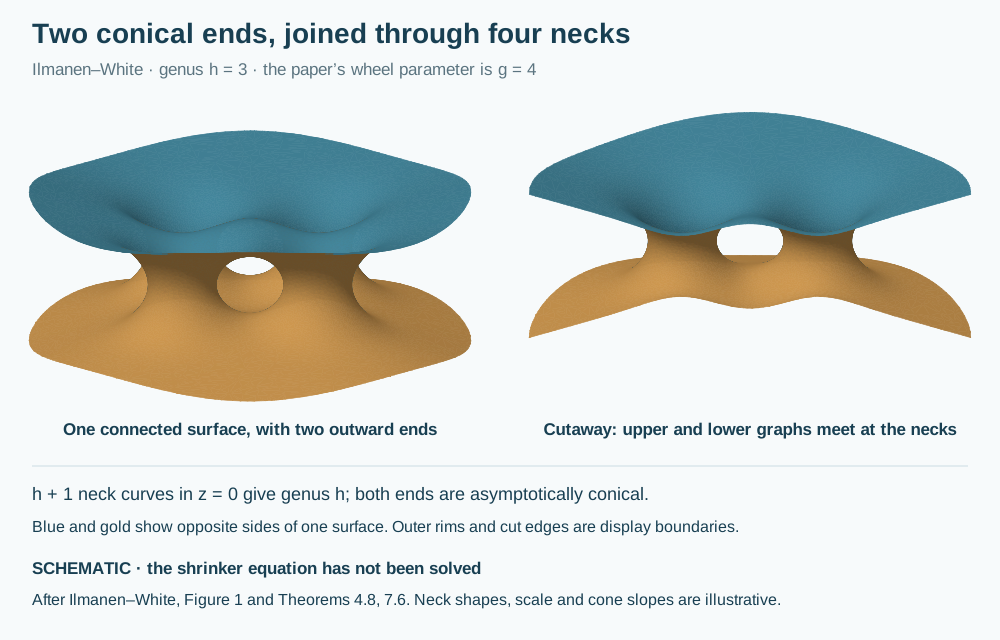
This is a connected orientable noncompact surface, of dimension two and codimension one, with topology a closed genus-$h$ surface with two punctures. Both ends are smoothly asymptotically conical. The part above $P=\{ z=0\} $ is a graph over the unbounded component of $P\setminus \Sigma _ h$; the lower part is its reflection. The intersection with $P$ consists of $h+1$ disjoint smooth closed curves.
Its symmetries include reflection in $P$, reflections in the vertical planes at angles $j\pi /(h+1)$, and rotation through $2\pi /(h+1)$ about the vertical axis. The two cone links lie on opposite sides of the equator.
The authors construct a compact embedded initial surface of genus $h+1$ whose first singular time has exactly one singular point and this multiplicity-one tangent shrinker. Corollary 4.11 gives uniqueness of the tangent flow at that point, not uniqueness of all shrinkers with these topological data.
As $h\to \infty $, the shrinkers converge as varifolds to $2P$. After passage to a subsequence, convergence is smooth with multiplicity two away from one circle in $P$. For sufficiently large $h$, the initial compact wheel fattens immediately after its first singular time. No effective genus threshold for fattening is given.
The conical ends imply quadratic area growth and finite entropy, with $\lambda (\Sigma _ h)=F_{0,1}(\Sigma _ h)$. An exact value or a numerical upper bound for this particular construction is not recorded here. In particular, the entropy bound for Ketover's construction is not transferred to this one.
See [IlmanenWhite2025], version 3: Theorem 1.1 (PDF p. 2), Theorem 4.8 and Corollaries 4.9 and 4.11 (pp. 10–12), Theorem 7.6 (pp. 20–21), Theorem 9.4 (p. 26), and Theorem 10.5 (p. 31). The paper leaves open whether these shrinkers coincide with Ketover's doubled-plane examples. The interactive illustration follows the upper-graph and reflection description, with $h+1$ equatorial neck curves and two flaring ends. Its default genus $h=3$ matches the topology of Figure 1 (credited there to David Chopp); it does not reproduce Chopp's numerical surface. Neck shapes, lengths, and cone slopes are illustrative, and the shrinker equation has not been solved. The outer rims and cutaway edges are display truncations, not boundaries of the complete surface.
Comments
Comments are not enabled yet.