MCF-stack: Special Solutions of Mean Curvature Flow

§ 2.50 Lee–Wang embedded quadric shrinkersA400A6F0174B

Earliest recorded reference: (first arXiv submission).

Paper credits and chronology

Paper credits are chronological and include every author of the cited papers. They identify sources, not exclusive discovery credit. Background-only citations do not determine the date of this example. A classical example may predate the references recorded here.

  1. Lee–Mu-Tao Wang — 2008-02-04 (first arXiv submission).
A400A6F0174B
0EB941FB0D2B

(An embedded mixed-sign quadric family) Let $n\geq 3$, $n/2<k<n$, and $S=2k-n>0$. Put

\[ Q_+=\left\{ x\in \mathbb R^ n:\sum _{j\leq k}x_ j^2-\sum _{j>k}x_ j^2=2S\right\} ,\qquad X(x,s)=(e^{is}x_1,\ldots ,e^{is}x_ k,e^{-is}x_{k+1},\ldots ,e^{-is}x_ n). \]

The domain is the mapping torus

\[ (Q_+\times \mathbb R)/((x,s)\sim (-x,s+\pi )). \]

This exact map gives a complete proper embedded Lagrangian of dimension and codimension $n$ in $\mathbb C^ n$, with $\vec H=-X^\perp /2$. Its flow is $L_ t=\sqrt{-t}\, X(Q_+\times \mathbb R)$ for $t<0$. These are the unit-weight cases of [LeeWang2010], Propositions 2.1–2.2: the weights are $k$ copies of $1$ and $n-k$ copies of $-1$.

The fiber $Q_+$ is $S^{k-1}\times \mathbb R^{n-k}$. The antipodal gluing is part of the topology; a product with $S^1$ cannot in general replace this mapping torus. The full manifold is connected, noncompact, and has one end. When $n-k=1$ the gluing exchanges the two fiber ends; otherwise the fiber already has one end. It is orientable exactly when $n$ is even. The $n=3$, $k=2$ case is a nonorientable three-manifold, not a surface with a genus.

The $SO(k)\times SO(n-k)$ action and the indicated circle action preserve the image. The Lagrangian angle is $Ss+\pi /2$ locally; it is harmonic, so the example is Hamiltonian stationary, although it is not stationary under MCF. It is asymptotic to the corresponding quadric cone. Properness follows directly from $|X|=|x|$ on the mapping torus. Its polynomial volume growth gives finite entropy, equal to centered Gaussian area in this normalized shrinker setting; no numerical value or stability theorem is asserted here. The figure uses the exact $n=3$, $k=2$ case, as explained below. The companion expander is Example 4.18.

For the illustrated weights $(1,1,-1)$, put $r_ t(u)=\sqrt{u^2-2t}$. At $t<0$ the complete flow has the explicit coordinates

\[ F_ t(\theta ,u,s)=\bigl (r_ t(u)\cos \theta \, e^{is}, r_ t(u)\sin \theta \, e^{is},u e^{-is}\bigr ), \qquad \theta \in \mathbb R/(2\pi \mathbb Z),\quad u\in \mathbb R,\quad s\in \mathbb R. \]

The circle coordinate obeys $(\theta ,u,s+\pi )\sim (\theta +\pi ,-u,s)$. Fixing $s=0$ gives $x_1^2+x_2^2-x_3^2=-2t$ and waist radius $\sqrt{-2t}$. The four views use one spatial scale and the fixed ambient crop $|F_ t|\leq 3.6$. Thus the shrinking waist approaches the cone while the noncompact ends remain visible. The cut edges are display boundaries. The phase leaves are two-dimensional slices of the full flow, and are not themselves surface mean curvature flows in $\mathbb R^3$.

The circle-action view projects a selected phase leaf and sampled circle orbits by

\[ P(z_1,z_2,z_3)=\left(\operatorname {Re}z_1, \frac{\operatorname {Re}z_2+\operatorname {Im}z_1}{\sqrt2}, \frac{\operatorname {Re}z_3+\operatorname {Im}z_2}{\sqrt2}\right). \]

Changing $s$ changes a spatial coordinate, not the time. Crossings in this projection need not be self-intersections in $\mathbb R^6$. The optional positive-time views use the same quadric equation, with $x_3=\pm \sqrt{x_1^2+x_2^2+2t}$. These two real sheets belong to the connected companion expander after circle gluing. The $t=0$ cone is singular; Theorem 1.1 and Section 3 of [LeeWang2010] give the Brakke continuation through it without mass loss, rather than a smooth flow across zero.
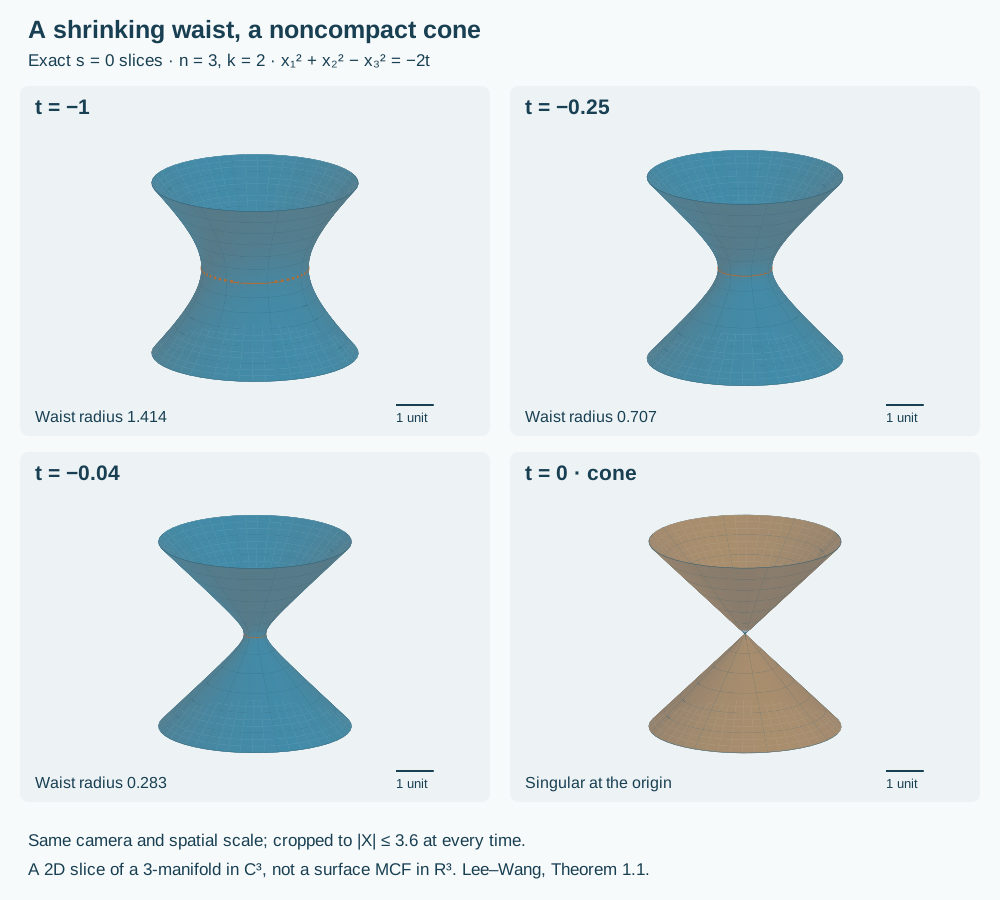
Exact Lee–Wang real slices at t = −1, −0.25, −0.04 and 0: a hyperboloidal waist contracts to a double cone at a common spatial scale.
Exact time slices and projected circle action. The n = 3, k = 2 flow in C³, with weights (1, 1, −1). Four s = 0 slices share one spatial scale and the fixed crop |X| ≤ 3.6; the waist radius √(−2t) tends to zero. Circle action shows a projected phase leaf and sampled orbits in R⁶. Include expander shows the companion positive-time branch of the Brakke continuation; t = 0 is singular. These 2D slices do not evolve by their own mean curvature in R³. Open drawing · Numerical references and credits

Ambient space, topology, embeddedness and entropy

Full Euclidean ambient dimension is 2n, at least six. The time viewer uses n = 3, k = 2: two-dimensional phase leaves and a projection of sampled circle orbits, not a surface flow in R³. Projection crossings do not change embeddedness. The optional t ≥ 0 cone and expander illustrate the source’s Brakke continuation; properties here concern smooth t < 0 shrinker slices.

Embedded unit-weight shrinkers in Cⁿ, n ≥ 3, n/2 < k < n · Euclidean dimension ≥ 5 · Embedded
Ambient space
Euclidean dimension ≥ 5
Topology
Mapping torus of Sᵏ⁻¹ × Rⁿ⁻ᵏ under the antipodal gluing; not in general a product.
Embeddedness
Embedded: Embedded for this explicitly restricted case; no claim about other weights, groups, or singular limits.
Compactness
Noncompact
Surface genus
Intrinsic dimension at least three; surface genus is inapplicable.
Topological ends
One end, including when the gluing exchanges two fiber ends.
Entropy
Finite; value not recorded: F₀,₁ = λ < ∞ for the complete proper normalized shrinker with polynomial volume growth; no value recorded.
Gaussian area
Finite; value not recorded: F₀,₁ = λ < ∞ for the complete proper normalized shrinker with polynomial volume growth; no value recorded.

Compare examples by these properties →

References on this page

  1. [LeeWang2010] Yng-Ing Lee and Mu-Tao Wang. Hamiltonian stationary cones and self-similar solutions in higher dimension. 2010. Reviewed edition 0802.0359v1; selected statements checked. URL: https://arxiv.org/abs/0802.0359v1.All uses in this project ↩ 1 ↩ 2
Cite this page

Comments

Comments are not enabled yet.