MCF-stack: Special Solutions of Mean Curvature Flow

§ 2.23 Closed shrinkers of large even genus via torus–sphere gluing (Colding–Minicozzi II, 2009; Møller, 2011; Drugan–Lee–X. H. Nguyen, 2017)1AD8ABE5C210

Earliest recorded reference: (first arXiv submission).

Paper credits and chronology

Paper credits are chronological and include every author of the cited papers. They identify sources, not exclusive discovery credit. Background-only citations do not determine the date of this example. A classical example may predate the references recorded here.

  1. Colding–Minicozzi II — 2009-08-26 (first arXiv submission). Background only: General mean-convexity and instability theorems applied to the constructed family; this paper predates its construction.
  2. Møller — 2011-11-30 (first arXiv submission).
  3. Drugan–Lee–X. H. Nguyen — 2017-08-30 (first arXiv submission).
1AD8ABE5C210

Møller's construction is stated in [Moller2014], Theorem 1, and summarized in the supplied [DLN2018], Section 3.3, PDF pp. 10–11.

A105C87CB202

There is an integer $g_0$ such that for every even $g\geq g_0$ there exists a compact smooth embedded orientable surface $\Sigma _ g\subset \mathbb R^3$ of genus $g$ satisfying $\vec H=-X^\perp /2$. Its flow is $M_ t=\sqrt{-t}\, \Sigma _ g$, $t<0$. This is an existence construction by desingularization, not an explicit formula and not an existence assertion for every positive genus.

  • Each surface is complete and proper, has no ends, and is invariant under a dihedral group of order $2g$.

  • Along the constructed family as $g\to \infty $, the surfaces converge in Hausdorff distance to the union of a round shrinking sphere and a rotational shrinking torus. Convergence is locally smooth away from their two intersection circles ([Moller2014], pp. 1–2). The limiting union is singular and is not one of the smooth members.

  • These surfaces are not mean convex and are entropy unstable: apply [CM12], Theorems 0.17 and 0.12, to the compact embedded non-spherical surfaces. Their homothetic flows have Type I extinction at the origin.

  • The cited construction supplies no exact coordinates or exact entropy value and makes no uniqueness assertion for a specified genus.

The illustration follows Figures 1–2 of [Moller2014]: a sphere of radius $2$ intersects a non-circular rotational shrinking torus along two circles. In cylindrical coordinates $(r,\theta ,z)$, the displayed numerical torus meets the sphere near $r=1.783$, $z=\pm 0.906$, consistent with Proposition 2.1. These are numerical coordinates, not exact formulas. Rotation, a quarter cutaway, and a meridian view expose both sheets and the circles where the desingularization takes place. The removed sector is only a viewing aid. As in the paper's Figure 1, this is the singular configuration before handle insertion, not a computed smooth surface $\Sigma _ g$.

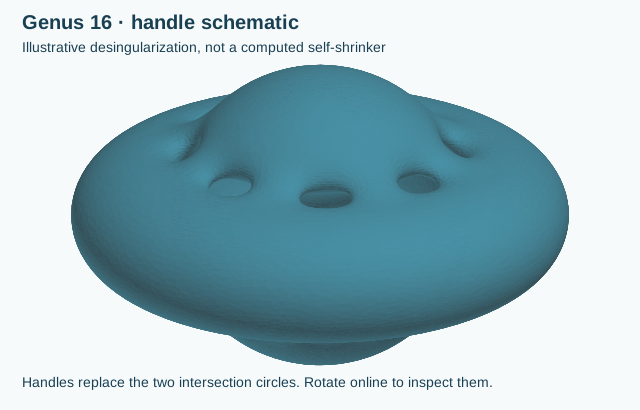
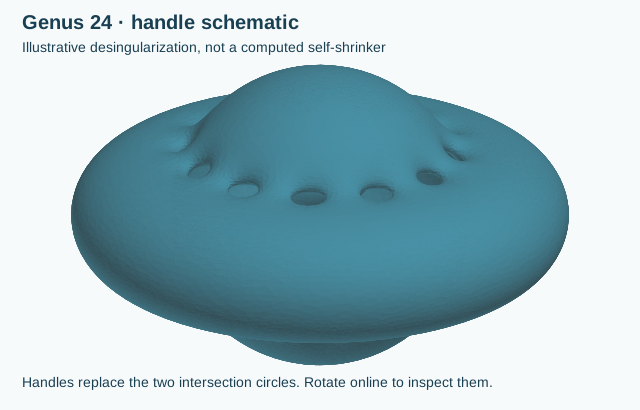
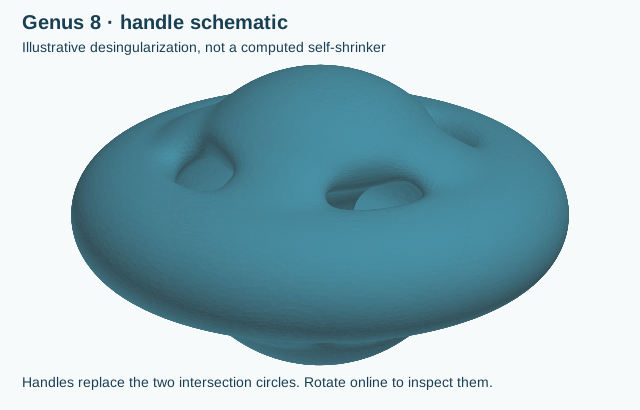
The second illustration shows how the two intersection circles can be replaced by handles, using gluing schematics of genera $8$, $16$, and $24$. Their mesh topology is checked, but these models do not solve the self-shrinker equation and are not certified approximations to $\Sigma _ g$. The chosen genera illustrate the topology; the cited theorem does not give an explicit $g_0$ that would establish these particular values as members of its constructed family.
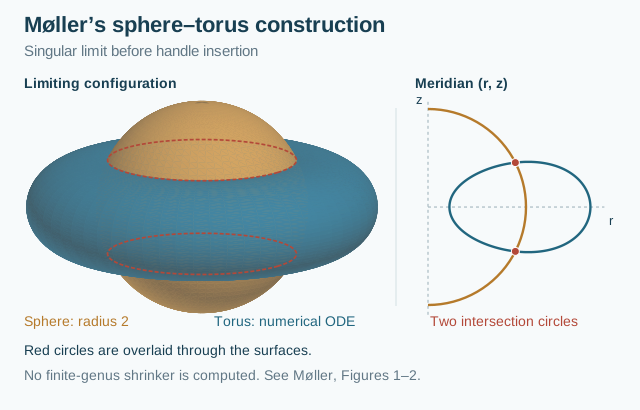
Møller sphere–torus gluing input: a shaded limiting configuration and meridian show the radius-two sphere, numerical shrinking torus, and two intersection circles. No desingularized surface is computed.
Numerical limiting configuration. Sphere of radius 2 (gold) and non-circular shrinking torus (blue, numerical ODE), following Møller’s Figures 1–2. Dashed red circles mark the intersections and are drawn through the surfaces. Rotate, zoom, toggle the sheets or cutaway, and inspect the meridian. This is the singular input before handle insertion, not a computed finite-genus shrinker. Open drawing · Numerical references and credits

A genus-eight sphere–torus gluing schematic with two rings of handles; the interactive selector also offers genus sixteen and twenty-four. These are not computed self-shrinkers.
Finite-genus gluing schematics. Select genus 8, 16, or 24 to see handles replacing both intersection circles. Each displayed mesh is connected, closed, orientable, and has the indicated genus. These are illustrative smoothings of the sphere–torus configuration, not numerical solutions of the self-shrinker equation. The theorem gives no explicit threshold that certifies these particular genera. Open drawing · Genus 16 drawing · Genus 24 drawing · Numerical references and credits

Ambient space, topology, embeddedness and entropy

Properties refer to the smooth surfaces in the existence theorem. The figures show the singular sphere–torus limit and illustrative handle models of genera 8, 16, and 24. The latter are topology-checked meshes, not computed shrinkers; the theorem gives no explicit genus threshold, and no entropy is inferred from either picture.

Closed orientable surface · Euclidean space ℝ³ · Embedded
Ambient space
Euclidean space ℝ³
Topology
Closed orientable surface
Embeddedness
Embedded: The constructed finite-genus surfaces are embedded; the intersecting sphere–torus configuration is only their singular limit.
Compactness
Compact
Surface genus
Sufficiently large even genus
Topological ends
0 (compact)
Entropy
Finite; value not recorded: Finite; no value recorded.
Gaussian area
Finite; value not recorded: F₀,₁ = λ for the normalized shrinker. Finite; no value recorded.

Compare examples by these properties →

References on this page

  1. [Moller2014] Niels Martin Møller. Closed self-shrinking surfaces in $\mathbb R^3$ via the torus. 2014. Version 2, 18 November 2014; also summarized in the supplied Drugan–Lee–Nguyen survey. URL: https://arxiv.org/abs/1111.7318v2, arXiv:1111.7318.All uses in this project ↩ 1 ↩ 2 ↩ 3
  2. [DLN2018] Gregory Drugan, Hojoo Lee, and Xuan Hien Nguyen. A survey of closed self-shrinkers with symmetry. Results in Mathematics, 73(1):32, 2018. Article 32, 32 pages; locators refer to the supplied published edition. URL: https://arxiv.org/abs/1708.09113, doi:10.1007/s00025-018-0763-3.All uses in this project ↩ 1
  3. [CM12] Tobias H. Colding and William P. Minicozzi, II. Generic mean curvature flow I: generic singularities. Annals of Mathematics, 175(2):755–833, 2012. URL: https://doi.org/10.4007/annals.2012.175.2.7, doi:10.4007/annals.2012.175.2.7.All uses in this project ↩ 1
Cite this page

Comments

Comments are not enabled yet.