826D61792601
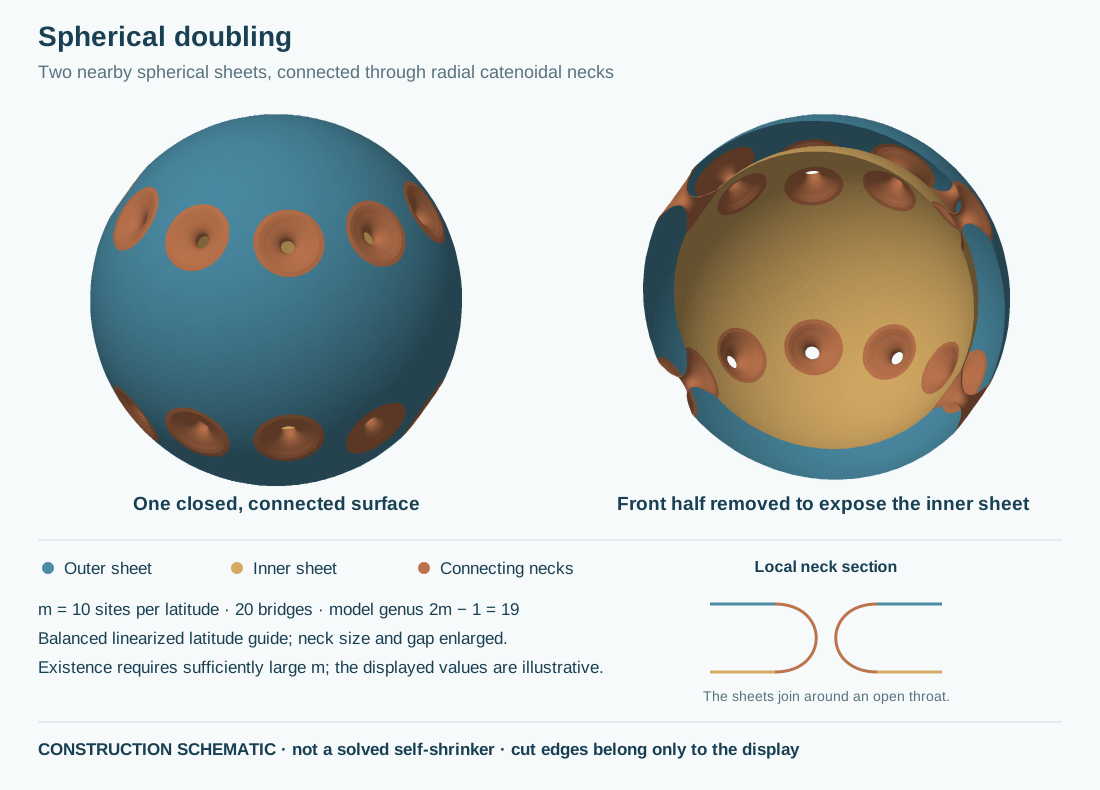
For every sufficiently large integer $m$, Kapouleas–McGrath construct a smooth closed embedded surface $S_ m\subset \mathbb R^3$ by doubling the round self-shrinking sphere $S^2(2)$. In the two-latitude subfamily, two nearby sphere sheets are joined by $2m$ small catenoidal bridges, with $m$ bridge sites on each of two latitude circles. The resulting surface satisfies
The formula specifies the evolution after the existence construction; it is not an explicit formula for $S_ m$.
The surface has dimension two and codimension one. It is connected, orientable, compact without boundary, smoothly embedded, complete and proper. Its genus is $g=2m-1$, and it has no topological ends.
This statement is the specialization $k_\circ =2$ and $\mathbf m=(m)$ of the construction. The threshold for sufficiently large $m$ is not made effective here. It does not supply all small genera.
The selected surfaces are invariant under $\mathcal G_ m=D_{2m}\times \mathbb Z_2$, of order $4m$, where $D_{2m}$ denotes a dihedral group of order $2m$. This is an asserted symmetry subgroup, not a classification of the entire isometry group.
As $m\to \infty $, the surfaces converge as varifolds to the radius-two sphere with multiplicity two. Each member before the limit is a smooth embedded connected surface; the doubled sphere is the limiting configuration.
Since $S_ m$ is a centered shrinker, its entropy equals its normalized Gaussian area. The area inequality in the Gaussian metric $g=e^{-|x|^2/4}g_{\rm Euc}$ gives
\[ \lambda (S_ m)=F(S_ m)=\frac1{4\pi }\int _{S_ m}e^{-|x|^2/4}\, d\mathcal H^2 <2F(S^2(2))=\frac8e. \]This is a rigorous bound obtained from the gluing theorem, not a numerical entropy computation. An individual numerical entropy, the exact Gaussian Morse index, and a uniqueness classification are not recorded by this entry.
The spherical input has the required trivial Jacobi kernel, verified directly in Section 10 of the source. This specialization does not rely on the separate theorem on doubling the Angenent torus.
See [KapouleasMcGrath2023], arXiv version 4: Theorem 10.5 (PDF page 66), Theorem 9.40 (page 65), Definitions 7.10–7.11 and Remark 7.12 (page 40), and Theorem 5.7 with equation (5.9) (page 30; also Theorem A on page 3). The genus formula is $2g_{S^2}-1+|L|=-1+2m$. The interactive construction schematic shows the two sheets joined through radial catenoidal necks, with a cutaway exposing the inner sheet. Its latitude placement uses a numerical balanced linearized guide from equation (10.3) and Definitions 7.24 and 7.29; the neck sizes and sheet separation are enlarged for visibility. The displayed values of $m$ illustrate the topology but are not asserted to lie in the existence range. This drawing is neither a solved self-shrinker nor an approximation with a proved error bound.
Comments
Comments are not enabled yet.