MCF-stack: Special Solutions of Mean Curvature Flow

§ 2.36 Flow-generated Platonic and polygonal shrinkers1AF8BDC11238

Earliest recorded reference: (first arXiv submission).

Paper credits and chronology

Paper credits are chronological and include every author of the cited papers. They identify sources, not exclusive discovery credit. Background-only citations do not determine the date of this example. A classical example may predate the references recorded here.

  1. Hoffman–Martín–White — 2025-02-27 (first arXiv submission).
1AF8BDC11238
A455BCCC51D0

(Hoffman–Martin–White ray-avoiding shrinkers) Let $Q\subset \mathbb R^3$ be the union of rays from the origin through either the face centers of a regular Platonic solid or the vertices of a regular horizontal $n$-gon, $n\geq 3$. If $q$ is the number of rays, Hoffman–Martin–White construct a smooth embedded shrinker $\Sigma _ Q$ of genus $q-1$ such that

\[ \Sigma _ Q\cap Q=\varnothing ,\qquad \vec H_{\Sigma _ Q}=-X^\perp /2. \]

The associated smooth flow is $\sqrt{-t}\, \Sigma _ Q$, $t<0$. This is a construction through singularities of mean curvature flow, not an explicit formula.

  • The surface has dimension two and codimension one, is complete, proper, orientable and without boundary, and has all symmetries of $Q$. The genera are $3,5,7,11,19$ for the tetrahedron, cube, octahedron, dodecahedron and icosahedron respectively. For the regular $n$-gon the genus is $n-1$.

  • It occurs with multiplicity one as a tangent shrinker of an initially compact, smoothly embedded surface in $\mathbb R^3\setminus Q$. This realization statement is part of the construction, rather than an identification with Ketover's min-max surface.

  • The theorem does not determine compactness or the number and types of ends for the Platonic examples or the small-$n$ polygonal examples. The discussion after the theorem states that the polygonal examples are noncompact for sufficiently large $n$ and converge to a multiplicity-two plane as $n\to \infty $; it does not give an exact end count there.

  • Each example has finite entropy as a tangent shrinker of a compact initial flow, and $\lambda (\Sigma _ Q)=F_{0,1}(\Sigma _ Q)$. No numerical entropy bound or exact value is recorded here. No uniqueness or equality with the corresponding Ketover or Ilmanen–White constructions is asserted.

See [HMW2026], version 3: Theorem 12 and its discussion (PDF pp. 8–9), with the multiplicity-one tangent-flow convention on p. 4. The compact numerical pictures mentioned in the paper do not establish compactness of the members selected by the theorem. The illustration is an original compact topology model inspired by the construction of initial surfaces in Theorem 24 (PDF pp. 15–16): a thickened spherical edge skeleton has one passage around each ray of $Q$. In the polygonal case the skeleton consists of $n$ meridian semicircles joining the poles, midway between the excluded rays. The inner and outer walls join around the passages, giving genus $q-1$. The cutaway exposes this cavity. These models are not computed shrinkers or simulated flow slices; their compactness is not a claim about the tangent shrinkers. The cubical silhouette also recalls Chopp's numerical picture in Figure 2, without reproducing its mesh.
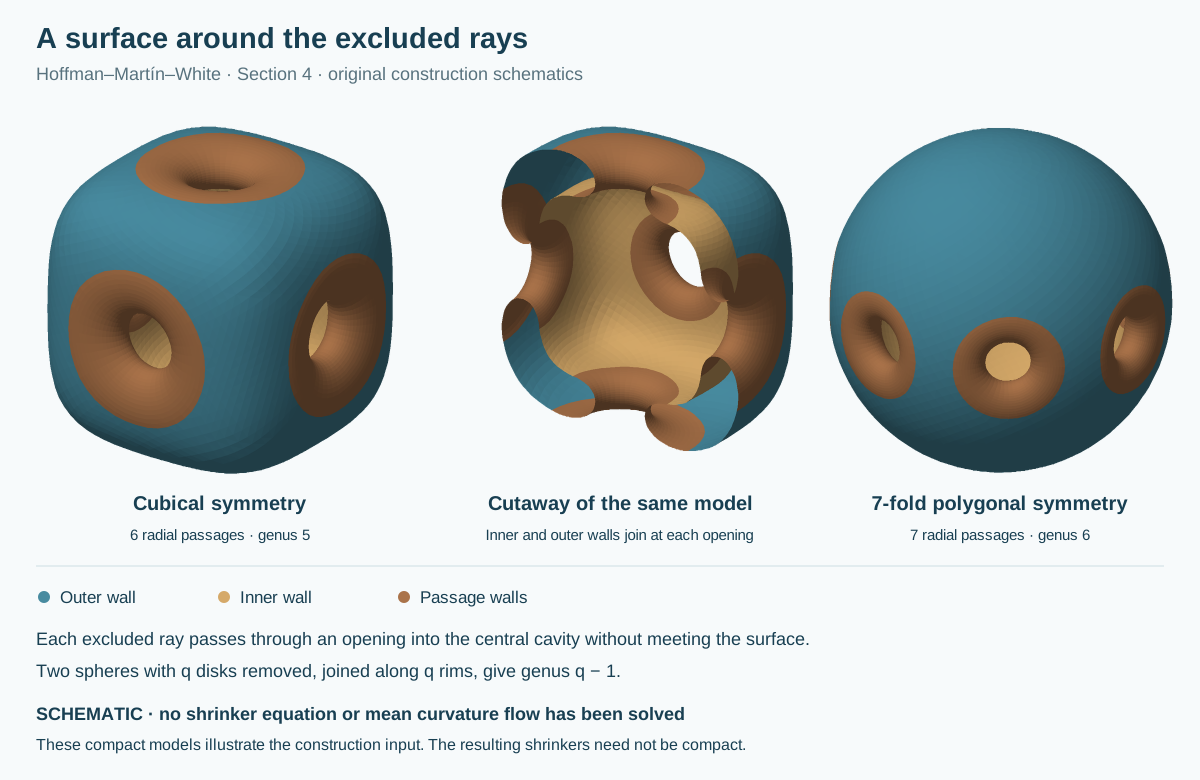
A rounded cubical surface with six openings and genus five, a cutaway exposing its central cavity, and a sevenfold polygonal construction model. Schematics, not computed shrinkers.
Original construction schematic. A rounded cubical shell with six radial passages illustrates genus five and avoidance of the six face-center rays. Select any Platonic symmetry or a regular polygon, show the excluded rays Q, and use Cutaway to reveal the inner wall. Inspired by Section 4 and Theorem 24 of Hoffman–Martín–White; the cubical silhouette also recalls Chopp’s numerical picture in Figure 2. These original compact models illustrate the topology of the construction input. They are not computed self-shrinkers or simulated flow slices, and do not establish compactness of the tangent shrinkers. The sufficiently large polygonal shrinkers are noncompact. Open drawing · Numerical references and credits

Ambient space, topology, embeddedness and entropy

MCF construction, separate from the min-max entries; no equality or noncongruence theorem is asserted. Compact numerical pictures do not determine compactness of the theorem’s selected surfaces. The interactive punctured-shell models illustrate the topology of the initial-surface construction in Theorem 24; their compactness and display parameters are not properties of the tangent shrinkers.

Platonic face-center ray configurations · Euclidean space ℝ³ · Embedded
Ambient space
Euclidean space ℝ³
Topology
Orientable surface of genus q−1, where q is the number of faces; compactness and ends unresolved
Embeddedness
Embedded: The flow-generated shrinkers are smooth and embedded in all recorded symmetry subfamilies.
Compactness
Not specified for this subfamily
Surface genus
3, 5, 7, 11, 19 for tetrahedron, cube, octahedron, dodecahedron, icosahedron
Topological ends
Not determined by Theorem 12
Entropy
Finite; value not recorded: Finite; an exact value or numerical upper bound is not recorded for this construction.
Gaussian area
Finite; value not recorded: F₀,₁ = λ for the normalized shrinker. Finite; an exact value or numerical upper bound is not recorded for this construction.
Regular n-gon ray configurations, n ≥ 3 · Euclidean space ℝ³ · Embedded
Ambient space
Euclidean space ℝ³
Topology
Orientable surface of genus n−1; compactness and end count not specified in the general theorem
Embeddedness
Embedded: The flow-generated shrinkers are smooth and embedded in all recorded symmetry subfamilies.
Compactness
Not specified for this subfamily
Surface genus
n−1, n ≥ 3
Topological ends
Not determined by Theorem 12
Entropy
Finite; value not recorded: Finite; an exact value or numerical upper bound is not recorded for this construction.
Gaussian area
Finite; value not recorded: F₀,₁ = λ for the normalized shrinker. Finite; an exact value or numerical upper bound is not recorded for this construction.
Regular n-gon, sufficiently large n · Euclidean space ℝ³ · Embedded
Ambient space
Euclidean space ℝ³
Topology
Noncompact orientable genus-(n−1) surface
Embeddedness
Embedded: The flow-generated shrinkers are smooth and embedded in all recorded symmetry subfamilies.
Compactness
Noncompact
Surface genus
n−1 for sufficiently large n
Topological ends
Exact end count not recorded
Entropy
Finite; value not recorded: Finite; an exact value or numerical upper bound is not recorded for this construction.
Gaussian area
Finite; value not recorded: F₀,₁ = λ for the normalized shrinker. Finite; an exact value or numerical upper bound is not recorded for this construction.

Compare examples by these properties →

References on this page

  1. [HMW2026] David Hoffman, Francisco Martín, and Brian White. Generating shrinkers by mean curvature flow. 2026. Checked arXiv version 3, January 21, 2026; manuscript revised January 20, 2026; 50 pages. URL: https://arxiv.org/abs/2502.20340v3, arXiv:2502.20340.All uses in this project ↩ 1
Cite this page

Comments

Comments are not enabled yet.