B28BB2912147
For every sufficiently large integer $m$, Nguyen constructs a smooth complete embedded surface $\widetilde M_ m\subset \mathbb R^3$ of genus $m-1$, with one asymptotically conical end. The source uses
Thus the catalogue's normalized example is $M_ m=\sqrt{2}\, \widetilde M_ m$, which satisfies $\mathbf H=-X^\perp /2$, and its flow is $M_ m(t)=\sqrt{-t}\, M_ m$ for $t<0$.
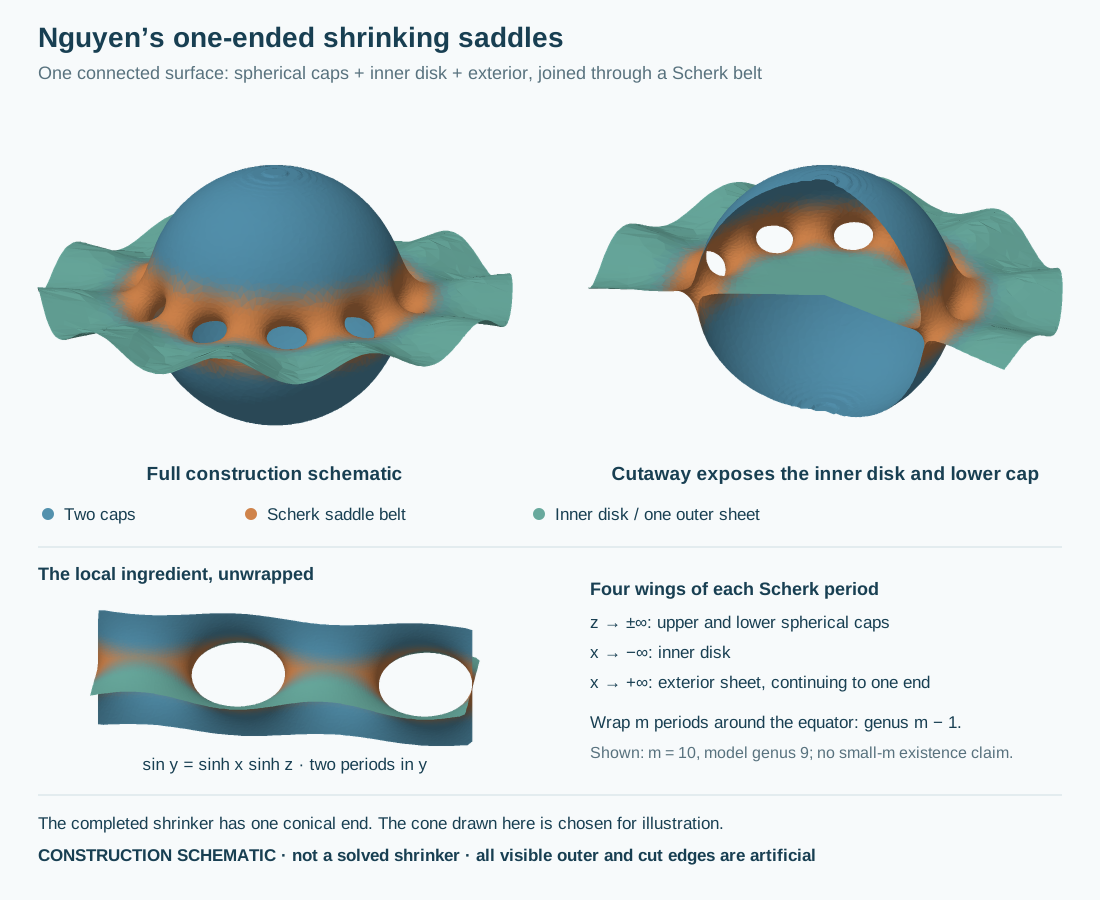
The construction replaces the intersection circle of a sphere and a plane by a bent, scaled singly periodic Scherk surface, then solves the nonlinear shrinker equation by a perturbation argument. In the catalogue normalization the input sphere has radius $2$. This is an existence construction, with no closed parametrization of the completed shrinker. Its proved properties and construction data include the following.
The surface has dimension two and codimension one. It is connected, orientable, noncompact, proper, and without boundary. Outside a compact set it is a graph over the exterior of a planar disk. Consequently it has one topological end; the asymptotic cone is not an assertion that the end is planar.
The $m$ periods of the Scherk piece produce genus $m-1$. The existence theorem requires $m$ sufficiently large and does not establish the small-$m$ cases.
The surface is invariant under a half-turn about the $x$-axis and under reflections in vertical planes making angles $\pi /(2m)+j\pi /m$, $j\in \mathbb Z$, with that axis. These are finite symmetries, not full rotational symmetry.
As $m\to \infty $, the source proves convergence to the spherical input on compact subsets of the upper half-ball in Theorem 1(iv), and convergence to the singly periodic Scherk model after translating and rescaling the joining region in Theorem 1(vi). These limits describe different spatial scales.
The conical graphical end gives quadratic area growth and finite entropy. In the stated normalization $F_{0,1}(M_ m)=\lambda (M_ m)$; no scalar entropy value or uniform numerical bound is recorded here. The theorem does not give a global uniqueness or stability classification.
Source: [NguyenShrinker2014], Theorem 1 and its preceding topology paragraph, PDF p. 2; the construction of the outer graphical piece and Proposition 14, PDF p. 13; Definition 21, PDF p. 20; the final fixed-point argument, PDF pp. 24–25. This is another sphere–plane desingularization construction beside Example 2.22; no identification or noncongruence between the two families is asserted. The interactive construction schematic shows a connected saddle belt, with a cutaway exposing the inner disk and lower cap. Its unwrapped view triangulates the exact minimal ingredient
which has period $2\pi $ in the $y$-direction (Section 2, PDF p. 7). The four wings attach to the two caps, the inner disk, and the exterior sheet (Definition 13, PDF p. 13). The global drawing uses an illustrative wrapping and cap map, with a freely chosen conical profile; it does not compute the source's unbalancing parameter, matched rotational caps, or nonlinear correction. The displayed period counts are not asserted to lie in the existence range.
Comments
Comments are not enabled yet.