A515DF7C7C60
There is an integer $g_0$ such that for every integer $g\geq g_0$ there exists a smooth complete embedded orientable self-shrinker $\Sigma _ g\subset \mathbb R^3$ of genus $g$, with
The construction desingularizes the intersection circle of a plane through the origin and $S^2(2)$. It is a gluing existence theorem; no explicit parametrization of $\Sigma _ g$ is provided.
The surface has dimension two and codimension one, is noncompact, has exactly one end, and separates $\mathbb R^3$ into two connected components. Its topology is an orientable closed genus-$g$ surface with one point removed. The compact core and graphical end give properness.
It is invariant under the dihedral symmetry group of order $4g+4$ specified in the construction.
Outside a ball the end is a graph over a plane, asymptotic to a nonplanar regular cone whose link is a nonzero smooth vertical graph over a great circle of $S^2$. The end has asymptotic height $u(\rho ,\theta )=\rho \sigma (\theta )+O(\rho ^{-1})$; the function $\sigma $ is determined by the construction, not an explicit formula. See equation (1.2), PDF p. 4.
As $g\to \infty $, the surfaces converge locally in Hausdorff distance to $S^2(2)\cup P$. The source gives an $O(R/g)$ Hausdorff bound inside $B_ R(0)$; convergence is locally smooth away from the intersection circle. The limiting union is singular, and is not one of the smooth shrinkers.
The conical geometry gives quadratic area growth and finite entropy. The source supplies no exact entropy value or numerical entropy bound for individual $g$. It records entropy instability on PDF p. 4. No uniqueness or identification with another construction is asserted.
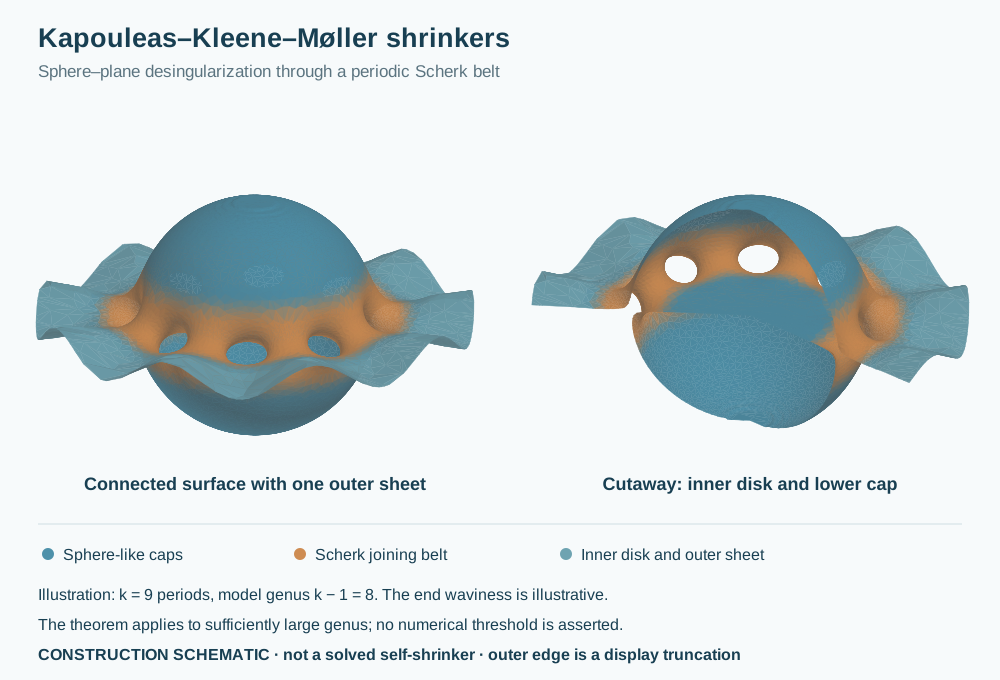
The picture resolves the joining circle using a Scherk-based construction model. The local ingredient in the paper is the singly periodic minimal surface
with period $2\pi $ in $w$; see equation (5.1), PDF p. 9. Section 5 curls $k=g+1$ periods around the equator and attaches the four wings to the upper cap, lower cap, inner disk, and outer sheet. The genus relation is in Remark 5.12, PDF p. 12. The illustration uses a simplified coordinate map and an adjustable conical deformation, not the paper's matched initial surface or the nonlinear correction that solves the shrinker equation. Its cutaway exposes the inner disk and the joining belt. The displayed values $k=6,9,12$ illustrate the topology and do not assert that these genera lie in the theorem's existence range. The outer edge is a display truncation; the waviness is not the computed function $\sigma $. Figure 1 of the paper, PDF p. 3, is itself captioned as a conjectural genus-eight shrinker.
Comments
Comments are not enabled yet.