MCF-stack: Special Solutions of Mean Curvature Flow

§ 2.35 Ketover self-shrinking doubled planes8423ACEAF2E2

Earliest recorded reference: (first arXiv submission).

Paper credits and chronology

Paper credits are chronological and include every author of the cited papers. They identify sources, not exclusive discovery credit. Background-only citations do not determine the date of this example. A classical example may predate the references recorded here.

  1. Ketover — 2024-07-01 (first arXiv submission).
8423ACEAF2E2

The following is [Ketover2024], Theorem 1.1, arXiv version 2, PDF pp. 2–3. The construction is variational, with genus determined in Section 6 and the ends analyzed in Section 8.

9E9A8A1CC506

For every integer $g\geq 1$ there exists an embedded self-shrinker $\Sigma _ g\subset \mathbb R^3$ of genus $g$ such that

\[ \lambda (\Sigma _ g)=F_{0,1}(\Sigma _ g)<2, \qquad \lim _{g\to \infty }\lambda (\Sigma _ g)=2. \]

The normalized smooth flow is $M_ t=\sqrt{-t}\, \Sigma _ g$, $t<0$. There is no explicit formula for $\Sigma _ g$.

  • The construction gives a smooth complete properly embedded boundaryless surface of dimension two and codimension one. It is invariant under the prismatic group $D_{g+1}\times \mathbb Z_2$, including reflection across the horizontal plane $P=\{ z=0\} $. The group has order $4(g+1)$.

  • For all sufficiently large $g$, the surface is noncompact with exactly two asymptotically conical ends: one in $z>0$ and one in $z<0$, each graphical over the exterior of a disk in $P$. Their cone links converge in $C^0$ to the equator as $g\to \infty $. For these $g$, the topology is a closed orientable genus-$g$ surface with two points removed.

  • For the small-genus members, this theorem does not establish noncompactness or an exact number of ends. Numerical evidence for two ends already at $g=1$ is stated separately in Remark 1.2.

  • As $g\to \infty $, $\Sigma _ g\to 2P$ as varifolds. From every subsequence one can extract a further subsequence and find a radius $r>0$ such that the surfaces are two normal graphs converging smoothly on each compact subset of $P\setminus C_ r$, where $C_ r=\{ (x,y,0):x^2+y^2=r^2\} $. The radius is part of the subsequential conclusion, not a prescribed geometric parameter.

  • For sufficiently large $g$, the level set flow starting from the smooth surface $\Sigma _ g$ fattens (Theorem 1.3, PDF p. 4). The homothetic flow reaches its asymptotic cone at time zero; this statement concerns weak continuation beyond that singular time.

  • Entropy minimization among genus-$g$ shrinkers is conjectural (Remark 1.2). Neither uniqueness nor a particular value below two is claimed.

The interactive picture is an original topology schematic informed by Proposition 7.4 (PDF pp. 36–37) and Section 8. In the subsequential large-genus regime of that proposition, $\Sigma _ g\cap P\cap B_ R(0)$ consists of $g+1$ embedded closed curves for each fixed $R>r$ and $g$ sufficiently far along the subsequence. The drawing represents these as the waists of $g+1$ necks joining two sheets near a circle. A cutaway reveals the neck walls and the gap between the sheets; the outer rims are display truncations. The round waists, neck sizes, circle radius and cone slopes are illustrative, not computed geometry. The selectable genera do not specify a threshold for the two-end theorem, and the small-genus two-ended pictures are conjectural. The multiplicity-two plane is a varifold limit rather than a smooth member of the family.
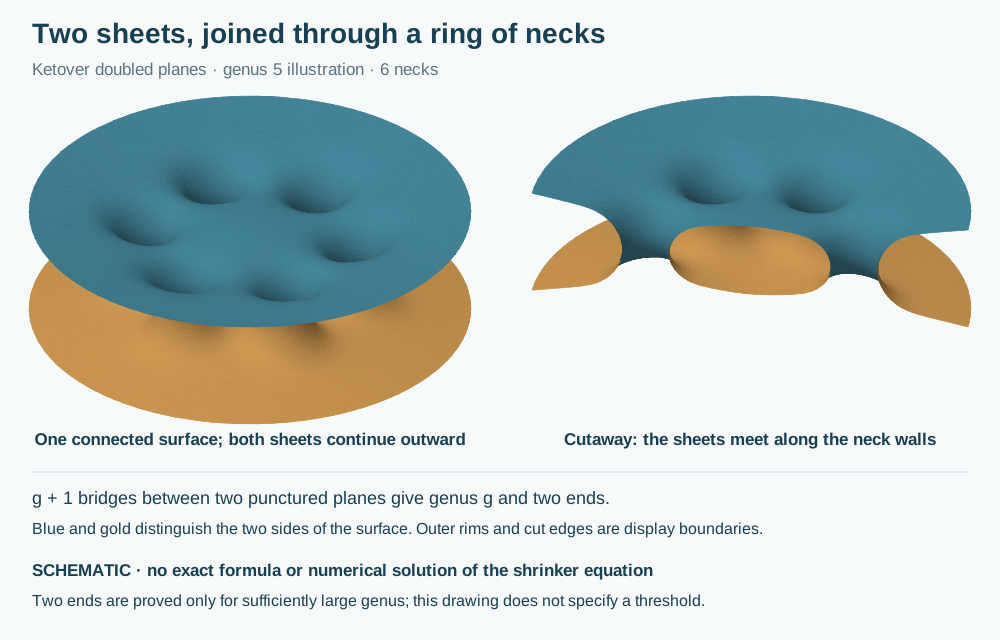
Genus-five schematic with six smooth necks joining upper and lower sheets around a circle. Each sheet extends outward toward a conical end. A cutaway exposes the neck walls. Both outer rims are display truncations, not boundaries of the complete surface.
Interactive doubled-plane schematic. Informed by Ketover, Proposition 7.4 and Section 8: two sheets joined by g + 1 necks near a circle. Rotate, choose a genus, or use Cutaway to inspect the connections. Two ends are proved only for sufficiently large genus; the displayed choices do not specify a threshold. This is not a computed shrinker. Open drawing · Numerical references and credits

Ambient space, topology, embeddedness and entropy

Compactness and end count are not inferred for the small-genus members. Entropy tends to 2 as g tends to infinity.

Genus one · Euclidean space ℝ³ · Embedded
Ambient space
Euclidean space ℝ³
Topology
Embedded genus-one surface
Embeddedness
Embedded: The surfaces are properly embedded for every stated genus. A multiplicity-two plane occurs only in the large-genus limit.
Compactness
Not specified for this subfamily
Surface genus
1
Topological ends
Not established for this member
Entropy
Proved bound or relation: λ < 2 (proved; no individual exact value).
Gaussian area
Proved bound or relation: F₀,₁ = λ for this normalized shrinker. λ < 2 (proved; no individual exact value).
Arbitrary positive genus · Euclidean space ℝ³ · Embedded
Ambient space
Euclidean space ℝ³
Topology
Embedded genus-g surface
Embeddedness
Embedded: The surfaces are properly embedded for every stated genus. A multiplicity-two plane occurs only in the large-genus limit.
Compactness
Not specified for this subfamily
Surface genus
Every g ≥ 2
Topological ends
Not established for every g
Entropy
Proved bound or relation: λ < 2 (proved; no individual exact value).
Gaussian area
Proved bound or relation: F₀,₁ = λ for this normalized shrinker. λ < 2 (proved; no individual exact value).
Sufficiently large genus · Euclidean space ℝ³ · Embedded
Ambient space
Euclidean space ℝ³
Topology
Closed genus-g surface minus two points
Embeddedness
Embedded: The surfaces are properly embedded for every stated genus. A multiplicity-two plane occurs only in the large-genus limit.
Compactness
Noncompact
Surface genus
Sufficiently large genus g
Topological ends
Exactly 2 conical ends
Entropy
Proved bound or relation: λ < 2 (proved; no individual exact value).
Gaussian area
Proved bound or relation: F₀,₁ = λ for this normalized shrinker. λ < 2 (proved; no individual exact value).

Compare examples by these properties →

References on this page

  1. [Ketover2024] Daniel Ketover. Self-shrinkers whose asymptotic cones fatten. 2024. Version 2, 21 November 2024, 47 pages. URL: https://arxiv.org/abs/2407.01240v2, arXiv:2407.01240.All uses in this project ↩ 1
Cite this page

Comments

Comments are not enabled yet.