98593B70A49E
(Periodic quadric shrinkers) Fix $n\geq 2$, $a_ j>0$, $\alpha =-1/2$, and put $Q(u)=\prod _{j=1}^ n(a_ j+u)$ and $\phi =\sum _ j\phi _ j$. Solve
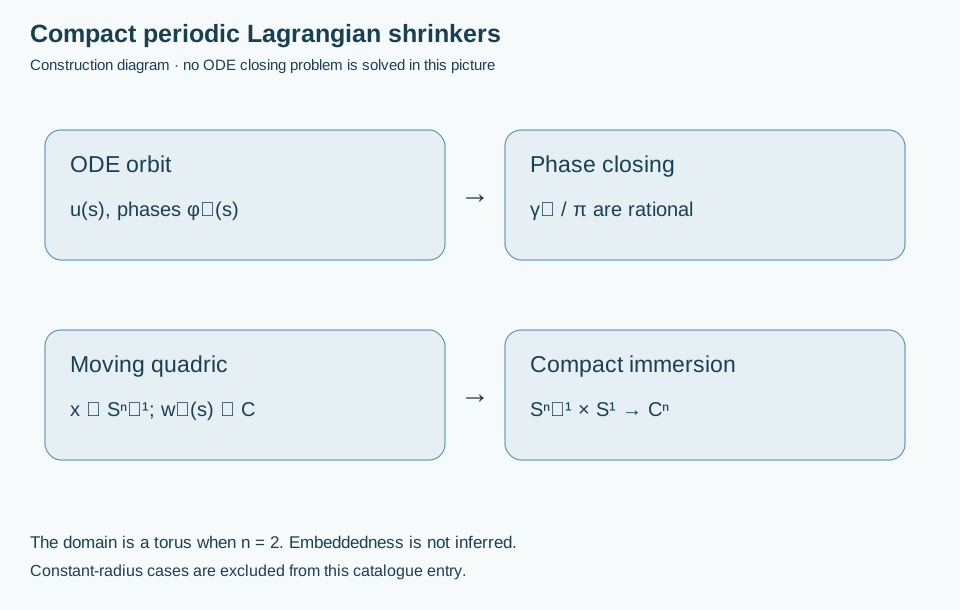
Require $a_ j+u>0$ and $A=\sqrt{Q(u)}e^{-u/4}\sin (\phi -\theta )>0$. Choose nonconstant periodic data for which all phase increments over a period of $u$ are rational multiples of $\pi $. A common period $T$ then closes all $w_ j(s)=\sqrt{a_ j+u(s)}e^{i\phi _ j(s)}$. The immersion is
Theorems A, B, E(a)(ii), and F of [JoyceLeeTsui2010] establish these ODE solutions and a dense set of closing initial data. They satisfy $\vec H=-X^\perp /2$, and $\sqrt{-t}\, X$, $t<0$, is their mean curvature flow.
The parameter manifold is compact, hence the immersion is complete and proper. It has dimension and codimension $n$, no ends, and topology $\mathbb S^{n-1}\times \mathbb S^1$; for $n=2$ it is a torus. Coordinate reflections are symmetries. Embeddedness, uniqueness, and stability are not inferred from the immersion theorem. The drawing is a construction diagram, not a numerically closed solution. The constant-radius subcase, including familiar overlapping examples, is excluded here.
Comments
Comments are not enabled yet.