FA65887C28F1
Let $T^2\subset \mathbb R^3$ be a normalized embedded Angenent shrinking torus as in Example 2.13. For every integer $k\geq 1$, its Euclidean product
is a smooth embedded shrinker of dimension $k+2$ and codimension one. If $X_ T(p)$ parametrizes the torus, the exact product and flow formulas are
The torus factor itself is specified by its closed weighted geodesic or rotational ODE, not by a closed elementary formula. Since the Euclidean factor is tangent to the product,
This verifies the product construction directly.
Each product is connected, complete, proper, noncompact, and without boundary, with topology $T^2\times \mathbb R^ k$. It has two topological ends when $k=1$ and one when $k\geq 2$. Its intrinsic dimension is at least three, so a surface genus is not assigned; genus one describes the torus factor only.
The product inherits the torus's axial rotational symmetry and is invariant under translations and orthogonal transformations in the Euclidean factor. The two ends of $\Sigma _1\subset \mathbb R^4$ have the fixed torus as cross-section.
Gaussian integration in the Euclidean factor gives, for $a\in \mathbb R^3$, $b\in \mathbb R^ k$, and $\tau >0$,
\[ F_{(a,b),\tau }(\Sigma _ k)=F_{a,\tau }(T^2),\qquad \lambda (\Sigma _ k)=\lambda (T^2)=F_{0,1}(\Sigma _ k). \]Indeed, the extra factor is $(4\pi \tau )^{-k/2}\int _{\mathbb R^ k}e^{-|z-b|^2/(4\tau )}\, dz=1$. Thus the numerical estimate $1.85122$ for the torus also estimates these products, with the same lack of a certified error enclosure; the product identity itself is exact.
As Euclidean products of a closed nonflat embedded shrinker, these examples fall within the realization theorem of [CLSZ2026], Theorem 1.2, PDF p. 2: each can occur with multiplicity one as a first-singularity tangent flow of a closed embedded hypersurface in the corresponding Euclidean space. The theorem does not assert that the initial closed hypersurface is this noncompact product.
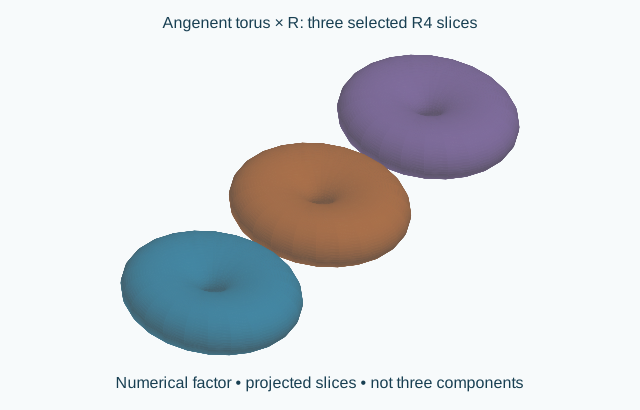
The factor is constructed in [Angenent1992]; the numerical entropy estimate is [BerchenkoKogan2021], Section 5, with its error-bound limitation in Section 6. The interactive picture shows only three $z$-slices of $\Sigma _1$ after projection from $\mathbb R^4$ to $\mathbb R^3$. It uses the catalogue's numerical torus mesh. Apparent intersections are projection artifacts; the three slices do not represent three components or the entire three-dimensional hypersurface.
Comments
Comments are not enabled yet.