0177A2718D72
(Sun–Wang–Zhou Gaussian-width shrinkers) For every $2\leq n\leq 6$ there is a sequence of smooth, connected, embedded self-shrinking hypersurfaces $\Sigma _ k^ n\subset \mathbb R^{n+1}$. They are normalized by $\vec H=-X^\perp /2$, with associated smooth flows $M_ t=\sqrt{-t}\, \Sigma _ k$ for $t<0$. The construction is variational and does not give explicit parametrizations.
Each shrinker is complete, proper, boundaryless, and has finite entropy. The construction is a multiplicity-one limit of free-boundary min-max hypersurfaces in exhausting balls with metrics approaching the Gaussian metric. The final shrinker has no free boundary.
Write $G_ n=(4\pi )^{-1}e^{-|x|^2/(2n)}g_{\mathrm{Euc}}$ and let $\omega _ k(\mathbb R^{n+1},G_ n)$ be its Gaussian $k$-width, defined by exhaustion. Then
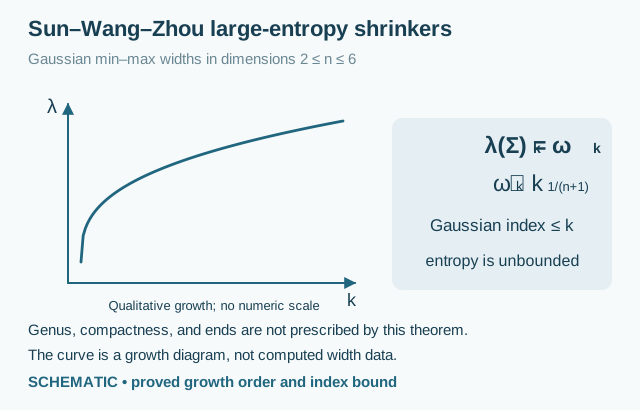
\[ F_{0,1}(\Sigma _ k)=\lambda (\Sigma _ k) =\omega _ k(\mathbb R^{n+1},G_ n),\qquad \lambda (\Sigma _ k)\asymp k^{1/(n+1)}. \]The growth statement means comparison up to positive constants depending on $n$, and in particular $\lambda (\Sigma _ k)\to \infty $. It is not a closed formula for an individual width or a plotted list of computed values. The unbounded entropies ensure infinitely many different examples, without requiring consecutive widths to be strictly different.
The Gaussian Morse index for compactly supported normal variations satisfies $\mathrm{index}(\Sigma _ k)\leq k$. This is an upper bound, not an equality or an entropy-stability claim.
The theorem does not specify a genus, a number of ends, end asymptotics, compactness, or a symmetry group for each member. In dimension two the genus is therefore left unrecorded in the property browser, rather than inferred from the min-max parameter.
In every dimension $n\geq 2$ and for every $\Lambda >0$, there is a smooth embedded shrinker with $\Lambda <\lambda (\Sigma )<\infty $ and finite Gaussian index. For $n\geq 7$ this follows by taking a lower-dimensional example and a Euclidean product. For example, $\Sigma ^6\times \mathbb R^{n-6}\subset \mathbb R^{n+1}$ has the same entropy as $\Sigma ^6$, and Theorem 5.3 preserves finiteness of index under each line product. These higher-dimensional product examples are noncompact; this extension does not assert the $n$-dimensional Gaussian-width growth law above beyond $n=6$.
Sources: [SunWangZhou2024], Theorem 1.6 and Corollary 1.7, arXiv version 1, PDF p. 4; Definition 5.1 and the proof of Theorem 1.6, pp. 39–42; Definition 5.2, p. 40; Theorem 5.3 and its proof, pp. 42–44. The illustration is a diagram of the width-growth conclusion, not numerical entropy data or a surface model.
Comments
Comments are not enabled yet.