MCF-stack: Special Solutions of Mean Curvature Flow

§ 2.37 Flow-generated sphere–plane shrinkers036F44595178

Earliest recorded reference: (first arXiv submission).

Paper credits and chronology

Paper credits are chronological and include every author of the cited papers. They identify sources, not exclusive discovery credit. Background-only citations do not determine the date of this example. A classical example may predate the references recorded here.

  1. Hoffman–Martín–White — 2025-02-27 (first arXiv submission).
036F44595178
45B364E949D5

(Hoffman–Martin–White sphere–plane family) Write $d_1=\sqrt{2\pi /e}$ and $d_2=4/e$. For every integer $g\geq 1$ and every fixed

\[ 1+d_2<\delta <1+d_1, \]

Hoffman–Martin–White construct a smooth embedded shrinker $\Sigma _ g\subset \mathbb R^3$ of genus $g$ with $\lambda (\Sigma _ g)<\delta $. They produce it as a tangent shrinker of an intrinsically flowing compact surface in $S^2\times \mathbb R$; the tangent shrinker itself is Euclidean. It satisfies $\vec H=-X^\perp /2$, with homothetic flow $\sqrt{-t}\, \Sigma _ g$ for $t<0$. No explicit parametrization is known from this construction.

  • This is a connected, orientable, complete, properly embedded surface of dimension two and codimension one. It contains the union $Q_ g$ of $g+1$ horizontal lines through the origin at angles $j\pi /(g+1)$, and $\Sigma _ g\cap \{ z=0\} =Q_ g$. In particular it is noncompact. Its complement of the horizontal plane has genus zero.

  • The symmetry group $G_ g$ used here is generated by reflection in vertical planes at angles $(2j+1)\pi /(2(g+1))$, rotations about the vertical axis through $2\pi /(g+1)$, and half-turns about the lines in $Q_ g$. This is the Costa–Hoffman–Meeks symmetry group specified in Section 5.

  • For all sufficiently large $g$, $\Sigma _ g$ has exactly one asymptotically conical end. For small $g$, the theorem does not specify an exact number of ends. For a fixed admissible $\delta $, as $g\to \infty $ the surfaces converge to $\{ z=0\} \cup S^2(2)$, smoothly with multiplicity one away from the equatorial intersection circle.

  • The normalized Gaussian area equals entropy and obeys

    \[ F_{0,1}(\Sigma _ g)=\lambda (\Sigma _ g)<\delta <1+\sqrt{2\pi /e}<3. \]

    The choice of $\delta $ is part of the existence statement; it does not assign an exact entropy to a fixed uniquely determined member.

  • No identification with the Buzano–Nguyen–Schulz min-max examples or the Kapouleas–Kleene–Moller and Nguyen gluing examples is proved. The shared topology and limiting configuration do not establish that they coincide or are distinct.

See [HMW2026], version 3: Section 5 (PDF pp. 16–17), Theorems 40–42 (pp. 26–31), Section 9 (p. 40), and Lemma 64 (pp. 45–46). The source uses $\leq \delta $ in Theorem 40; the strict bound above is its refined choice in Theorem 41. Figures 1 and 5 (PDF pp. 3 and 26) show numerical simulations credited to Francisco Torralbo and Mario Schulz. Our interactive picture is an original topology schematic informed by those figures and the sphere–disk surgery in Figure 6 (p. 27): a connected surface, a cutaway exposing its central sheet and lower cap, the exact horizontal trace $Q_ g$, and the separate sphere–plane limit. Its one-ended finite-genus shape and cone slope are illustrative; they are not computed from the shrinker equation and do not determine the small-genus end count.
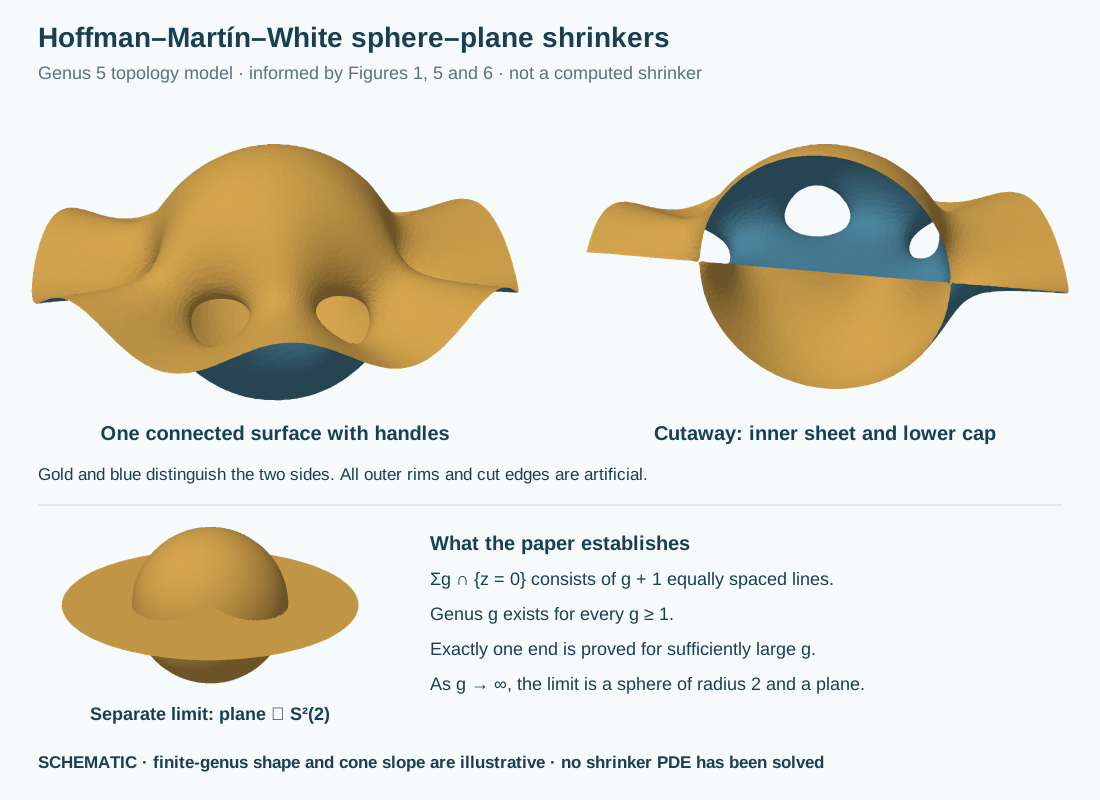
Hoffman–Martín–White sphere–plane topology schematic: alternating openings join rounded caps to a central sheet and exterior. Full surface and cutaway, with a separate radius-two sphere and plane limit. Not a computed shrinker.
Topology schematic and limiting configuration. An original connected genus-g model informed by Hoffman–Martín–White, Figures 1, 5–6 and Theorems 40–42. Visual sources include Francisco Torralbo’s numerical illustrations (Figure 1) and Mario B. Schulz’s numerical illustration (Figure 5). Rotate the surface, remove its front half, inspect the g+1 horizontal lines, or compare with the separate sphere–plane limit. The model has one exterior sheet; exactly one end is proved only for sufficiently large genus. Shape and cone slope are illustrative, not a computed self-shrinker. Gold and blue distinguish its two sides; outer and cut edges are display boundaries. Open drawing · Numerical references and credits

Ambient space, topology, embeddedness and entropy

The Euclidean shrinker is a tangent flow of an intrinsic compact flow in S²×ℝ. Choose 1+4/e < δ < 1+√(2π/e); the constructed member depends on this choice.

Genus-one member · Euclidean space ℝ³ · Embedded
Ambient space
Euclidean space ℝ³
Topology
Noncompact orientable genus-one surface containing two horizontal lines
Embeddedness
Embedded: The flow-generated surfaces are properly embedded for every stated genus, including the genus-one member.
Compactness
Noncompact
Surface genus
1
Topological ends
Exact number not specified for small genus
Entropy
Proved bound or relation: λ < δ < 1+√(2π/e) < 3, for a chosen δ > 1+4/e.
Gaussian area
Proved bound or relation: F₀,₁ = λ for the normalized shrinker. λ < δ < 1+√(2π/e) < 3, for a chosen δ > 1+4/e.
Genus g ≥ 2 · Euclidean space ℝ³ · Embedded
Ambient space
Euclidean space ℝ³
Topology
Noncompact orientable genus-g surface containing g+1 horizontal lines
Embeddedness
Embedded: The flow-generated surfaces are properly embedded for every stated genus, including the genus-one member.
Compactness
Noncompact
Surface genus
Every integer g ≥ 2
Topological ends
Exact number not specified in the all-genus theorem
Entropy
Proved bound or relation: λ < δ < 1+√(2π/e) < 3, for a chosen δ > 1+4/e.
Gaussian area
Proved bound or relation: F₀,₁ = λ for the normalized shrinker. λ < δ < 1+√(2π/e) < 3, for a chosen δ > 1+4/e.
Sufficiently large genus · Euclidean space ℝ³ · Embedded
Ambient space
Euclidean space ℝ³
Topology
Closed orientable genus-g surface with one puncture
Embeddedness
Embedded: The flow-generated surfaces are properly embedded for every stated genus, including the genus-one member.
Compactness
Noncompact
Surface genus
Every sufficiently large integer g
Topological ends
Exactly 1 asymptotically conical end
Entropy
Proved bound or relation: λ < δ < 1+√(2π/e) < 3, for a chosen δ > 1+4/e.
Gaussian area
Proved bound or relation: F₀,₁ = λ for the normalized shrinker. λ < δ < 1+√(2π/e) < 3, for a chosen δ > 1+4/e.

Compare examples by these properties →

References on this page

  1. [HMW2026] David Hoffman, Francisco Martín, and Brian White. Generating shrinkers by mean curvature flow. 2026. Checked arXiv version 3, January 21, 2026; manuscript revised January 20, 2026; 50 pages. URL: https://arxiv.org/abs/2502.20340v3, arXiv:2502.20340.All uses in this project ↩ 1
Cite this page

Comments

Comments are not enabled yet.