MCF-stack: Special Solutions of Mean Curvature Flow

§ 2.38 Flow-generated three-ended shrinkers5245200FA4A7

Earliest recorded reference: (first arXiv submission).

Paper credits and chronology

Paper credits are chronological and include every author of the cited papers. They identify sources, not exclusive discovery credit. Background-only citations do not determine the date of this example. A classical example may predate the references recorded here.

  1. Hoffman–Martín–White — 2025-02-27 (first arXiv submission).
5245200FA4A7
5CED6ED3B586

(Hoffman–Martin–White three-ended family) For every sufficiently large integer $g$, Hoffman–Martin–White construct a smooth embedded shrinker $\Sigma _ g\subset \mathbb R^3$ with genus $2g$ and exactly three ends. It has the normalization and smooth evolution

\[ \vec H=-X^\perp /2,\qquad M_ t=\sqrt{-t}\, \Sigma _ g,\quad t<0. \]

The construction obtains the surface as a multiplicity-one tangent shrinker of a flow whose initial surface is compact and embedded in $S^2\times \mathbb R$ with its product metric. The shrinker lives in the Euclidean tangent space. There is no explicit parametrization.

  • It is a connected, orientable, complete, proper noncompact surface of dimension two and codimension one. Its topology is a closed genus-$2g$ surface with three punctures; the three ends are annular and asymptotically conical.

  • It has the group $G_ g$ and the union of lines $Q_ g$ specified in Example 2.37. In particular, $\Sigma _ g\cap \{ z=0\} =Q_ g$ and $\Sigma _ g\setminus \{ z=0\} $ has genus zero. These are the symmetries of the genus-$g$ Costa–Hoffman–Meeks minimal surface, but the shrinker has genus $2g$.

  • As $g\to \infty $, the surfaces converge to the horizontal plane with multiplicity three. After passage to a subsequence, convergence is smooth away from one circle in that plane. The circle is part of the limiting analysis, not an independently prescribed radius.

  • The entropy has a bound $\lambda (\Sigma _ g)\leq \Lambda <\infty $ independent of $g$, and $F_{0,1}(\Sigma _ g)=\lambda (\Sigma _ g)$. The paper does not specify a numerical value of $\Lambda $ in this theorem. This entry therefore does not assert $\lambda <3$ or an exact entropy limit.

  • For each small $g$ the preceding construction produces a shrinker with genus $g$ or $2g$ and a uniform entropy bound; the assertions of genus $2g$ and three ends require $g$ sufficiently large. The paper's genus-two picture is explicitly conjectural and is not a numerical approximation. No uniqueness or identification with Shao–Zou's tripling construction is proved.

See [HMW2026], version 3: Theorem 43 (PDF p. 31), Theorem 55 and Conjecture 56 (p. 38), Theorem 59 (p. 39), Proposition 62 and Lemma 64 (pp. 45–46). The interactive illustration is an original connected topology model guided by Figure 7: three exterior sheets are joined by alternating upper and lower necks. Its cutaway exposes the neck interiors, and its plan relates the necks to $Q_ g$. The separate limit view shows a single plane with multiplicity three. Neck sizes, end slopes, and the displayed circle radius are illustrative; no shrinker equation or mean curvature flow has been computed, and the displayed small values of $g$ do not assert three-ended existence.
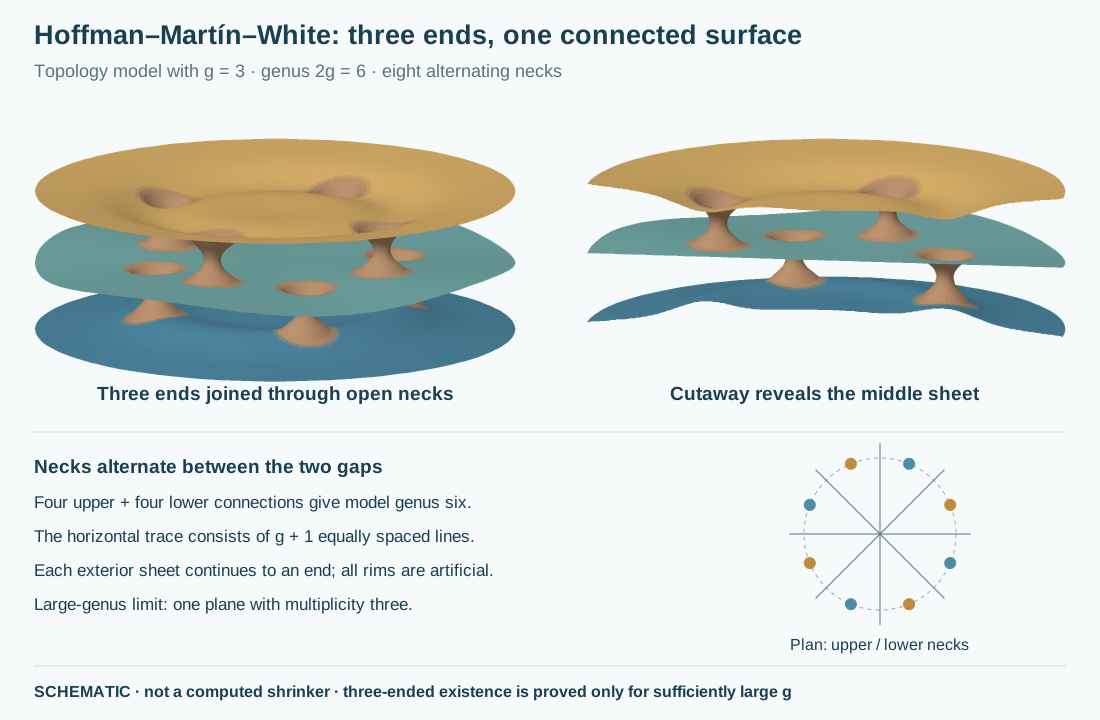
Connected three-ended HMW topology schematic with alternating upper and lower necks. Full view, cutaway and neck plan; model g = 3, genus six. Not a computed shrinker.
Original topology schematic. An original connected topology model informed by Hoffman–Martín–White, Figure 7 and Theorem 43. Three exterior sheets are joined by alternating open necks. Rotate, zoom, use the cutaway, inspect the neck layout, or compare with the separate multiplicity-three plane limit. The model has genus 2g; three-ended existence is proved only for sufficiently large g. The paper’s genus-two picture, credited to Matthias Weber, is conjectural and is not a numerical approximation. Neck sizes, end slopes and separation are illustrative; no shrinker equation has been solved. Outer rims and cut edges are display boundaries. Open drawing · Numerical references and credits

Ambient space, topology, embeddedness and entropy

The genus 2g and exactly three ends are proved only for g sufficiently large. The Euclidean shrinker arises from an initial compact flow in S²×ℝ.

Large-genus three-ended subfamily · Euclidean space ℝ³ · Embedded
Ambient space
Euclidean space ℝ³
Topology
Closed orientable genus-2g surface with three punctures
Embeddedness
Embedded: The constructed three-ended surfaces are smooth and embedded.
Compactness
Noncompact
Surface genus
2g for sufficiently large integers g
Topological ends
Exactly 3 asymptotically conical annular ends
Entropy
Proved bound or relation: λ ≤ Λ < ∞ uniformly in g; no numerical value for Λ is specified.
Gaussian area
Proved bound or relation: F₀,₁ = λ for the normalized shrinker. λ ≤ Λ < ∞ uniformly in g; no numerical value for Λ is specified.

Compare examples by these properties →

References on this page

  1. [HMW2026] David Hoffman, Francisco Martín, and Brian White. Generating shrinkers by mean curvature flow. 2026. Checked arXiv version 3, January 21, 2026; manuscript revised January 20, 2026; 50 pages. URL: https://arxiv.org/abs/2502.20340v3, arXiv:2502.20340.All uses in this project ↩ 1
Cite this page

Comments

Comments are not enabled yet.