4BFAC8529BEA
(Shao–Zou plane stackings) Fix an integer $k\geq 2$. For every sufficiently large integer $m$, with the threshold allowed to depend on $k$, Shao–Zou construct an embedded self-shrinker $\Sigma _{k,m}\subset \mathbb R^3$ with
Their parameter is $J=(k-1)/2$. The smooth flow is $\sqrt{-t}\, \Sigma _{k,m}$ for $t<0$. The surface is obtained by elliptic gluing, rather than an explicit parametrization.
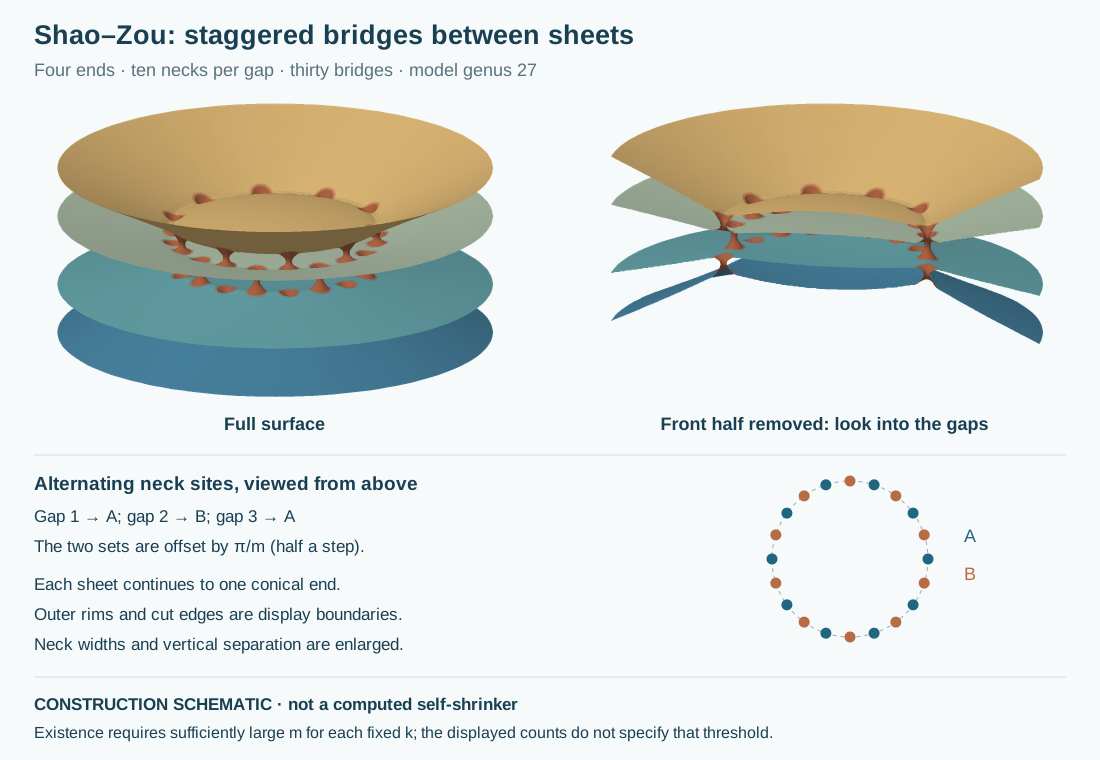
The construction stacks $k$ perturbations of the horizontal plane and connects each consecutive pair by $m$ catenoidal bridges. Thus there are $(k-1)m$ bridges in total, placed on alternating equally spaced neck configurations whose radii approach the same balanced radius. Consecutive configurations have angular offset $\pi /m$ (Definition 4.3 and equations (5.15), (5.23)). The compact core and graphical ends give a connected, orientable, complete, proper, boundaryless noncompact surface.
Each of the $k$ annular ends is asymptotic to a cone. Theorem 8.1 gives the leading cone slopes in terms of the solved bridge parameters with error estimates; these asymptotic expressions are not formulas for the whole shrinker.
For even $k$, the asserted symmetry is the $m$-gonal prism group $D_{mh}$; for odd $k$, it is the $m$-gonal antiprism group $D_{md}$. Both have order $4m$. Horizontal reflection is a symmetry in the even-$k$ case and is not an element of the stated antiprism group in the odd-$k$ case.
For fixed $k$ and $m\to \infty $, $\Sigma _{k,m}$ converges as a varifold to the horizontal plane with multiplicity $k$. Each surface before the limit is embedded with multiplicity one. The limiting plane is not a smooth member of the positive-genus family.
Conical ends imply quadratic area growth and finite entropy, and $F_{0,1}(\Sigma _{k,m})=\lambda (\Sigma _{k,m})$. No exact value or numerical entropy upper bound is asserted here. A local varifold limit alone is not used to assign a numerical entropy limit.
The source expects its $k=2$ and $k=3$ examples to agree with earlier doubled- and tripled-plane constructions when the parameters overlap, but it does not prove those identifications. It supplies no uniqueness or exact Morse-index classification.
See [ShaoZou2025], version 1: the introductory theorem (PDF p. 2), Definition 2.28 and Remark 2.29 (p. 7), and Theorem 8.1 (pp. 31–32). In particular, this gives examples with four or more ends, beyond the one-, two-, and three-ended constructions already listed. The interactive illustration is a connected construction schematic with open necks and a cutaway. Its radial profiles are guided by the linearized solutions in Lemma 4.11; its neck dimensions, sheet separation, and end slopes are illustrative. The finite-$m$ matching and nonlinear shrinker equation have not been solved, and the displayed bridge counts are not asserted to meet the large-$m$ hypothesis.
Comments
Comments are not enabled yet.