F576920EB05F
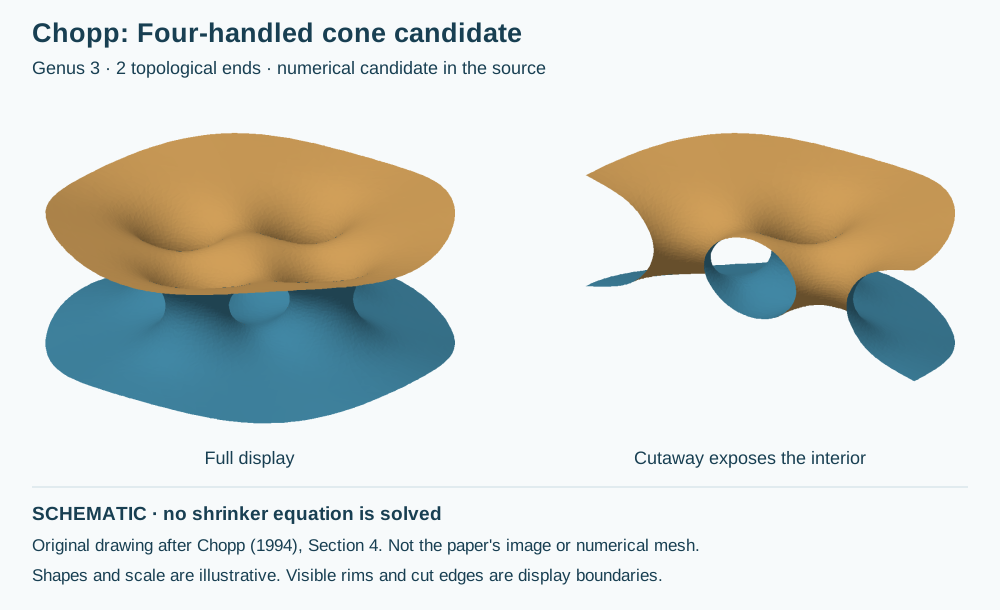
(The numerical Angenent–Ilmanen–Chopp surface) This is Chopp's numerical genus-three, two-ended shrinker candidate in $\mathbb R^3$. It is a surface of dimension two and codimension one, with intended topology a genus-three orientable surface minus two points. The four connecting necks do not give genus four. With its axis taken to be $x_1$, the symmetry group is $\mathbb Z_2\times D_4$, where $D_4$ has eight elements and acts on the transverse plane.
The starting geometry is a cylinder with two transverse holes bored through its axis. Level selection balances radial and longitudinal neck pinches. Dilation then exposes a candidate whose two ends appear smoothly asymptotic to a nonrotational double cone $C$. The intended surface is smooth, embedded, complete, proper and without boundary, but its existence and asymptotics are numerical assertions in the cited papers. There is no closed formula. The normalization is
Here the last equality describes the proposed singular trace, not a smooth slice. Chopp's displayed mesh requires a further dilation to obtain $\Sigma =M_{-1}$.
The 1994 paper reports $E=0.0505$ and minimum cone opening about $1.2627$ radians. The 1995 paper reports approximately $1.263$ radians ($72.3$ degrees). These are numerical estimates without certified error bounds. The reported opening exceeds the numerically estimated critical rotational-expander aperture $66.04$ degrees. The barrier argument in the 1995 paper then predicts two distinct smooth self-expanding continuations for $t>0$ and fattening of the level-set flow. Its Main Result is explicitly conditional on Assertion 1 and verification of the numerics; it is not an unconditional existence proof for this particular genus-three surface. The level-set flow itself is unique as a set-valued flow; “nonuniqueness” here concerns distinct thin continuations inside it.
Sources: [Chopp1994], Section 4.6, pp. 12–13, Figures 26–28; [AIC95], Section 1 and Assertion 1, pp. 1940–1944, Section 3, pp. 1953–1955, and the conditional Main Result in Section 4, p. 1956. No uniqueness, stability spectrum, Gaussian area or entropy value is established for the numerical shrinker. The double-cone expander results are recorded in Examples 4.5 and 4.6. The rigorous Ilmanen–White family is separate (Example 2.34); its theorem does not identify a member with this computed mesh.
The rotatable picture is a genus-three topology schematic with four necks and two ends. It neither solves the shrinker equation nor verifies fattening. Chopp's related compact four-handled dumbbell in Section 4.5, Figure 24, failed his self-similarity test ($E=0.584$) and is not a sixth shrinker candidate. Semiregular polyhedra and a trefoil are future-work proposals in Section 5, not constructions established there.
Comments
Comments are not enabled yet.