MCF-stack: Special Solutions of Mean Curvature Flow

§ 2.14 Chopp cubical shrinker candidate90FE05D9053E

Earliest recorded reference: (publication year).

Paper credits and chronology

Paper credits are chronological and include every author of the cited papers. They identify sources, not exclusive discovery credit. Background-only citations do not determine the date of this example. A classical example may predate the references recorded here.

  1. Chopp — 1994 (publication year).
90FE05D9053E

Chopp's level-set computations produce five new shrinker candidates in [Chopp1994]. These entries describe numerical evidence, not existence theorems. The paper also recovers the Angenent torus of Example 2.13.

04E9A0B8F725

(Numerical genus-five cube) The cubical candidate is a two-dimensional hypersurface in $\mathbb R^3$, with the topology of a closed orientable surface of genus five and cubical symmetry. Chopp starts with the boundary of a ball bored along the three coordinate axes. The connected central cavity has six openings; this is not a genus-three solid with three disjoint tunnels.

The algorithm evolves a family of level sets, selects a level using a geometric ratio, and dilates to maintain a chosen volume. It gives an approximation, with no closed parametrization or exact implicit equation for the shrinker. The target equation and associated flow, in our convention, are

\[ H=\frac{\langle X,\nu \rangle }{2},\qquad M_ t=\sqrt{-t}\, \Sigma ,\qquad -\infty <t<0. \]

Chopp's equation (3.1) instead uses $H=\langle X,\nu \rangle /(2T)$ for an unrescaled surface $S$; the corresponding normalized surface would be $\Sigma =T^{-1/2}S$. His constant-volume display is not automatically the slice at $t=-1$.

The intended surface is smooth, compact, embedded and without boundary; if such a surface exists it is complete and proper and has no ends. The computation does not establish this existence statement. The reported self-similarity diagnostic is $E=0.01869$, and subsequent ordinary MCF approximately preserves the computed shape. This is a finite-grid check, not a certified error bound. No uniqueness, stability spectrum, Gaussian area or entropy value is established for this particular candidate. The diagnostic $E$ is not Gaussian area or entropy.

Source: [Chopp1994], Sections 2–3 and 4.1, pp. 2–8, Figures 8–12. The later constructions in Examples 2.36 and 2.27 have related symmetries; no identification with this numerical surface is asserted. The rotatable illustration is a compact topology schematic with six passages into a cavity, not Chopp's computed mesh or a newly solved shrinker.
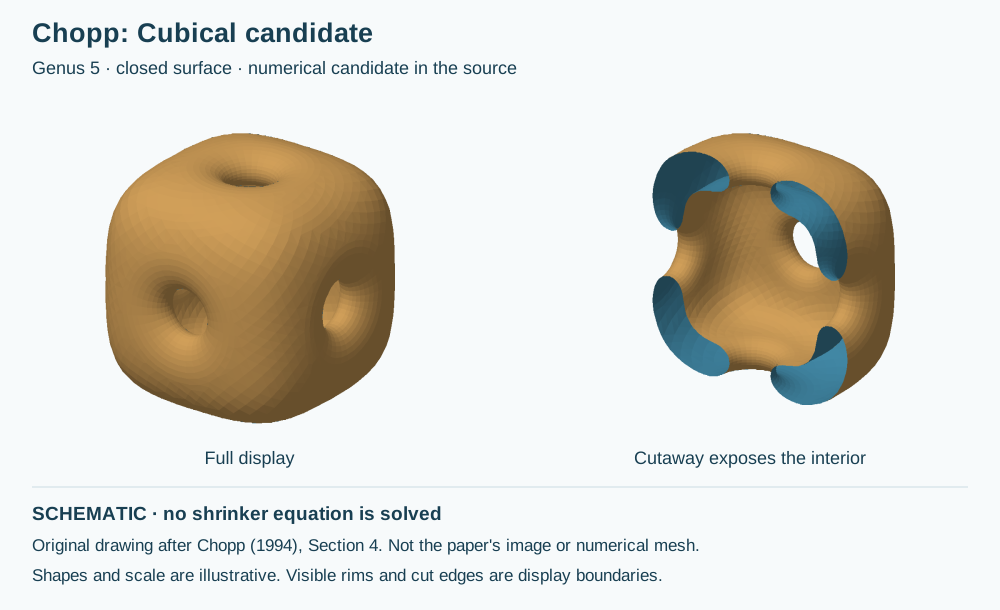
Original topology schematic: genus 5, closed. Chopp’s paper reports a numerical candidate; this drawing is not his mesh and does not solve the shrinker equation. Scale and neck shapes are illustrative. Use the cutaway to see the central cavity.
Schematic of a numerical candidate. Original topology schematic: genus 5, closed. Chopp’s paper reports a numerical candidate; this drawing is not his mesh and does not solve the shrinker equation. Scale and neck shapes are illustrative. Use the cutaway to see the central cavity. Open drawing · Numerical references and credits

Ambient space, topology, embeddedness and entropy

Numerical shrinker candidate, not a proved existence result for this computed surface. Topology and compactness describe the intended surface; the drawing is schematic.

Numerical candidate: Chopp cubical shrinker candidate · Euclidean space ℝ³ · Not recorded
Ambient space
Euclidean space ℝ³
Topology
Intended orientable genus-5 surface without punctures (closed)
Embeddedness
Not recorded: The target is embedded and the numerical construction uses embedded level sets, but existence of an exact embedded shrinker with these properties is not proved in the reviewed computation.
Compactness
Compact
Surface genus
5, the topology of the numerical candidate
Topological ends
0, for the intended complete surface; finite-window boundaries are not ends
Entropy
Not recorded: No entropy value or bound established for this numerical candidate. The self-similarity diagnostic E is not entropy.
Gaussian area
Not recorded: No normalized centered Gaussian area recorded; do not infer it from the drawing or identify it with entropy for an approximate surface.

Compare examples by these properties →

References on this page

  1. [Chopp1994] David L. Chopp. Computation of self-similar solutions for mean curvature flow. Experimental Mathematics, 3(1):1–15, 1994. Journal scan reviewed in full. Five numerical candidates in Sections 4.1–4.4 and 4.6; the four-handled dumbbell in Section 4.5 fails the self-similarity test. No existence proof is supplied. URL: https://doi.org/10.1080/10586458.1994.10504572, doi:10.1080/10586458.1994.10504572.All uses in this project ↩ 1 ↩ 2
Cite this page

Comments

Comments are not enabled yet.