MCF-stack: Special Solutions of Mean Curvature Flow

§ 2.11 Nonclosed shrinking curves dense in an annulus3A8C87C9FFF8

Earliest recorded reference: (first arXiv submission).

Paper credits and chronology

Paper credits are chronological and include every author of the cited papers. They identify sources, not exclusive discovery credit. Background-only citations do not determine the date of this example. A classical example may predate the references recorded here.

  1. Halldórsson — 2010-07-09 (first arXiv submission).
3A8C87C9FFF8
4973C84D3B2B

The nonclosed branch of the planar shrinking-curve classification is recorded in [Halldorsson2012], Theorem 5.1 and Section 5, PDF pp. 11–13. These are smooth complete immersed curves $X:\mathbb R\to \mathbb R^2$ of codimension one, in the normalization $\vec H=-X^\perp /2$. With arclength $s$, left normal $N=iT$, and signed curvature $k$, solve

\[ u'=uv,\qquad v'=\frac12-u^2,\qquad \theta '=u,\qquad X(s)=-2i e^{i\theta (s)}(u(s)+iv(s)). \]

Here $u(0)=r_{\min }/2$, $v(0)=0$, $\theta (0)=0$ and $0<r_{\min }<\sqrt2$. The phase orbit $(u,v)$ is periodic; write $P$ for its period and $\alpha =(2\pi )^{-1}\int _0^ P u(s)\, ds$. Choose $r_{\min }$ so that $\alpha $ is irrational. The period analysis gives $1/2<\alpha <1/\sqrt2$, and every irrational value in this interval occurs. This is an ODE construction with an irrational turning condition, not a closed formula.

The image is dense in the annulus $r_{\min }\leq |X|\leq r_{\max }$, where

\[ r_{\min }e^{-r_{\min }^2/4}=r_{\max }e^{-r_{\max }^2/4}, \qquad r_{\max }>\sqrt2. \]

Successive radial excursions are congruent by rotation through $2\pi \alpha $. The curvature is positive and periodic, with $k e^{-|X|^2/4}$ constant: local strict convexity does not imply global embeddedness. The curve is nonembedded and nonproper. Its parameter manifold is the noncompact line, with two intrinsic ends, despite its bounded image; neither end escapes to spatial infinity. Completeness follows from the global unit-speed parametrization. The annulus is the image closure, not a two-dimensional flow.

The exact evolution from this ODE-defined profile is $M_ t=\sqrt{-t}\, X(\mathbb R)$, $-\infty <t<0$, interpreted as a parametrized immersion. At every regular time its Gaussian area and entropy are infinite, with arclength counted on the parameter domain: an infinite-length curve lies in a bounded set, so every fixed Gaussian weight is bounded below there. This elementary consequence is separate from the source classification. No finite-entropy or stability theorem is claimed for this branch. For rational $\alpha =m/\ell $, the curve closes and is already recorded in Example 2.1; the circle and stationary line are Examples 2.9 and 2.10. The drawings numerically shoot for $\alpha =1/\sqrt2-1/100$ (a narrower annulus) and $\alpha =(\sqrt5-1)/2$ (a broader annulus). One complete excursion is highlighted, and its rotated continuations show how the image approaches density as the displayed parameter window grows. The same finite segment is shown at $t=-4,-1,-1/4,-1/16$, on a common spatial scale; the corresponding dilation factors are $2,1,1/2,1/4$. At time $t<0$, the annular radii are $\sqrt{-t}\, r_{\min }$ and $\sqrt{-t}\, r_{\max }$. The dashed circles are guides to the image closure, not additional components. The limit $t=0$ is not a regular immersed time slice. Finite precision cannot certify irrationality or depict the full dense image.
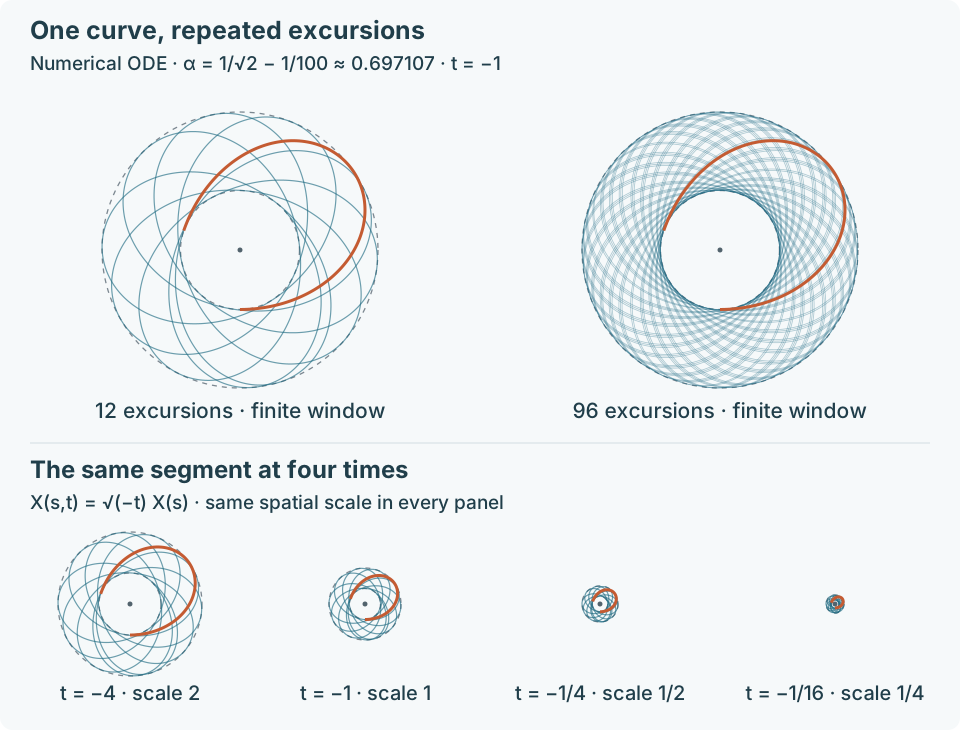
Annulus-dense shrinking curve with one orange excursion, a denser finite window, and four time slices on the same spatial scale.
Numerical ODE approximation. Numerical ODE profiles with irrational turning targets. Orange marks one full excursion; blue shows its rotated continuations. The upper panels compare 12 and 96 excursions at t = −1. The lower panels show the same segment at t = −4, −1, −1/4, −1/16 with one spatial scale. Dashed circles bound the image closure and are not extra flow components. Open drawing · Numerical references and credits

Explore nonclosed shrinking curves dense in an annulus

Numerical experiment. Choose a narrow or broad annulus, vary the number of displayed excursions, and animate or select time slices. Spatial scale stays fixed as time changes. The initial ODE profile is numerical; its time law X(s,t) = √(−t)X(s) is exact. The full curve is dense only for mathematically irrational turning; floating-point shooting cannot certify irrationality.

Open full-page visualization ↗

Explore the interactive flow
Ambient space, topology, embeddedness and entropy

Bounded image, complete noncompact domain, nonproper immersion. Gaussian divergence is a direct calculation, not an extra cited entropy theorem.

Irrational turning branch · Euclidean plane ℝ² · Not embedded
Ambient space
Euclidean plane ℝ²
Topology
Noncompact line ℝ
Embeddedness
Not embedded: Repeated rotated excursions intersect; this is a recurrent, nonproper immersion. The annulus is the closure of its image, not its parameter manifold.
Compactness
Noncompact
Surface genus
Not a surface
Topological ends
2 intrinsic ends of the parameter manifold
Entropy
Exact formula: ∞ at every regular time, with arclength counted on the immersion: infinite length in a compact region makes every Gaussian integral diverge.
Gaussian area
Exact formula: ∞ at every regular time, with arclength counted on the immersion: infinite length in a compact region makes every Gaussian integral diverge.

Compare examples by these properties →

References on this page

  1. [Halldorsson2012] Höskuldur P. Halldórsson. Self-similar solutions to the curve shortening flow. Transactions of the American Mathematical Society, 364(10):5285–5309, 2012. URL: https://arxiv.org/abs/1007.1617v2, doi:10.1090/S0002-9947-2012-05632-7.All uses in this project ↩ 1
Cite this page

Comments

Comments are not enabled yet.