48A9185FB30C
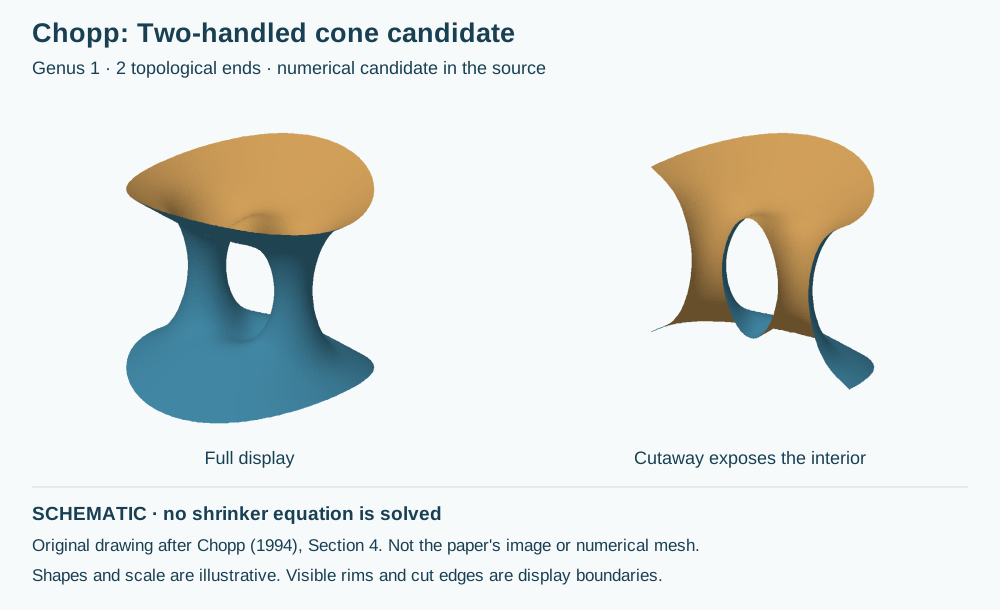
(Numerical genus-one surface with two ends) Chopp's two-handled cone is a numerical shrinker candidate in $\mathbb R^3$, with dimension two, codimension one, and the intended topology of a twice-punctured torus. Thus its surface genus is one and it has two topological ends; the phrase “two-handled” is not a genus count. The initial surface consists of two horizontal planes joined by the three crossing tubes shown in Figure 21. A ratio of handle cross-sectional areas selects a level, and an area to the power $3/2$ controls dilation.
The resulting geometry is a finite-window numerical approximation, not a closed formula or an existence theorem. The intended normalized flow is $M_ t=\sqrt{-t}\, \Sigma $, $t<0$, with $\vec H=-X^\perp /2$. The target is an embedded noncompact surface without boundary; the computation does not prove a complete proper extension. Its two ends appear conical. Figure 23 records angular variation of the cone opening, so one should not substitute a rotational double cone for the observed asymptotic cone. The reported minimum opening is about $0.739$ radians; it is a numerical estimate, not an exact asymptotic invariant. The coordinate-reflection pattern is visible in Figures 20–21; no continuous rotational symmetry or general parameter family is asserted.
The reported self-similarity diagnostic is $E=0.01983$, excluding boundary sample points, on a $100\times 100\times 100$ grid. See [Chopp1994], Section 4.4, pp. 11–12, Figures 20–23. Neither a uniqueness or stability theorem nor a Gaussian area or entropy value is established. The paper proposes a possible relation to fattening; it does not prove that this candidate fattens. In particular, the later argument for the four-handled example in Example 2.18 does not establish that claim for this smaller opening. The original rotatable schematic shows genus one and two flaring ends; its slopes and neck shapes are illustrative.
Comments
Comments are not enabled yet.