2DED712E1192
In Joyce–Lee–Tsui, Theorems E–F, choose $1\le m<n$, $\lambda _1=\cdots =\lambda _ m=1$, $\lambda _{m+1}=\cdots =\lambda _ n=-1$, and $C=1$. For the coupled ODE data of Theorems A–B the immersion is
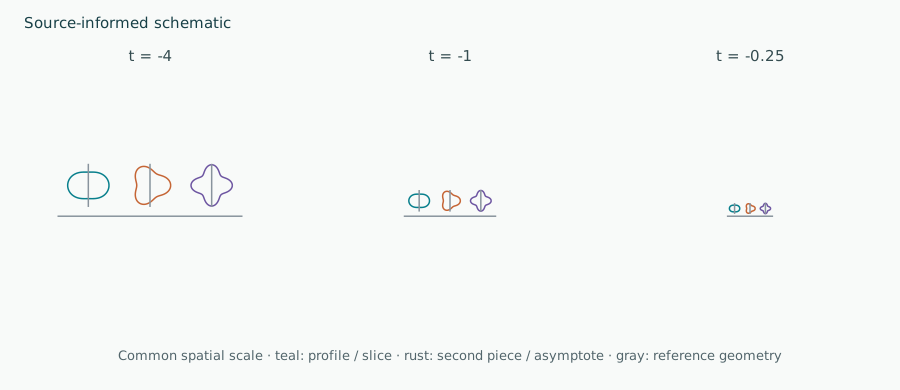
This entry records the nonconstant-amplitude periodic case. If all phase increments are rational multiples of $\pi $, the $w_ j$ have a common period and the source describes a closed noncompact immersed Lagrangian with parameter topology $S^1\times S^{m-1}\times \mathbb R^{n-m}$. For fixed sign of the soliton parameter such periodic initial data are dense in the allowed data. The $m=1$ parameter quadric has two components, and image identifications must be treated separately. The constant-amplitude Hamiltonian-stationary overlap is already included in the Lee–Wang quadric examples. For negative soliton parameter this is a self-shrinker; after normalization its flow is $\sqrt{-t}\, L$, $t<0$. Periodic bounded nonvanishing amplitudes give completeness and properness of the resulting periodic immersion. The theorem does not assert that every such immersion is embedded. Nonperiodic quasiperiodic data instead give nonclosed images with larger-dimensional closures and are not assigned the same topology or properness. The figure is a phase-loop and indefinite-quadric schematic; it does not falsely replace the coupled ODE by independent sinusoidal phases.
Sources: [JoyceLeeTsui2010].
Comments
Comments are not enabled yet.