10374A017921
There is a simple closed profile $s\mapsto (x(s),r(s))$ in $r>0$ whose rotation gives
For Euclidean arclength $s$ and tangent angle $\alpha $, the profile solves
Equivalently, it is a closed geodesic of $r^{2(n-1)}e^{-(x^2+r^2)/2}(dx^2+dr^2)$ on $r>0$. The theorem selects a closed orbit by shooting; the profile is not given by a closed formula. Its flow is $\sqrt{-t}\, \Sigma $, $t<0$.
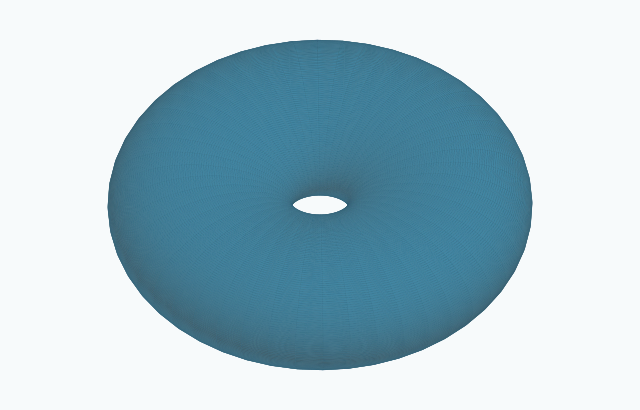
The hypersurface is compact, embedded, complete and proper, with topology $S^1\times S^{n-1}$, rotational $O(n)$ symmetry and reflection symmetry across $x=0$. When $n=2$ it is a torus in $\mathbb R^3$.
It is not mean convex. Indeed, the compact embedded mean-convex classification in [CM12], Theorem 0.17, would force a sphere. It shrinks to the origin with a Type I singularity.
It is entropy unstable by [CM12], Theorem 0.12, which applies to this compact embedded non-spherical hypersurface. No exact entropy value or global uniqueness assertion is supplied here. Berchenko–Kogan's numerical calculation estimates its entropy as approximately $1.85122$ ([BerchenkoKogan2021], Section 5, PDF pp. 10–12). This estimate has no certified error enclosure; Section 6, Question 6.3, leaves rigorous error bounds open. The proved bound for the separately constructed variational torus is recorded in Example 2.28.
The interactive figure revolves a numerically closed solution of this ODE; its caption records the shooting residual. The profile is not circular. The variational torus in [DLN2018], Theorem 2, is a separate existence construction; that survey does not identify it with Angenent's torus.
Comments
Comments are not enabled yet.