MCF-stack: Special Solutions of Mean Curvature Flow

§ 2.27 Ketover shrinkers with Platonic symmetryB675C6112328

Earliest recorded reference: (first arXiv submission).

Paper credits and chronology

Paper credits are chronological and include every author of the cited papers. They identify sources, not exclusive discovery credit. Background-only citations do not determine the date of this example. A classical example may predate the references recorded here.

  1. Ketover — 2016-02-23 (first arXiv submission).
B675C6112328

[Ketover2016], Theorem 0.1, constructs five families by equivariant Gaussian min-max. The compact doubled solids used in the sweepout describe the genus and symmetry of the construction; compactness of the limiting shrinker is not proved.

AE0CC89EB3E2

There are smooth connected embedded self-shrinking surfaces $\Sigma \subset \mathbb R^3$ with the following pairs of genus and rotational symmetry group:

\[ (g,G)=(3,T_{12}),\quad (5,O_{24}),\quad (7,O_{24}), \quad (11,I_{60}),\quad (19,I_{60}). \]

Here the subscripts give the orders of the tetrahedral, octahedral, and icosahedral rotation groups. The normalization is $\vec H=-X^\perp /2$, and $M_ t=\sqrt{-t}\, \Sigma $ for $t<0$. No explicit parametrization is supplied.

  • The sweepout joins two spherical sheets by one neck for each face of a tetrahedron, cube, octahedron, dodecahedron, or icosahedron, respectively. The numbers of necks are $4,6,8,12,20$; the first neck connects the components, so the genus is one less than this number. This is a construction description, not an exact metric model.

  • The min-max limit is multiplicity one. It is complete and proper, has no boundary, and retains the stated genus and symmetry. The construction controls the genus but does not determine compactness, the number of ends, or end asymptotics. In particular, a compact picture suggested by numerical work must not be used to assign zero ends to these proved examples.

  • The proof gives a useful strict Gaussian-area bound:

    \[ \frac4e < F_{0,1}(\Sigma )=\lambda (\Sigma )<\frac8e. \]

    For the doubled cube, the first equivariant width is $4/e$, the second is strictly below twice the first by Lemma 2.4, and the equality of the two widths is excluded in Remark 2.7. Remark 2.5 gives the same construction for the other four symmetry types. These are bounds, not computed entropy values.

  • No uniqueness or stability classification is asserted. The two-parameter equivariant construction alone does not give an index bound for unrestricted variations. Later constructions with similar symmetries need not be different surfaces, and no identification is assumed here.

Sources: [Ketover2016], Theorem 0.1 and the compactness discussion, PDF pp. 2–3; Theorems 1.1 and 1.3, p. 5; Lemma 2.4 and multiplicity-one argument, p. 12; Remark 2.5 and Remark 2.7, pp. 14–15. The illustration shows the neck counts and symmetry of the sweepout, not a numerical solution or a proof of compactness of the limit.
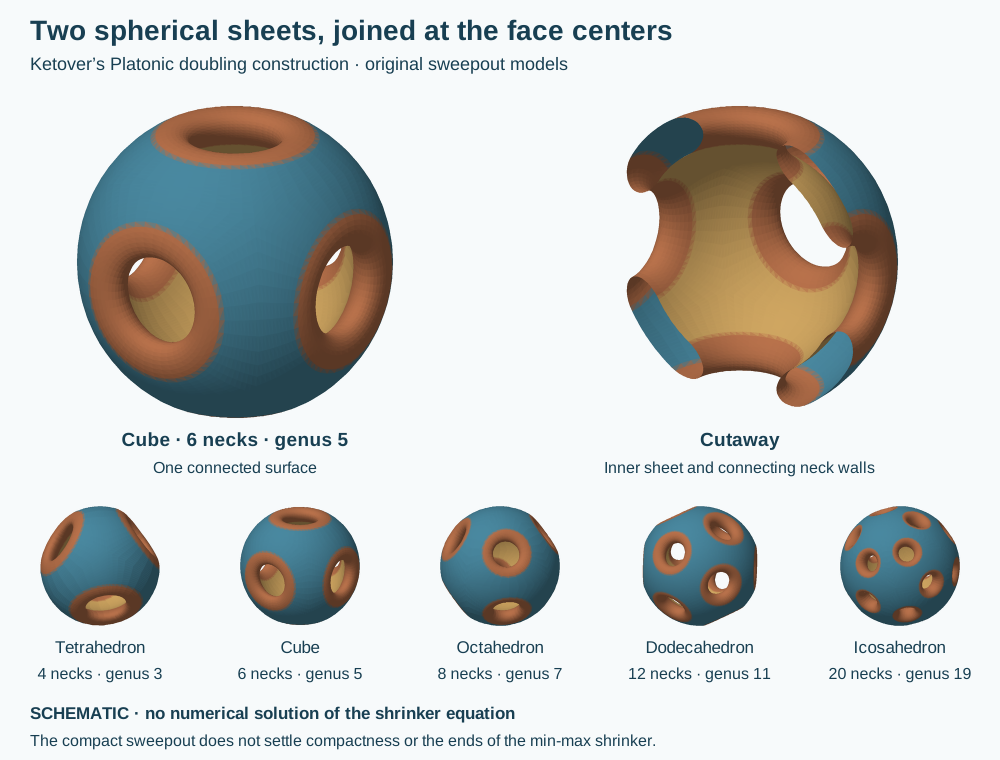
Full and cutaway views of two spherical sheets joined through six face-center necks in the cube arrangement, giving genus five. Five models show all Platonic face-center arrangements. Original construction schematic, not a solved self-shrinker.
Interactive construction schematic. Two spherical sheets are joined by one radial neck at each face center, following Ketover’s doubling sweepout (pp. 2 and 9–10). Choose a Platonic solid to see 4, 6, 8, 12, or 20 necks and genus 3, 5, 7, 11, or 19. Cutaway reveals the inner sheet; display separation enlarges the gap. Colors mark parts of one connected surface. These are compact comparison surfaces with illustrative neck sizes, not computed self-shrinkers. Compactness and ends of the min-max limits remain undetermined. Open drawing · Numerical references and credits

Ambient space, topology, embeddedness and entropy

Five equivariant min-max constructions. Compactness and ends are not proved; the diagram illustrates sweepout topology. No identification with later constructions is assumed.

Tetrahedral symmetry: genus 3 · Euclidean space ℝ³ · Embedded
Ambient space
Euclidean space ℝ³
Topology
Orientable embedded surface of genus 3; T₁₂ rotation symmetry. The doubled 4-face sweepout does not establish compactness of its limit.
Embeddedness
Embedded: All five recorded symmetry/genus constructions give smooth embedded surfaces.
Compactness
Not specified for this subfamily
Surface genus
3
Topological ends
Not established in the cited existence theorem
Entropy
Proved bound or relation: 4/e < λ < 8/e; exact value not given.
Gaussian area
Proved bound or relation: F₀,₁ = λ for the normalized shrinker; 4/e < F₀,₁ < 8/e.
Cubic symmetry: genus 5 · Euclidean space ℝ³ · Embedded
Ambient space
Euclidean space ℝ³
Topology
Orientable embedded surface of genus 5; O₂₄ rotation symmetry. The doubled 6-face sweepout does not establish compactness of its limit.
Embeddedness
Embedded: All five recorded symmetry/genus constructions give smooth embedded surfaces.
Compactness
Not specified for this subfamily
Surface genus
5
Topological ends
Not established in the cited existence theorem
Entropy
Proved bound or relation: 4/e < λ < 8/e; exact value not given.
Gaussian area
Proved bound or relation: F₀,₁ = λ for the normalized shrinker; 4/e < F₀,₁ < 8/e.
Octahedral symmetry: genus 7 · Euclidean space ℝ³ · Embedded
Ambient space
Euclidean space ℝ³
Topology
Orientable embedded surface of genus 7; O₂₄ rotation symmetry. The doubled 8-face sweepout does not establish compactness of its limit.
Embeddedness
Embedded: All five recorded symmetry/genus constructions give smooth embedded surfaces.
Compactness
Not specified for this subfamily
Surface genus
7
Topological ends
Not established in the cited existence theorem
Entropy
Proved bound or relation: 4/e < λ < 8/e; exact value not given.
Gaussian area
Proved bound or relation: F₀,₁ = λ for the normalized shrinker; 4/e < F₀,₁ < 8/e.
Dodecahedral symmetry: genus 11 · Euclidean space ℝ³ · Embedded
Ambient space
Euclidean space ℝ³
Topology
Orientable embedded surface of genus 11; I₆₀ rotation symmetry. The doubled 12-face sweepout does not establish compactness of its limit.
Embeddedness
Embedded: All five recorded symmetry/genus constructions give smooth embedded surfaces.
Compactness
Not specified for this subfamily
Surface genus
11
Topological ends
Not established in the cited existence theorem
Entropy
Proved bound or relation: 4/e < λ < 8/e; exact value not given.
Gaussian area
Proved bound or relation: F₀,₁ = λ for the normalized shrinker; 4/e < F₀,₁ < 8/e.
Icosahedral symmetry: genus 19 · Euclidean space ℝ³ · Embedded
Ambient space
Euclidean space ℝ³
Topology
Orientable embedded surface of genus 19; I₆₀ rotation symmetry. The doubled 20-face sweepout does not establish compactness of its limit.
Embeddedness
Embedded: All five recorded symmetry/genus constructions give smooth embedded surfaces.
Compactness
Not specified for this subfamily
Surface genus
19
Topological ends
Not established in the cited existence theorem
Entropy
Proved bound or relation: 4/e < λ < 8/e; exact value not given.
Gaussian area
Proved bound or relation: F₀,₁ = λ for the normalized shrinker; 4/e < F₀,₁ < 8/e.

Compare examples by these properties →

References on this page

  1. [Ketover2016] Daniel Ketover. Self-shrinking platonic solids. 2016. Source locators refer to arXiv version 1, 23 February 2016, 17 pages. Compactness is explicitly left unresolved. URL: https://arxiv.org/abs/1602.07271v1, arXiv:1602.07271, doi:10.48550/arXiv.1602.07271.All uses in this project ↩ 1 ↩ 2
Cite this page

Comments

Comments are not enabled yet.