8E8F9B32C891
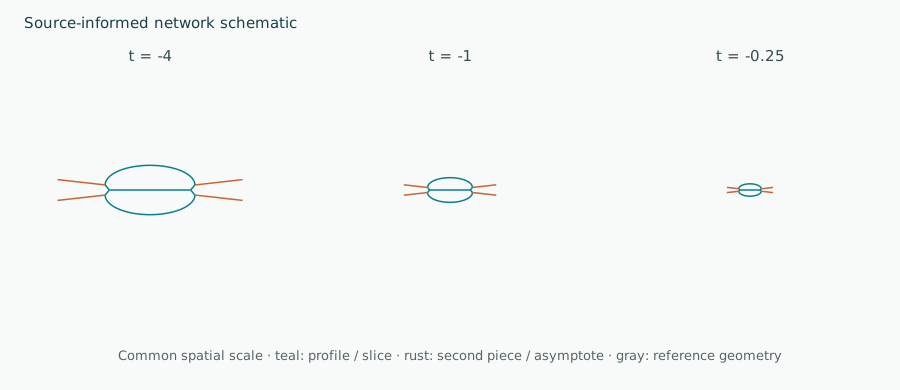
This planar network has the regular two-region configuration classified by Chang–Lue. Its branches satisfy $\mathbf k=-X^\perp /2$, and three branches meet at each junction at angles $2\pi /3$. The associated network flow is $\sqrt{-t}\, \Gamma $, $-\infty <t<0$. Exterior straight rays pass through the shrinker center when extended. The network is embedded in the network sense: branches intersect only at the specified junctions; it is not a smooth immersed curve at those junctions. An arclength branch can be computed from $x'=\cos \theta $, $y'=\sin \theta $, $\theta '=(x\sin \theta -y\cos \theta )/2$, subject to global closing and junction conditions. These conditions, rather than arbitrary shooting data, define the example. The cited papers establish the relevant existence or classification. The no-theta-network result must not be confused with existence of the cisgeminate eye. No exhaustive classification of networks with arbitrarily many regions is claimed. The complete noncompact network has finitely many bounded arcs and rays, so its Gaussian area and entropy are finite. Surface genus is inapplicable. Where the figure uses a symmetric shooting solution it reports numerical junction residuals; asymmetric configurations are explicitly labeled construction diagrams. Time scaling is exact in either picture, but does not turn a schematic profile into a solved shrinker.
Sources: [ChangLue2019].
Comments
Comments are not enabled yet.