MCF-stack: Special Solutions of Mean Curvature Flow

§ 2.4 Shrinking fish network (Chen–Guo, 2007; Chang, 2021)BAA362BD1D2D

Earliest recorded reference: (publication year).

Paper credits and chronology

Paper credits are chronological and include every author of the cited papers. They identify sources, not exclusive discovery credit. Background-only citations do not determine the date of this example. A classical example may predate the references recorded here.

  1. Chen–Guo — 2007 (publication year).
  2. Chang — 2021-07-09 (first arXiv submission).
BAA362BD1D2D
6E3C2D665CDD

This planar network has the asymmetric two-ray, one-region configuration. Its branches satisfy $\mathbf k=-X^\perp /2$, and three branches meet at each junction at angles $2\pi /3$. The associated network flow is $\sqrt{-t}\, \Gamma $, $-\infty <t<0$. Exterior straight rays pass through the shrinker center when extended. The network is embedded in the network sense: branches intersect only at the specified junctions; it is not a smooth immersed curve at those junctions. An arclength branch can be computed from $x'=\cos \theta $, $y'=\sin \theta $, $\theta '=(x\sin \theta -y\cos \theta )/2$, subject to global closing and junction conditions. These conditions, rather than arbitrary shooting data, define the example. The cited papers establish the relevant existence or classification. The no-theta-network result must not be confused with existence of the cisgeminate eye. No exhaustive classification of networks with arbitrarily many regions is claimed. The complete noncompact network has finitely many bounded arcs and rays, so its Gaussian area and entropy are finite. Surface genus is inapplicable. Where the figure uses a symmetric shooting solution it reports numerical junction residuals; asymmetric configurations are explicitly labeled construction diagrams. Time scaling is exact in either picture, but does not turn a schematic profile into a solved shrinker.

Sources: [Chang2026, ChenGuo2007].
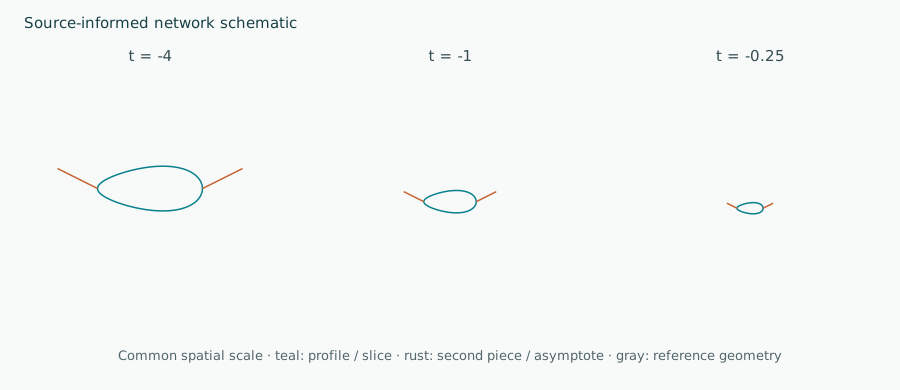
Shrinking fish network. Three times on common axes. Source-based junction diagram; curved arcs are schematic, not a solved shrinker profile.
Source-informed network schematic. Three times on common axes. Source-based junction diagram; curved arcs are schematic, not a solved shrinker profile. Open drawing · Numerical references and credits

Ambient space, topology, embeddedness and entropy

Source construction and dimension restrictions are stated on the reading page. Illustrations have their own accuracy labels.

Regular planar network · Euclidean plane ℝ² · Embedded
Ambient space
Euclidean plane ℝ²
Topology
The asymmetric two-ray, one-region configuration
Embeddedness
Embedded: Embedded as a network with prescribed 120-degree triple junctions, not a smooth curve there.
Compactness
Noncompact
Surface genus
Not a smooth surface; surface genus is inapplicable.
Topological ends
Two topological ends.
Entropy
Finite; value not recorded: Finite on each stated smooth slice; no numerical value or uniform time bound is recorded.
Gaussian area
Finite; value not recorded: Finite on each stated smooth slice; no numerical value or uniform time bound is recorded.

Compare examples by these properties →

References on this page

  1. [Chang2026] Jui-En Chang. Stability of regular shrinkers in the network flow. The Journal of Geometric Analysis, 2026. URL: https://arxiv.org/abs/2107.04338, arXiv:2107.04338, doi:10.1007/s12220-026-02357-5.All uses in this project ↩ 1
  2. [ChenGuo2007] Xinfu Chen and Jong-Shenq Guo. Self-similar solutions of a 2-D multiple-phase curvature flow. Physica D, 229:22–34, 2007. URL: https://doi.org/10.1016/j.physd.2007.03.009, doi:10.1016/j.physd.2007.03.009.All uses in this project ↩ 1
Cite this page

Comments

Comments are not enabled yet.