MCF-stack: Special Solutions of Mean Curvature Flow

§ 2.10 Planes through the shrinker center (Colding–Minicozzi II, 2009; Drugan–Lee–X. H. Nguyen, 2017)CB99B1567911

Earliest recorded reference: (first arXiv submission).

Paper credits and chronology

Paper credits are chronological and include every author of the cited papers. They identify sources, not exclusive discovery credit. Background-only citations do not determine the date of this example. A classical example may predate the references recorded here.

  1. Colding–Minicozzi II — 2009-08-26 (first arXiv submission).
  2. Drugan–Lee–X. H. Nguyen — 2017-08-30 (first arXiv submission).
CB99B1567911

Planes are stationary solutions that also satisfy the shrinker equation; see [DLN2018], Sections 2.5 and 3.3, and [CM12], Theorem 0.16.

97FD822B6630

Let $P$ be an $n$-dimensional linear subspace of $\mathbb R^ N$, where $1\leq n<N$. Then

\[ M_ t=P,\qquad -\infty <t<\infty , \qquad \vec H=0,\quad X^\perp =0. \]

Thus $P$ is both a stationary flow and a normalized self-shrinker. An affine plane is a shrinker centered at any point of that plane; it satisfies the centered equation at the origin only if it contains the origin.

  • The inclusion is complete, proper, embedded, flat, noncompact and boundaryless, with topology $\mathbb R^ n$ and Euclidean volume growth. It has two ends for $n=1$ and one end for $n\geq 2$.

  • The solution has no finite singular time. The identity $\sqrt{-t}\, P=P$ does not describe a geometric collapse. Its entropy is exactly one.

  • In codimension one it is entropy stable and $F$-stable under the notions in [CM12]; no conclusion about a different constrained variation problem is intended.

The picture shows a bounded patch of a plane in $\mathbb R^3$. Its boundary is a viewing boundary, not a boundary of the flow.
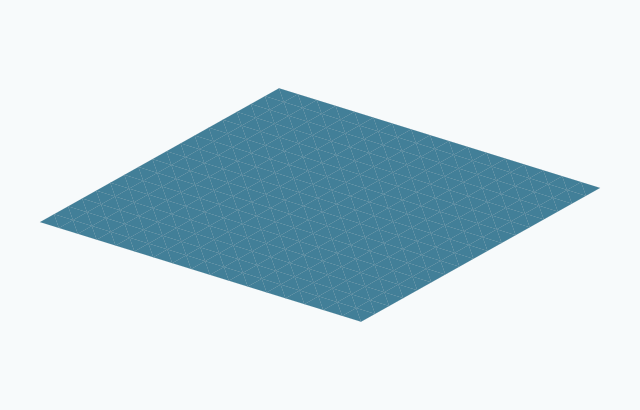
Planes through the shrinker center. A finite viewing patch of a plane through the origin. Its visible boundary is not part of the complete solution.
Exact formula. A finite viewing patch of a plane through the origin. Its visible boundary is not part of the complete solution. Open drawing · Numerical references and credits

Ambient space, topology, embeddedness and entropy
Lines in ℝᴺ, N ≥ 2 · Euclidean plane ℝ²; Euclidean space ℝ³; Euclidean space ℝ⁴; Euclidean dimension ≥ 5 · Embedded
Ambient space
Euclidean plane ℝ²; Euclidean space ℝ³; Euclidean space ℝ⁴; Euclidean dimension ≥ 5
Topology
Line ℝ
Embeddedness
Embedded: The linear-subspace inclusion is an embedding.
Compactness
Noncompact
Surface genus
Not a surface
Topological ends
2
Entropy
Exact formula: λ = 1.
Gaussian area
Exact formula: F₀,₁ = λ for the normalized shrinker. λ = 1.
Planes in ℝᴺ, N ≥ 3 · Euclidean space ℝ³; Euclidean space ℝ⁴; Euclidean dimension ≥ 5 · Embedded
Ambient space
Euclidean space ℝ³; Euclidean space ℝ⁴; Euclidean dimension ≥ 5
Topology
Plane ℝ²
Embeddedness
Embedded: The linear-subspace inclusion is an embedding.
Compactness
Noncompact
Surface genus
0
Topological ends
1
Entropy
Exact formula: λ = 1.
Gaussian area
Exact formula: F₀,₁ = λ for the normalized shrinker. λ = 1.
Higher-dimensional planes · Euclidean space ℝ⁴; Euclidean dimension ≥ 5 · Embedded
Ambient space
Euclidean space ℝ⁴; Euclidean dimension ≥ 5
Topology
Linear subspace ℝⁿ, 3 ≤ n < N
Embeddedness
Embedded: The linear-subspace inclusion is an embedding.
Compactness
Noncompact
Surface genus
Not a surface
Topological ends
1
Entropy
Exact formula: λ = 1.
Gaussian area
Exact formula: F₀,₁ = λ for the normalized shrinker. λ = 1.

Compare examples by these properties →

References on this page

  1. [DLN2018] Gregory Drugan, Hojoo Lee, and Xuan Hien Nguyen. A survey of closed self-shrinkers with symmetry. Results in Mathematics, 73(1):32, 2018. Article 32, 32 pages; locators refer to the supplied published edition. URL: https://arxiv.org/abs/1708.09113, doi:10.1007/s00025-018-0763-3.All uses in this project ↩ 1
  2. [CM12] Tobias H. Colding and William P. Minicozzi, II. Generic mean curvature flow I: generic singularities. Annals of Mathematics, 175(2):755–833, 2012. URL: https://doi.org/10.4007/annals.2012.175.2.7, doi:10.4007/annals.2012.175.2.7.All uses in this project ↩ 1 ↩ 2
Cite this page

Comments

Comments are not enabled yet.