§ 2.33 Chu–Sun genus-one shrinkers below the shrinking doughnutB050FA22AB2D
Earliest recorded reference: (first arXiv submission).
Paper credits and chronology
Paper credits are chronological and include every author of the cited papers. They identify sources, not exclusive discovery credit. Background-only citations do not determine the date of this example. A classical example may predate the references recorded here.
The flow construction in [ChuSun2025] gives an embedded genus-one shrinker with strictly less entropy than the Drugan–Nguyen shrinking doughnut. It does not identify the resulting surface with any particular previously constructed example.
AE7721D6799F
(Chu–Sun lower-entropy genus-one shrinkers) Let $\mathcal T\subset \mathbb R^3$ be the rotationally symmetric compact genus-one shrinker constructed by Drugan–Nguyen (Example 2.28). There is a smooth embedded genus-one shrinker $\Sigma \subset \mathbb R^3$ satisfying
It has dimension two and codimension one, is normalized by $\vec H=-X^\perp /2$, and yields the smooth self-similar flow $\sqrt{-t}\, \Sigma $ for $t<0$.
The surface is a multiplicity-one tangent-flow model at a genus-one singularity of an ancient level-set flow which is asymptotic, after rescaling as $t\to -\infty $, to $\mathcal T$. The ancient flow is allowed to pass through cylindrical and spherical singularities before the genus-one singularity. Thus the theorem does not assert that this is the first singularity of a smooth ancient flow.
The resulting shrinker is complete, proper, and boundaryless. Its compactness, end count, end asymptotics, and symmetry are not determined by this existence statement. No explicit parametrization, exact entropy value, or numerical shape is supplied.
Strictly smaller entropy rules out congruence with the chosen shrinking doughnut $\mathcal T$. It does not prove that $\Sigma $ differs from the Buzano–Nguyen–Schulz genus-one example. Remark 1.5 discusses that example and its numerical evidence, without proving the identification. It also does not identify $\mathcal T$ with Angenent's shooting torus.
For a shrinker minimizing entropy among all embedded genus-one shrinkers, Theorem 1.4 gives a further alternative: it is noncompact or has Gaussian Morse index exactly $5$. This statement applies to an entropy minimizer, not to every shrinker obtained by the interpolation construction. No uniqueness is asserted.
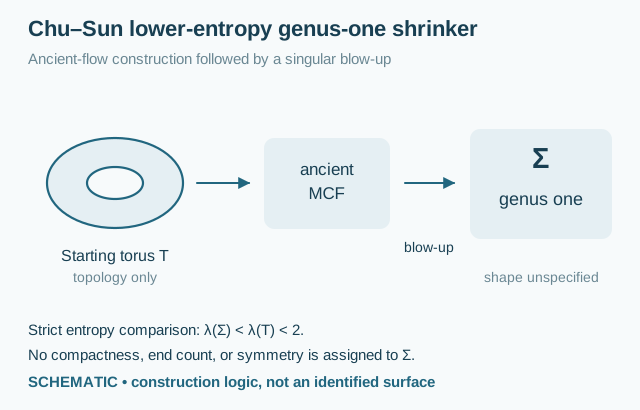
Sources: [ChuSun2025], Theorems 1.4 and 1.6, Remark 1.5 and Corollary 1.7, arXiv version 3, PDF pp. 3–4; proofs in Sections 5.2–5.5, pp. 33–34. The diagram records the flow construction and strict entropy drop; the final genus-one shrinker is left abstract because its compactness and ends are not specified.
Original schematic. A generic torus icon represents the topology of the starting Drugan–Nguyen rotational shrinker T. An ancient mean curvature flow and a singular blow-up produce a genus-one shrinker Sigma of strictly lower entropy. The final box deliberately leaves compactness, ends, symmetry, and geometric shape unspecified. Open drawing · Numerical references and credits
Chu–Sun construction: interactive numerical flow
Numerical experiment. Supplied by Ao Sun: 129 rescaled frames of a perturbed torus flow, with time playback, rotation and zoom, a stationary candidate overlay, and numerical diagnostics. This experiment illustrates the interpolation mechanism. It does not prove convergence, identify the shrinker in the existence theorem, or determine its compactness, ends, uniqueness, or stability. The displayed Gaussian density is computed on truncated surfaces, not a proved entropy value.
Chu–Sun alternative construction: second angular mode
Numerical experiment. Supplied by Ao Sun: 98 rescaled frames of the second angular-mode perturbation (ε = 0.4), compared with a numerical genus-one candidate with two apparent conical ends. The viewer shows approach and later departure, with no convergence claim. Late frames are resolution-limited; residual and Gaussian-density readouts are unavailable once the parametrization degenerates. This experiment does not establish an exact shrinker, identify a tangent-flow limit, or prove an end count, uniqueness, or stability for the theorem’s shrinker.
Explore the interactive flowAmbient space, topology, embeddedness and entropy
A multiplicity-one genus-one tangent-flow model with entropy strictly below the Drugan–Nguyen shrinking doughnut. Compactness and ends are not specified. No identification with the BNS genus-one shrinker is established.
Lower-entropy genus-one shrinker · Euclidean space ℝ³ · Embedded
Ambient space
Euclidean space ℝ³
Topology
Embedded orientable genus-one surface; compactness not specified
Embeddedness
Embedded: The lower-entropy genus-one shrinker supplied by the cited existence theorem is embedded.
Compactness
Not specified for this subfamily
Surface genus
1
Topological ends
Not established in the cited existence theorem
Entropy
Proved bound or relation: λ(Σ) < λ(Drugan–Nguyen torus) < 2; no exact value supplied.
Comments
Comments are not enabled yet.