635FBEF68A7E
The exact normalized immersion is
It lies in $\mathbb R^4=\mathbb C^2$, and $X_ t=\sqrt{-t}\, X$ gives a smooth flow for $t<0$.
This is a compact embedded Lagrangian torus of dimension two and codimension two, complete and proper. It is minimal in $S^3(2)$ and has the product rotation symmetry $U(1)\times U(1)$.
The induced metric is $2(d\theta _1^2+d\theta _2^2)$; it is intrinsically flat, has area $8\pi ^2$, $|\vec H|=1$, and $\vec H=-X/2$. Its entropy is exactly $2\pi /e$ ([ELS2020], Section 2 and Lemma 2.4, PDF pp. 3–6).
It is $F$-unstable under Lagrangian variations but $F$-stable under Hamiltonian variations after accounting for translations. It is locally volume minimizing under Hamiltonian variations (Lemmas 4.1–4.2 and Theorem 4.3, PDF p. 13).
Nevertheless it is not a local entropy minimum, even within Hamiltonian variations. For every $\varepsilon >0$ and $k\in \mathbb N$ there is a compact embedded Lagrangian torus Hamiltonian isotopic and $\varepsilon $-close in $C^ k$ whose first finite-time singularity has a blow-up outside the $U(2)$-orbit of the Clifford torus (Corollary 4.8 and Theorem 4.9, PDF p. 16).
A compact embedded two-dimensional self-shrinker in $\mathbb C^2$ sufficiently $C^{2,\alpha }$-close, for $0<\alpha <1$, is the Clifford torus up to translation, dilation and rotation (Theorem 5.7, PDF p. 29). This is a local rigidity statement.
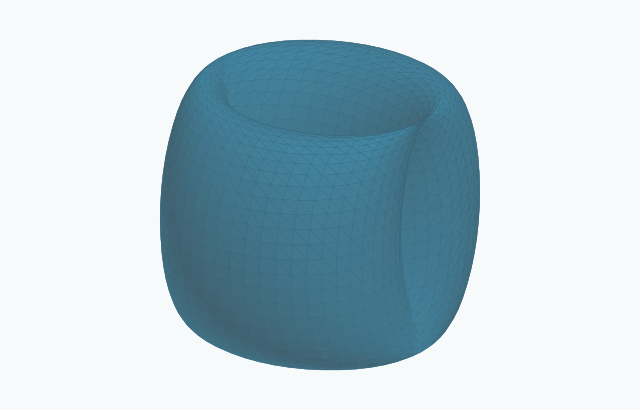
The interactive picture rotates the second and fourth coordinates in $\mathbb R^4$ and then projects onto the first three coordinates. Apparent intersections in a projection do not mean that the original torus is immersed nonembedded.
Comments
Comments are not enabled yet.