3AA6C1836470
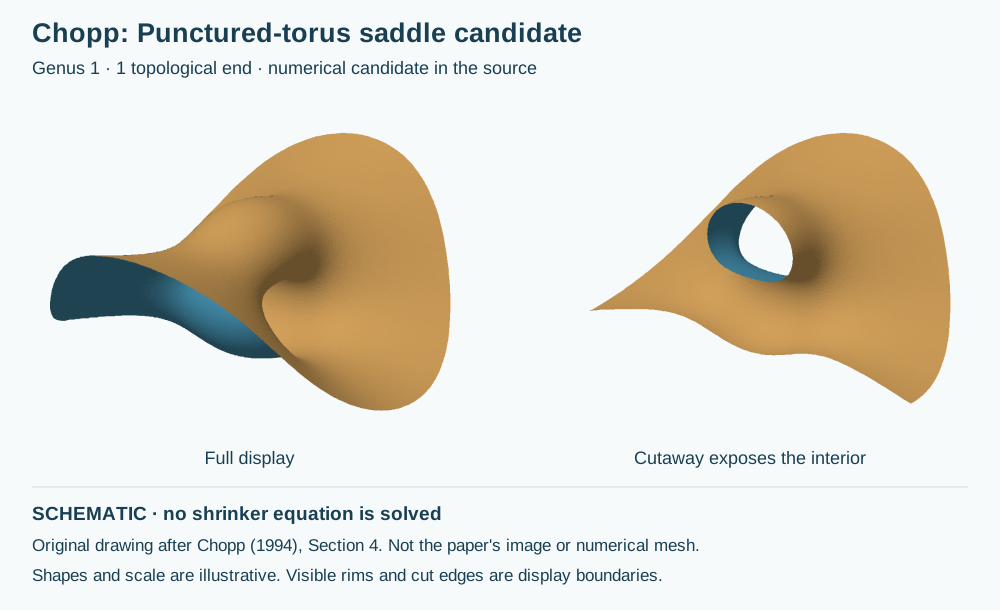
(Numerical one-ended saddle) The saddle in [Chopp1994], Section 4.3, is a noncompact numerical shrinker candidate in $\mathbb R^3$, of dimension two and codimension one. Its intended topology is a once-punctured torus: genus one and one topological end. The reported eight-element symmetry is generated by reflection in the $xz$-plane, reflection in the $yz$-plane, and $(x,y,z)\mapsto (y,x,-z)$.
The initial surface is a plane modified by two crossing tubes at the origin, as in Figure 17. Symmetry fixes the zero level; the computation uses the cross-sectional area of one handle, raised to the power $3/2$, as a scale control. The intended normalized equation is $\vec H=-X^\perp /2$, giving $\sqrt{-t}\, \Sigma $ for $t<0$ if an exact complete shrinker is obtained. There is no closed formula for $\Sigma $.
The computation is performed on a bounded window, with upwind boundary conditions. The intended surface is embedded and has no boundary, but completeness, properness and a smooth extension through the omitted end are not proved by this computation. The observed end tends toward a cone; no exact cone link or proved decay rate is supplied. The saddle geometry is not convex, and no curvature sign theorem or stability classification is established for an exact candidate.
Chopp reports $E=0.005848$ after excluding boundary sample points. He expressly states that the algorithm cannot demonstrate the existence of a complete self-similar surface. See Section 4.3, pp. 9–11, Figures 16–19; Figure 19 uses a $100\times 100\times 100$ grid. No Gaussian area, entropy value, uniqueness or certified numerical error bound is recorded. The illustration is an original punctured-torus schematic; its end rim is a display truncation. It is not a numerical reconstruction or an identification with the later one-ended families in Examples 2.32 and 2.21.
Comments
Comments are not enabled yet.