8EACFCA7AE0F
For every $n\geq 2$, Mramor–Payne construct an eternal embedded hypersurface flow $M_ t\subset \mathbb R^{n+1}$, $t\in \mathbb R$, on the outside of a rotational minimal catenoid. It is $O(n)\times O(1)$ invariant, mean convex after a choice of orientation, nonconvex, and has uniformly bounded curvature. Backward in time it converges smoothly and uniformly to that catenoid; forward in time its distance from the rotation axis tends to infinity. It is not a translator or another soliton.
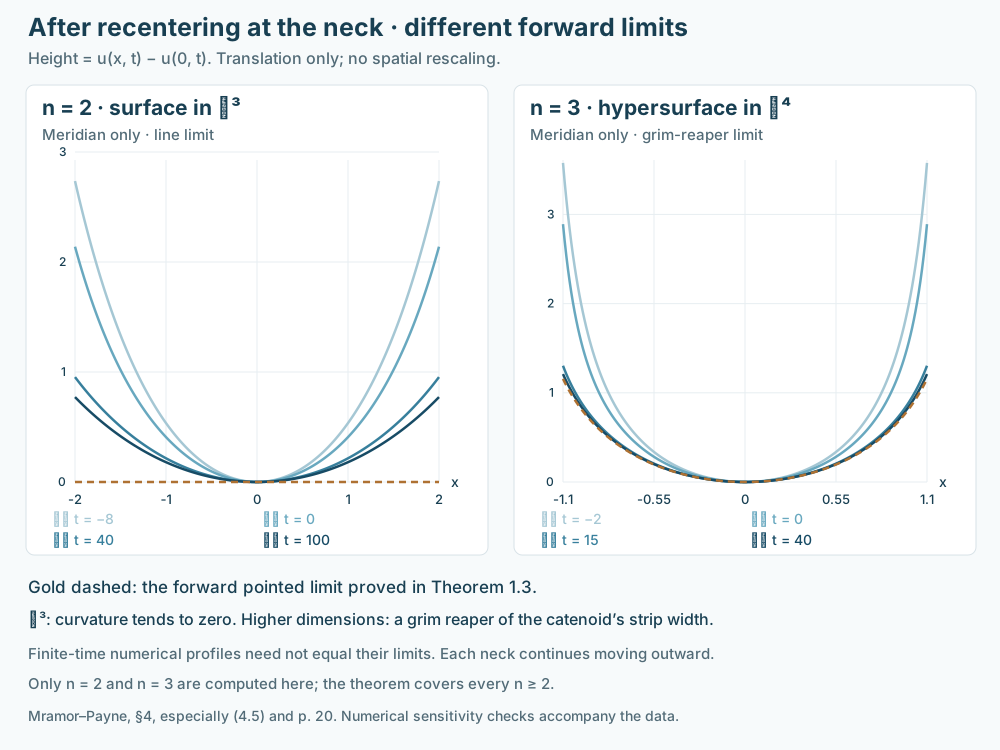
The rotational graphical construction gives complete proper noncompact slices with topology $S^{n-1}\times \mathbb R$ and two ends. For $n=2$ these are annuli in $\mathbb R^3$. In that dimension the pointed forward profile limit is a line and curvature tends to zero. For $n\geq 3$, recentered meridians converge instead to a grim reaper with the same width as the higher-dimensional catenoid. These are pointed profile limits, not a claim that the unshifted surfaces converge globally to a fixed grim cylinder.
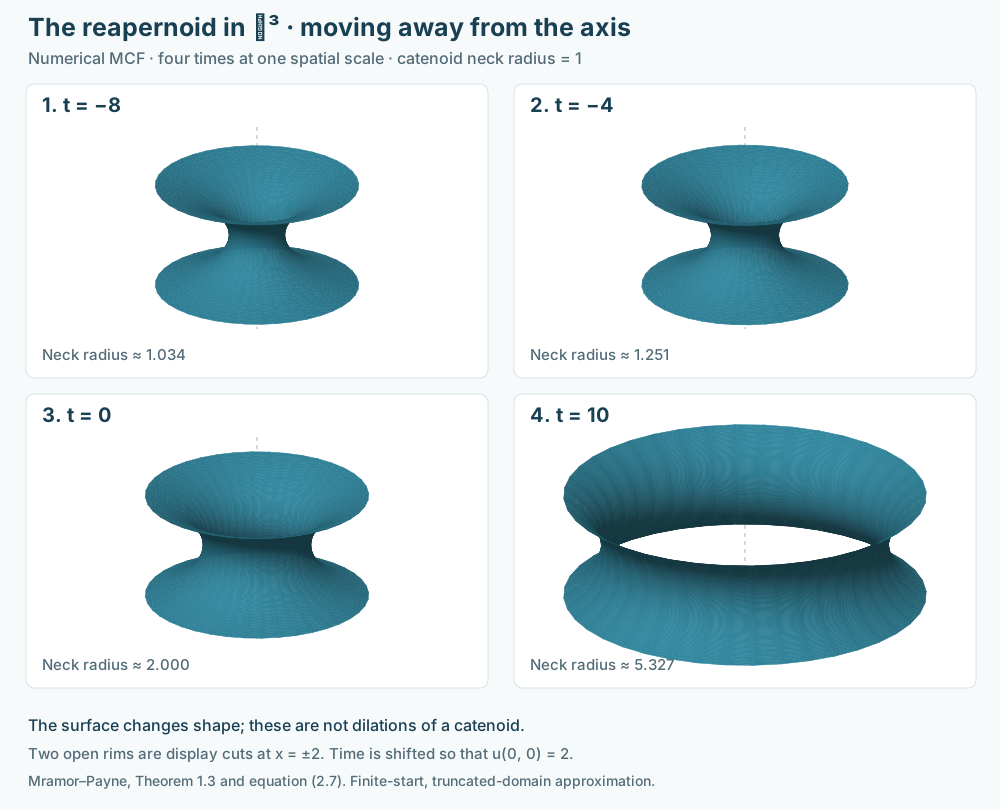
Source: [MP19], Theorem 1.3, pp. 4–5, and Section 4. The scale of the limiting catenoid is free; no explicit time-dependent profile, full uniqueness statement, or entropy value is recorded. The figure uses numerical solutions of the rotational evolution equation (2.7), rather than dilating a fixed catenoid.
Write the rotational hypersurface as
The reference catenoid has neck radius one. For $n=2$ its profile is exactly $w(x)=\cosh x$ on $\mathbb R$. Its outward parallel perturbation can be written parametrically as
for sufficiently small $\delta >0$. These offsets are the initial surfaces for the approximating flows, not time slices of the limiting eternal flow. The numerical illustrations use $\delta =10^{-4}$, evolve forward, and shift time so that $u(0,0)=2$. Space is not rescaled from frame to frame. The surface views in $\mathbb R^3$ cover $t\in [-8,10]$ and the meridian views continue to $t=100$; the $n=3$ meridians in $\mathbb R^4$ cover $t\in [-2,40]$. These finite intervals and their time origin are plotting choices, not the maximal interval of the theorem.
The neck moves outward: $u_ t>0$. In the convention $H=\operatorname {div}_ M\nu $, the normal pointing away from the rotation axis has $H<0$ on moving slices, so the mean curvature vector $-H\nu $ points outward. The convexity of the meridian does not make the hypersurface convex: its meridional and rotational principal curvatures have opposite signs.
The late-time views subtract the neck radius, showing $u(x,t)-u(0,t)$ without dilation. For $n=2$ the limiting graph is zero. For the plotted $n=3$ case, set
Here $a_3$ is the coordinate half-width for the stationary equation with $w(0)=1$, and $G$ is the recentered grim-reaper limit. The dashed limit curves are distinct from the finite-time numerical profiles. Only $n=2$ and $n=3$ are computed; the existence and limiting-shape theorem applies to every $n\geq 2$.
The computations use finite starting times, symmetry at the neck, and fixed values at artificial outer boundaries. Mesh, starting-offset, time-tolerance and domain comparisons are recorded with the figure data. They provide numerical evidence for these approximations, not a certified error estimate to an eternal solution.
Comments
Comments are not enabled yet.