263868E061E7
(Stationary special Lagrangian necks) For $n\geq 2$, $a_ j>0$, and phases $\psi _ j\in \mathbb R$, define
The map
parametrizes a complete proper embedded special Lagrangian of dimension and codimension $n$. Its constant flow $L_ t=X(\mathbb S^{n-1}\times \mathbb R)$ is eternal, $t\in \mathbb R$, since $\vec H=0$. This is the $\alpha =0$ case of [JoyceLeeTsui2010], Theorems C–D, credited there to Lawlor.
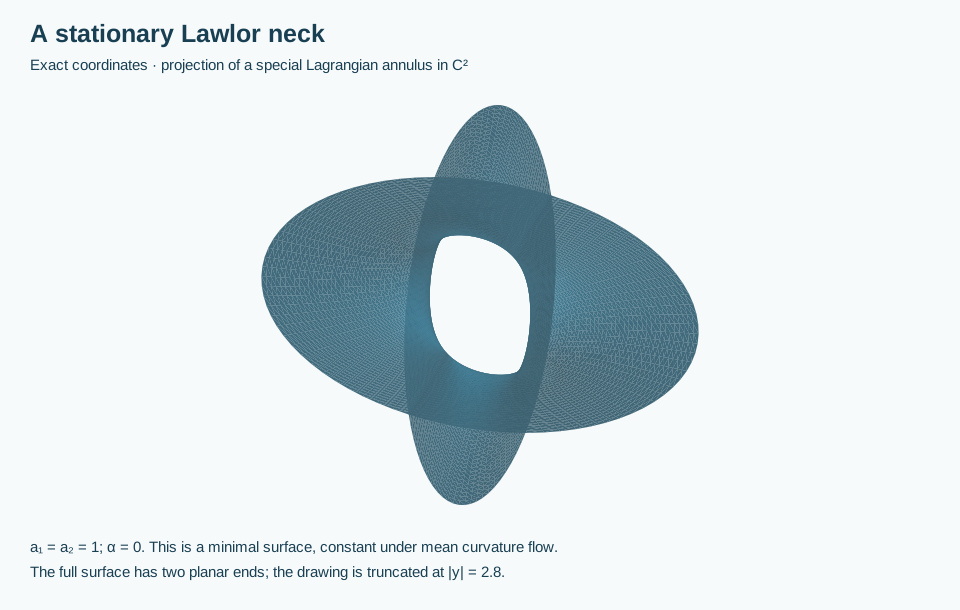
It has two planar ends and topology $\mathbb S^{n-1}\times \mathbb R$; in $\mathbb C^2$ it is an annulus. The positive characteristic angles sum to $\pi $. They determine a neck up to scale, and equal $a_ j$ give the rotational subfamily after a unitary change of coordinates. Calibration makes the neck area-minimizing for compactly supported competitors with the same boundary, hence stable for compactly supported variations.
For $n\geq 3$, [ImagiJoyceOliveira2016], Theorem 1.1, classifies closed-as-subsets, embedded, exact, asymptotically conical special Lagrangians with two transverse planar asymptotes and rate $\rho <0$, up to the specified special unitary rotation. The source's weaker rate $\rho <2$ additionally permits translation. These are conditional uniqueness statements. The drawing projects the exact $n=2$, $a_1=a_2=1$ map, whose common complex factor is $\sqrt{1+y^2/2}+iy/\sqrt2$.
Comments
Comments are not enabled yet.