MCF-stack: Special Solutions of Mean Curvature Flow

§ 5.29 Ancient torus curves in higher codimension (D. J. Altschuler–S. J. Altschuler–Angenent–Wu, 2012; Stryker–Sun, 2019)B6082DA55C46

Earliest recorded reference: (first arXiv submission).

Paper credits and chronology

Paper credits are chronological and include every author of the cited papers. They identify sources, not exclusive discovery credit. Background-only citations do not determine the date of this example. A classical example may predate the references recorded here.

  1. D. J. Altschuler–S. J. Altschuler–Angenent–Wu — 2012-07-17 (first arXiv submission).
  2. Stryker–Sun — 2019-08-07 (first arXiv submission).
B6082DA55C46
D28FAF32B556

(Compact ancient torus curves) Fix $m\geq 2$ and integers $1=k_1<k_2<\cdots <k_ m$. For $t<0$, let $r(t)>0$ be the unique solution of

\[ \sum _{j=1}^ m r(t)^{2k_ j^2}=-2t. \]

Then the exact parametrization

\[ \gamma _ t(\theta )= \bigl (r(t)^{k_1^2}\cos (k_1\theta ),r(t)^{k_1^2}\sin (k_1\theta ), \ldots ,r(t)^{k_ m^2}\cos (k_ m\theta ),r(t)^{k_ m^2}\sin (k_ m\theta )\bigr ), \qquad \theta \in \mathbb R/2\pi \mathbb Z, \]

is an ancient curve-shortening flow in $\mathbb R^{2m}$. Its scale is specified by an exact implicit equation; no elementary inverse in time is required. Equivalently,

\[ r'=-\frac{r}{\sum _ j k_ j^2r^{2k_ j^2}}. \]

Each time slice is a compact smooth embedded circle, hence complete and proper, with no ends and codimension $2m-1$. Embeddedness follows directly from $k_1=1$, because the first two coordinates already determine $\theta $. The name refers to a curve lying on a product of circles, not to a two-dimensional torus. It spans $\mathbb R^{2m}$, has a one-parameter simultaneous rotational symmetry, and is non-self-similar when $m\geq 2$ because the ratios of its different coordinate radii change with time.

The rescaled curves $(-t)^{-1/2}\gamma _ t$ tend to the radius-$\sqrt2$ circle with multiplicity $k_ m$ as $t\to -\infty $, and with multiplicity one as $t\uparrow 0$. Stryker–Sun prove

\[ \sup _{t<0}\lambda (\gamma _ t)=k_ m\lambda (S^1) =k_ m\sqrt{\frac{2\pi }{e}}, \]

which also bounds the entropy of every time slice. This is a supremum over time, not a formula for the entropy at each finite time. For the fixed center and Gaussian scale, direct integration gives

\[ F_{0,1}(\gamma _ t)=\sqrt\pi \left(\sum _ j k_ j^2r^{2k_ j^2}\right)^{1/2}e^{t/2}. \]

Indeed, $|\gamma _ t|^2=-2t$ and $|\partial _\theta \gamma _ t|^2=\sum _ jk_ j^2r^{2k_ j^2}$. The centered Gaussian area is distinct from the supremum defining $\lambda $.

Source: [SS19], equation (2.1), Propositions 2.1–2.2, Corollary 2.3, and Theorem A.1, PDF pp. 3–5 and 8–9. The general source formula allows $k_1>1$; if the frequencies have common divisor $d>1$, that parametrization is a $d$-fold cover and its mass counts multiplicity. The embedded subfamily above avoids this ambiguity. The construction was already present in [AAAW13], Section 3, equations (11)–(14), PDF pp. 8–9, as acknowledged in [SS19], Remark 1.3. The interactive figure uses $(k_1,k_2)=(1,2)$ in $\mathbb R^4$. Its three-coordinate display is a projection, with time and fourth-coordinate rotation controls.
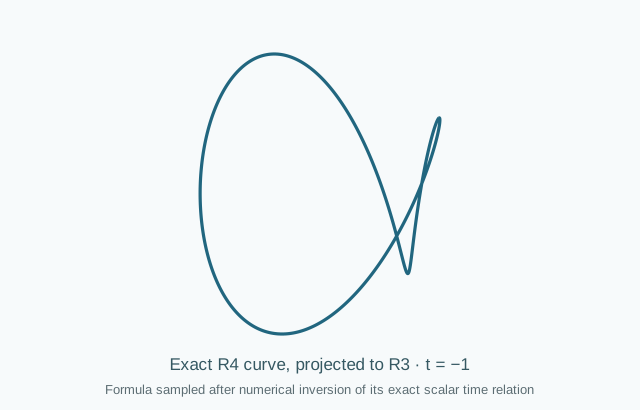
Frequencies (1,2). The time slider numerically inverts r²+r⁸=−2t in the exact formula; the viewing scale stays fixed. Apparent crossings may result from projection.
Exact R4 curve, projected to R3. Frequencies (1,2). The time slider numerically inverts r²+r⁸=−2t in the exact formula; the viewing scale stays fixed. Apparent crossings may result from projection. Open drawing · Numerical references and credits

Ambient space, topology, embeddedness and entropy

The chosen subfamily has k₁=1 and is embedded. A time supremum is not the exact entropy of every slice.

R4 frequencies (1,2) · Euclidean space ℝ⁴ · Embedded
Ambient space
Euclidean space ℝ⁴
Topology
Embedded circle S¹
Embeddedness
Embedded: The recorded subfamily has k₁ = 1, so its first two coordinates determine the circle parameter and every finite-time slice is embedded. Higher-multiplicity limits do not change this.
Compactness
Compact
Surface genus
Not a surface (a curve on a torus)
Topological ends
0 (compact)
Entropy
Proved bound or relation: For frequencies (1,2), λ(γₜ) ≤ 2√(2π/e) ≈ 3.04069; equality is the supremum over ancient time.
Gaussian area
Exact formula: F₀,₁(γₜ) = √π √D(t) e^(t/2), D = Σⱼ kⱼ² r^(2kⱼ²). Depends on the slice t < 0.
R4 frequencies (1,k), k ≥ 2 · Euclidean space ℝ⁴ · Embedded
Ambient space
Euclidean space ℝ⁴
Topology
Embedded circle S¹
Embeddedness
Embedded: The recorded subfamily has k₁ = 1, so its first two coordinates determine the circle parameter and every finite-time slice is embedded. Higher-multiplicity limits do not change this.
Compactness
Compact
Surface genus
Not a surface
Topological ends
0 (compact)
Entropy
Proved bound or relation: sup over t < 0 of λ(γₜ) = k_max √(2π/e); each slice is bounded by this. The value at a finite time is not recorded.
Gaussian area
Exact formula: F₀,₁(γₜ) = √π √D(t) e^(t/2), D = Σⱼ kⱼ² r^(2kⱼ²). Depends on the slice t < 0.
Higher-codimension torus curves · Euclidean dimension ≥ 5 · Embedded
Ambient space
Euclidean dimension ≥ 5
Topology
Embedded circle S¹ in ℝ²ᵐ, m ≥ 3
Embeddedness
Embedded: The recorded subfamily has k₁ = 1, so its first two coordinates determine the circle parameter and every finite-time slice is embedded. Higher-multiplicity limits do not change this.
Compactness
Compact
Surface genus
Not a surface
Topological ends
0 (compact)
Entropy
Proved bound or relation: sup over t < 0 of λ(γₜ) = k_max √(2π/e); each slice is bounded by this. The value at a finite time is not recorded.
Gaussian area
Exact formula: F₀,₁(γₜ) = √π √D(t) e^(t/2), D = Σⱼ kⱼ² r^(2kⱼ²). Depends on the slice t < 0.

Compare examples by these properties →

References on this page

  1. [SS19] Douglas Stryker and Ao Sun. Construction of high codimension ancient mean curvature flows. 2019. Citations use arXiv v2, September 5, 2019; downloaded PDF has 11 pages. Remark 1.3 acknowledges the earlier construction by Altschuler–Altschuler–Angenent–Wu. URL: https://arxiv.org/abs/1908.02688v2, arXiv:1908.02688, doi:10.48550/arXiv.1908.02688.All uses in this project ↩ 1 ↩ 2
  2. [AAAW13] Dylan J. Altschuler, Steven J. Altschuler, Sigurd B. Angenent, and Lani F. Wu. The zoo of solitons for curve shortening in ℝⁿ. Nonlinearity, 26(5):1189–1226, 2013. Citations use arXiv v1, July 17, 2012, 39 pages; Sections 1–8 reviewed for the curve-soliton expansion; downloaded PDF has a later typesetting date on its title page. URL: https://arxiv.org/abs/1207.4051v1, doi:10.1088/0951-7715/26/5/1189.All uses in this project ↩ 1
Cite this page

Comments

Comments are not enabled yet.