MCF-stack: Special Solutions of Mean Curvature Flow

§ 5.43 Lagrangian torus necks collapsing at infinite time0AE8973A4338

Earliest recorded reference: (first arXiv submission).

Paper credits and chronology

Paper credits are chronological and include every author of the cited papers. They identify sources, not exclusive discovery credit. Background-only citations do not determine the date of this example. A classical example may predate the references recorded here.

  1. Su–Tsai–Wood — 2024-01-04 (first arXiv submission).
0AE8973A4338 These compact flows live in a flat complex torus, which is kept in the Riemannian-ambient group.
2DFF070BC43F

(Immortal Lagrangian connected sums) Let $m\geq 3$ and let $X_1,X_2$ be special Lagrangian $m$-tori of the same phase in the flat Calabi–Yau torus $\mathbb C^ m/\Gamma $. Assume they intersect transversely at exactly one point, with tangent planes satisfying the Lawlor angle criterion (a type-one intersection). By [SuTsaiWood2026], the Main Theorem, Theorem 9.1, Proposition 9.5, and Corollary 9.6, a sufficiently small Lawlor-neck desingularization can be chosen to start a smooth embedded immortal Lagrangian flow $N_ t$.

After translating the initial time, take $t\geq 0$. Every finite-time slice is a compact complete proper embedded $m$-manifold of codimension $m$, with topology $\mathbb T^ m\mathbin {\# }\mathbb T^ m$ and no ends. As $t\to \infty $, the flow converges smoothly away from the intersection point to $X_1\cup X_2$. Its neck scale and curvature satisfy, for sufficiently large $t$,

\[ c\, t^{-1/(m-2)}\leq \varepsilon (t)\leq C\, t^{-1/(m-2)},\qquad \max _{N_ t}|A|=O(t^{1/(m-2)}). \]

Rescaling about the intersection point by $\varepsilon (t)^{-1}$ gives the Lawlor neck locally smoothly, and the curvature becomes unbounded. These are asymptotic estimates from a parabolic gluing construction, not an exact formula for $N_ t$. The singular limiting union does not make the regular slices nonembedded. No symmetry, uniqueness, or uniform mean-curvature decay is asserted. Euclidean Gaussian quantities are not assigned in this torus ambient space. For the illustration we choose equal characteristic angles $\pi /m$. Up to a common unitary rotation, the local Lawlor model from [SuTsaiWood2026], Section 2.3, has the exact profile

\[ \gamma _\varepsilon (s)=\varepsilon (1+is)^{1/m},\qquad L_\varepsilon =\{ \gamma _\varepsilon (s)\omega :s\in \mathbb R,\ \omega \in S^{m-1}\subset \mathbb R^ m\} , \]

using the principal root. Its waist radius is $\varepsilon $. Opposite points in the signed profile $\pm \gamma _\varepsilon $ represent the same spherical fiber; the full neck is connected. This local symmetry is a choice of model, not an assertion about the entire compact flow.

Equation (1.1) of the source gives $d(\varepsilon ^2)/dt=-c\varepsilon ^ m+o(\varepsilon ^ m)$, with $c>0$. Dropping the remainder yields the dimensionless illustration clock

\[ \frac{\varepsilon _{\rm model}(t)}{\varepsilon _0}=(1+\tau )^{-1/(m-2)},\qquad \tau =\frac c2(m-2)\varepsilon _0^{m-2}t\geq 0. \]

The time plate uses $m=3$ and one spatial scale; the separate magnified view divides lengths by the positive neck scale. At infinite time it displays the rescaled limit from Proposition 9.5. Dilating a minimal Lawlor neck alone does not solve MCF: the compact gluing and parabolic correction are essential and are not computed here.
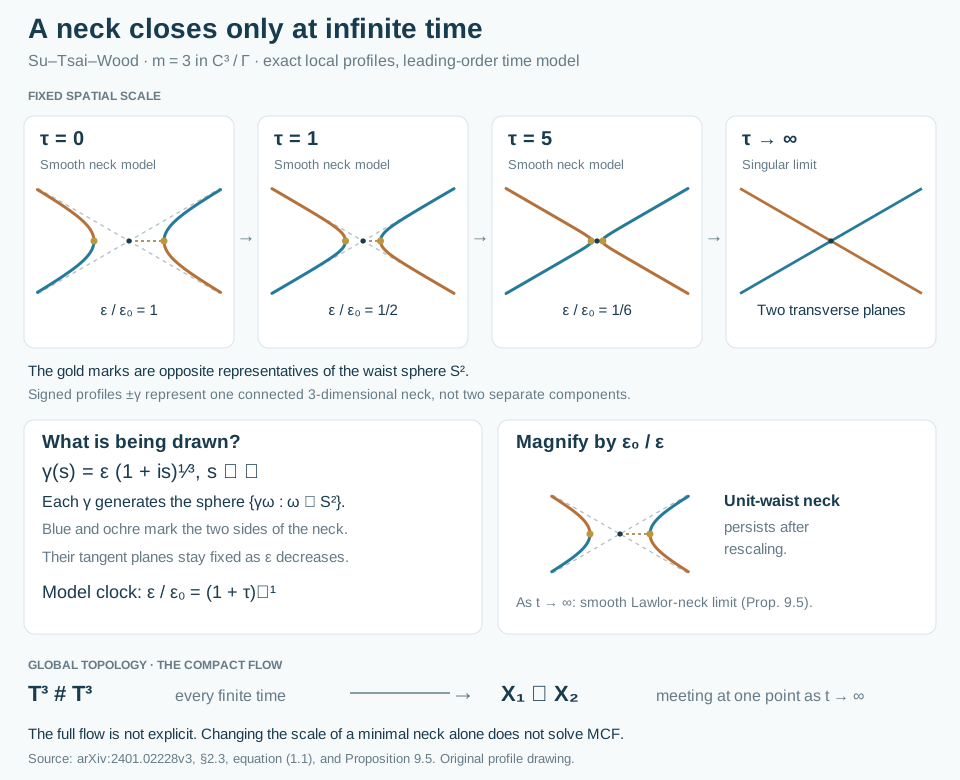
Four fixed-scale signed Lawlor profiles at model times τ = 0, 1, 5 and the infinite-time limit, together with a unit-waist magnified profile and the global connected-sum topology.
Exact local profiles; asymptotic time model. Compare model times, play the neck collapse, or change dimension. The equal-angle Lawlor profiles are exact; their dilation follows the leading-order scale law, not a computed mean curvature flow. The fixed spatial view approaches two transverse planes, while magnification retains a smooth neck. The compact flow lives in Cᵐ/Γ, m ≥ 3; the two profile branches represent the same connected neck. Open drawing shows four stages together. Open drawing · Numerical references and credits

Ambient space, topology, embeddedness and entropy

Dimensions, topology, and embeddedness refer to the stated full ambient geometry and regular slices. See the source hypotheses and illustration conventions on this page.

Lagrangian connected sum in Cᵐ/Γ, m ≥ 3 · Riemannian ambient manifold · Embedded
Ambient space
Riemannian ambient manifold
Topology
Tᵐ # Tᵐ for every finite-time slice
Embeddedness
Embedded: Finite-time slices are embedded; the transverse double point belongs only to the infinite-time limiting union.
Compactness
Compact
Surface genus
Dimension m ≥ 3; not a surface genus.
Topological ends
No ends (compact).
Entropy
Not applicable: Intrinsic mean curvature flow in a Riemannian ambient manifold; Euclidean Gaussian area and entropy are not assigned.
Gaussian area
Not applicable: Intrinsic mean curvature flow in a Riemannian ambient manifold; Euclidean Gaussian area and entropy are not assigned.

Compare examples by these properties →

References on this page

  1. [SuTsaiWood2026] Wei-Bo Su, Chung-Jun Tsai, and Albert Wood. Infinite-time singularities of the lagrangian mean curvature flow. 2026. Reviewed arXiv edition 2401.02228v3. Main Theorem (p. 4), Theorem 9.1, Proposition 9.5 and Corollary 9.6. m ≥ 3, flat complex torus, one transverse type-one intersection, neck scale and curvature rate. URL: https://arxiv.org/abs/2401.02228v3.All uses in this project ↩ 1 ↩ 2
Cite this page

Comments

Comments are not enabled yet.