MCF-stack: Special Solutions of Mean Curvature Flow

§ 5.42 Finite-time Lagrangian neck pinches with circle symmetry06177EF7798F

Earliest recorded reference: (first arXiv submission).

Paper credits and chronology

Paper credits are chronological and include every author of the cited papers. They identify sources, not exclusive discovery credit. Background-only citations do not determine the date of this example. A classical example may predate the references recorded here.

  1. Lotay–Oliveira — 2023-05-09 (first arXiv submission).
06177EF7798F
A25A9D4CCA2B

In an ALE or ALF hyperkähler four-manifold with a tri-Hamiltonian circle action, Lotay–Oliveira analyze the flow of embedded almost-calibrated circle-invariant Lagrangian surfaces. For compact surfaces, or the specified noncompact surfaces asymptotic to a pair of planes, finite-time singularities are neck pinches with the local models established in Theorem 1.1. Their examples guarantee such singularities under the geometric conditions of Section 4. Noncompact examples exist in the nontrivial Gibbons–Hawking settings described there; compact examples require the appropriate configuration of special Lagrangian spheres and phases. This is not a claim for every ambient manifold or every initial Lagrangian. For compact connected initial data, the flow can be continued through finitely many such singular times and converges to an $A_ k$-chain of embedded special Lagrangian spheres, with the precise current and phase conclusions of Theorem 1.4. A single smooth parameter manifold is not retained through a neck pinch. In the Gibbons–Hawking base, the surface is encoded by an arc and circle fibers; the evolution is a weighted curve-shortening equation. The diagram shows the arc approaching a center, the collapsing fiber and the separated chain after the pinch. It is a schematic of the proved mechanism, not a Euclidean surface of revolution asserted to solve the hyperkähler flow.

Sources: [LotayOliveira2023].
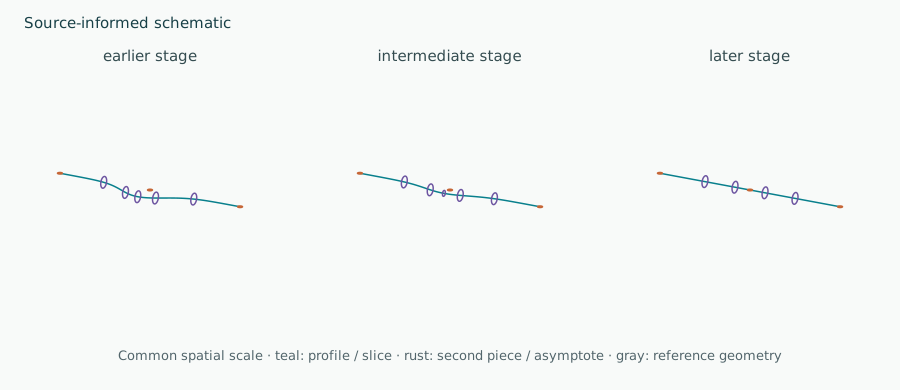
Finite-time Lagrangian neck pinches with circle symmetry. Gibbons–Hawking base arc and collapsing circle fiber at a center, followed by a chain. Three schematic stages distinguish the singular time from the regular slices.
Source-informed schematic. Gibbons–Hawking base arc and collapsing circle fiber at a center, followed by a chain. Three schematic stages distinguish the singular time from the regular slices. Open drawing · Numerical references and credits

Ambient space, topology, embeddedness and entropy

Source construction and dimension restrictions are stated on the reading page. Illustrations have their own accuracy labels.

Compact circle-invariant surfaces before a pinch · Riemannian ambient manifold · Embedded
Ambient space
Riemannian ambient manifold
Topology
Circle fibration over an arc; smooth connected compact case
Embeddedness
Embedded: The cited construction gives an embedding for this case.
Compactness
Compact
Surface genus
Genus zero.
Topological ends
No ends (compact parameter manifold).
Entropy
Not applicable: Euclidean Gaussian area and entropy are not assigned to this intrinsic curved-ambient flow.
Gaussian area
Not applicable: Euclidean Gaussian area and entropy are not assigned to this intrinsic curved-ambient flow.
Noncompact two-plane-asymptotic cases · Riemannian ambient manifold · Embedded
Ambient space
Riemannian ambient manifold
Topology
Circle-invariant surface with prescribed planar ends
Embeddedness
Embedded: The cited construction gives an embedding for this case.
Compactness
Noncompact
Surface genus
Not recorded.
Topological ends
Two topological ends.
Entropy
Not applicable: Euclidean Gaussian area and entropy are not assigned to this intrinsic curved-ambient flow.
Gaussian area
Not applicable: Euclidean Gaussian area and entropy are not assigned to this intrinsic curved-ambient flow.

Compare examples by these properties →

References on this page

  1. [LotayOliveira2023] Jason D. Lotay and Goncalo Oliveira. Neck pinch singularities and Joyce conjectures in Lagrangian mean curvature flow with circle symmetry. arXiv preprint, 2023. URL: https://arxiv.org/abs/2305.05744, arXiv:2305.05744.All uses in this project ↩ 1
Cite this page

Comments

Comments are not enabled yet.