1EF23C4EFFC0
(Helical curve-shortening flows) Fix $m\geq 1$ and integers $1\leq k_1<\cdots <k_ m$. Let $r(t)>0$, $t\in \mathbb R$, solve the exact implicit equation
The choice of constant makes $r(0)=1$. Then
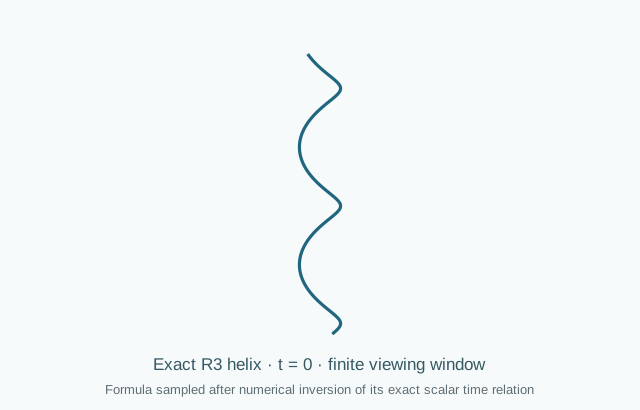
is an eternal curve-shortening flow in $\mathbb R^{2m+1}$. In the simplest case $m=1$, $k_1=1$, it is the three-dimensional helix
These are exact parametrizations with an implicitly determined time scale, not numerical ODE profiles. The ordinary differential equation is
The last coordinate makes every time slice a proper embedding of $\mathbb R$, and the induced metric is $(1+\sum _ jk_ j^2r^{2k_ j^2})ds^2$, so it is complete. It is noncompact with two ends and codimension $2m$, and it spans the stated ambient space. Simultaneous rotations together with translation along the last coordinate give its screw symmetry. Its radius decreases to zero as $t\to +\infty $, giving local smooth convergence to the axis, while $r(t)\to \infty $ as $t\to -\infty $. At any fixed finite time the ends continue winding; they are not asymptotic to the axis as $|s|\to \infty $.
Proposition 2.7 of [SS19] proves
This concerns the entire time family and does not say that every individual slice has infinite entropy. In fact, a direct calculation gives the exact fixed-time entropy below. Set $B=\sum _ jr^{2k_ j^2}$ and $D=\sum _ jk_ j^2r^{2k_ j^2}$. Direct Gaussian integration, using $|\Gamma _ t(s)|^2=B+s^2$, gives the exact centered value
For completeness, the same calculation at arbitrary Gaussian scale gives
Indeed, for a center $(a,z_0)\in \mathbb R^{2m}\times \mathbb R$, dropping the nonnegative squared distance in the first $2m$ coordinates bounds $F_{(a,z_0),\tau }$ by $(4\pi \tau )^{-1/2}\sqrt{1+D}\int _{\mathbb R}e^{-(s-z_0)^2/(4\tau )}\, ds=\sqrt{1+D}$. At the origin, $F_{0,\tau }=\sqrt{1+D}e^{-B/(4\tau )}$ tends to this upper bound as $\tau \to \infty $. Thus every finite-time helix has finite entropy, while the time supremum is infinite. This is a direct integration, additional to the cited time-supremum result.
Source: [SS19], equation (2.6), Propositions 2.6–2.7, and Theorem A.2, PDF pp. 6–7 and 9; see also [AAAW13], Section 3, PDF pp. 8–10. The interactive three-dimensional figure uses the simplest exact helix, with a time slider and the displayed range $-5\pi /2\leq s\leq 5\pi /2$. The family is eternal even though a display uses only finitely many turns.
Comments
Comments are not enabled yet.