MCF-stack: Special Solutions of Mean Curvature Flow

§ 5.26 Non-self-similar flows emerging from conesEA5C07CB7D0F

Earliest recorded reference: (first arXiv submission).

Paper credits and chronology

Paper credits are chronological and include every author of the cited papers. They identify sources, not exclusive discovery credit. Background-only citations do not determine the date of this example. A classical example may predate the references recorded here.

  1. Chen — 2022-12-21 (first arXiv submission).
EA5C07CB7D0F
AD7B9EFD3360

Let $\Sigma $ be a smooth asymptotically conical self-expander with positive finite Morse index for the expander functional, under the weighted decay hypotheses in Chen's Theorem 1.1. The source constructs an index-parameter family of solutions ancient in expander-rescaled time $s$, converging to $\Sigma $ as $s\to -\infty $. Their small graph functions lie in the source's weighted Hölder and spectral spaces; a generic chosen perturbation of an expander is not asserted to be ancient. With ordinary time $t=e^ s$, the associated MCF is $M_ t=\sqrt t\, \widetilde M_{\log t}$ on $0<t<T$ for a suitable $T>0$. It emerges from the same asymptotic cone at $t=0$ and need not be self-similar. Ordinary negative time is not part of this assertion, nor is global existence for all positive time. In the smooth graphical interval the slices retain the topology and embeddedness of the underlying embedded expander. The picture separates the limiting cone, an expander profile, and a small unstable-mode displacement. The displacement is a schematic mode, not a computed nonlinear flow or a universal growth rate.

Sources: [Chen2026].
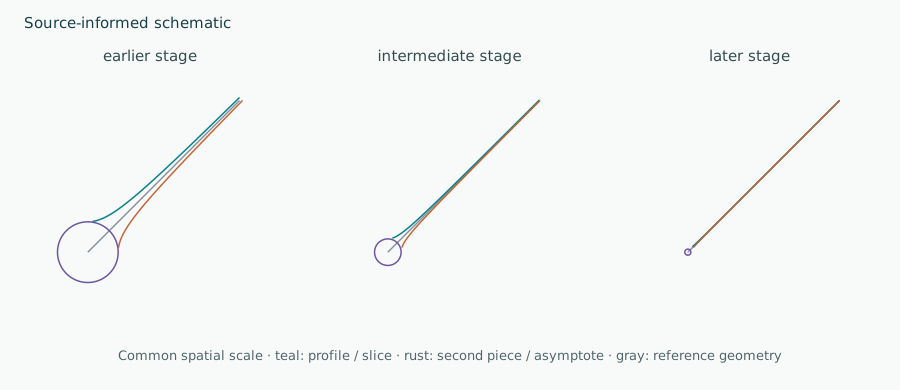
Non-self-similar flows emerging from cones. Ordinary positive time t = exp(s) is displayed alongside rescaled time. The cone is a limit; the mode amplitude is schematic and is not an exact MCF solution.
Source-informed schematic. Ordinary positive time t = exp(s) is displayed alongside rescaled time. The cone is a limit; the mode amplitude is schematic and is not an exact MCF solution. Open drawing · Numerical references and credits

Ambient space, topology, embeddedness and entropy

Source construction and dimension restrictions are stated on the reading page. Illustrations have their own accuracy labels.

Smooth embedded AC surface input, n = 2 · Euclidean space ℝ³ · Embedded
Ambient space
Euclidean space ℝ³
Topology
Topology inherited from the chosen expander
Embeddedness
Embedded: The cited construction gives an embedding for this case.
Compactness
Noncompact
Surface genus
Depends on the construction.
Topological ends
Depends on the input; asymptotic wings are not automatically topological ends.
Entropy
Not recorded: No quantitative conclusion is recorded from the cited construction.
Gaussian area
Not recorded: No quantitative conclusion is recorded from the cited construction.
Higher-dimensional smooth inputs · Euclidean space ℝ⁴; Euclidean dimension ≥ 5 · Embedded
Ambient space
Euclidean space ℝ⁴; Euclidean dimension ≥ 5
Topology
Topology inherited from the chosen expander
Embeddedness
Embedded: The cited construction gives an embedding for this case.
Compactness
Noncompact
Surface genus
Not a smooth surface; surface genus is inapplicable.
Topological ends
Depends on the input; asymptotic wings are not automatically topological ends.
Entropy
Not recorded: No quantitative conclusion is recorded from the cited construction.
Gaussian area
Not recorded: No quantitative conclusion is recorded from the cited construction.

Compare examples by these properties →

References on this page

  1. [Chen2026] Letian Chen. On the Existence and Uniqueness of Ancient Rescaled Mean Curvature Flows. Communications in Analysis and Geometry, pages 1–45, 2026. URL: https://arxiv.org/abs/2212.10798, arXiv:2212.10798, doi:10.4310/cag.260928092010.All uses in this project ↩ 1
Cite this page

Comments

Comments are not enabled yet.