MCF-stack: Special Solutions of Mean Curvature Flow

§ 5.18 Compact noncollapsed convex ancient ovals (Haslhofer–Hershkovits, 2013; Huisken–Sinestrari, 2014)12F33FD70B5C

Earliest recorded reference: (first arXiv submission).

Paper credits and chronology

Paper credits are chronological and include every author of the cited papers. They identify sources, not exclusive discovery credit. Background-only citations do not determine the date of this example. A classical example may predate the references recorded here.

  1. Haslhofer–Hershkovits — 2013-08-19 (first arXiv submission).
  2. Huisken–Sinestrari — 2014-05-29 (first arXiv submission). Background only: A general pinching rigidity theorem used to explain a limitation of the ancient ovals.
12F33FD70B5C
56D296501918

For $n\geq 2$ and every $1\leq j\leq n-1$, Haslhofer–Hershkovits construct an ancient hypersurface flow $M_ t\subset \mathbb R^{n+1}$, $-\infty <t<0$, with compact strictly convex embedded slices. Each slice is diffeomorphic to $S^ n$, hence complete and proper with no ends. The construction has $O(j+1)\times O(n-j)$ symmetry and is uniformly Andrews noncollapsed. It is not self-similar and becomes round at extinction.

Under backward parabolic blow-down,

\[ \lambda ^{-1}M_{\lambda ^2t}\longrightarrow S^ j(\sqrt{2j|t|})\times \mathbb R^{n-j}\quad (\lambda \to \infty ). \]

The tip rescalings selected in Claim 3.5 of [HH13] approach $\mathrm{Bowl}^{j+1}\times \mathbb R^{n-j-1}$, with the bowl normalized to unit tip curvature. Rescaled diameter is unbounded backward in time and curvature decay is type II. No closed formula or uniqueness follows from this construction. Gaussian area and entropy are finite for each compact slice; no fixed slice value is evaluated here.

Source: [HH13], Theorem 1.1 and Section 3. Huisken–Sinestrari's Theorem 3.2 in [HS14] shows why the hypothesis $h_{ij}\geq \varepsilon H g_{ij}$ with one $\varepsilon >0$ for all ancient times cannot hold for these nonspherical ovals: a closed convex ancient flow with that uniform pinching is a shrinking sphere.

The illustration specializes to $n=2$, $j=1$. It numerically evolves the boundary of the Minkowski sum of a unit ball and an ellipsoid with semiaxes $(8,1/2,1/2)$, using rotational mean curvature flow. This is a finite smooth convex seed inspired by the long capped cylinders in Section 3, not a closed formula for the ancient oval. Extinction is shifted to $t=0$, and parabolic scaling makes the axial-to-equatorial radius ratio equal to $2$ at $t=-1$. The slider samples $-1000\leq t\leq -0.001$.

Original size shows contraction at a fixed spatial scale. The default view shows $(-t)^{-1/2}M_ t$: the backward central limit is the cylinder of radius $\sqrt2$, while the extinction limit is the sphere of radius $2$. The right-tip view instead translates the tip to the origin and multiplies lengths by its mean curvature; the dashed comparison is a numerically integrated unit-speed bowl. These are different rescalings. Mesh refinement, time-tolerance refinement, and a shorter seed give consistent sampled profiles, but they do not certify an error to the ancient solution.
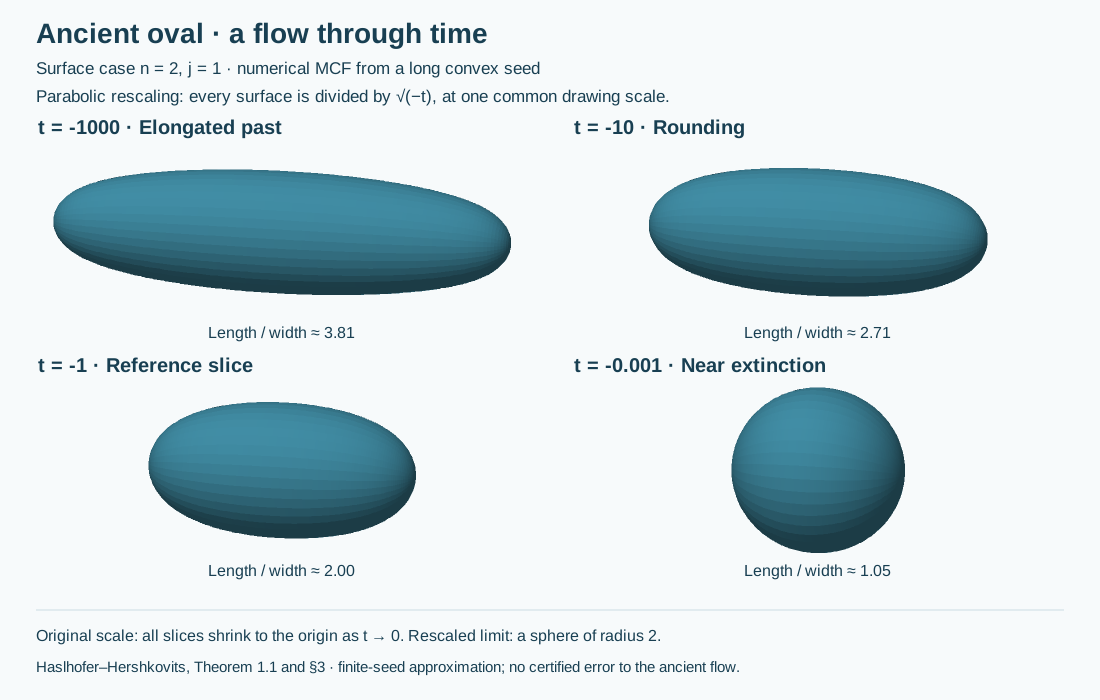
Four time slices of a numerical convex surface flow in three-space, from an elongated oval to an almost round sphere. Each is divided by square root of minus time at a common scale. Interactive time, rotation, zoom, meridian and bowl-tip comparisons.
Numerical PDE approximation. Surface case n = 2, j = 1: numerical rotational mean curvature flow from a long convex seed, following the limiting-construction strategy. Compare times, play the evolution, rotate, or inspect the meridian and the tip. The default view divides lengths by √(−t); Original size keeps the physical spatial scale fixed. Extinction is normalized to t = 0 and length/width = 2 at t = −1. These finite-seed computations are not certified slices of the ancient solution. Open drawing · Numerical references and credits

Ambient space, topology, embeddedness and entropy

The time-dependent illustration computes finite-seed rotational MCF for n = 2, j = 1. It is not certified ancient-flow data and does not supply Gaussian-area or entropy values. The properties below refer to the mathematical ancient flows.

Surface oval n = 2, j = 1 · Euclidean space ℝ³ · Embedded
Ambient space
Euclidean space ℝ³
Topology
Sphere S²
Embeddedness
Embedded: Embedded regular slices in the stated ambient space; schematic projections do not determine embeddedness.
Compactness
Compact
Surface genus
0
Topological ends
0 (compact)
Entropy
Finite; value not recorded: Finite for each smooth compact slice; no uniform value over ancient time is asserted.
Gaussian area
Finite; value not recorded: Finite for each smooth compact slice; no uniform value over ancient time is asserted.
Hypersurface ovals n ≥ 3, 1 ≤ j ≤ n−1 · Euclidean space ℝ⁴; Euclidean dimension ≥ 5 · Embedded
Ambient space
Euclidean space ℝ⁴; Euclidean dimension ≥ 5
Topology
Sphere Sⁿ
Embeddedness
Embedded: Embedded regular slices in the stated ambient space; schematic projections do not determine embeddedness.
Compactness
Compact
Surface genus
Not a surface
Topological ends
0 (compact)
Entropy
Finite; value not recorded: Finite for each smooth compact slice; no uniform value over ancient time is asserted.
Gaussian area
Finite; value not recorded: Finite for each smooth compact slice; no uniform value over ancient time is asserted.

Compare examples by these properties →

References on this page

  1. [HH13] Robert Haslhofer and Or Hershkovits. Ancient solutions of the mean curvature flow. 2013. arXiv:1308.4095v1. Selected theorem statements and construction passages checked November 6, 2026; proofs are cited, not independently verified. URL: https://arxiv.org/abs/1308.4095v1.All uses in this project ↩ 1 ↩ 2
  2. [HS14] Gerhard Huisken and Carlo Sinestrari. Convex ancient solutions of the mean curvature flow. 2014. arXiv:1405.7509v1. Selected theorem statements and construction passages checked November 6, 2026; proofs are cited, not independently verified. URL: https://arxiv.org/abs/1405.7509v1.All uses in this project ↩ 1
Cite this page

Comments

Comments are not enabled yet.