B7D6B1E7217F
Choose monotonically ordered heights $a_0<a_1<\cdots <a_ m$ and horizontal shifts $C_1,\ldots ,C_ m$. Angenent–You construct embedded eternal planar curve-shortening flows which for sufficiently negative time are assembled asymptotically from alternating grim reapers on consecutive strips. To record a definite nontrivial subfamily, take $m=3$. With $v_ k=\pi /(a_ k-a_{k-1})$, the separate asymptotic models are
This formula describes the model translators, not the glued eternal solution.
The actual flow is a graph $x=u(y,t)$ on $a_0<y<a_3$, exists for every $t\in \mathbb R$, and is complete, properly embedded and noncompact, with topology $\mathbb R$ and two ends asymptotic to the outer horizontal lines. The two-end and properness statements follow from this graphical description and the outer asymptotes. Curvature changes sign in the nontrivial chain; total absolute curvature is uniformly bounded. There is no closed formula for $u$; the classification and flow entropy are qualified below.
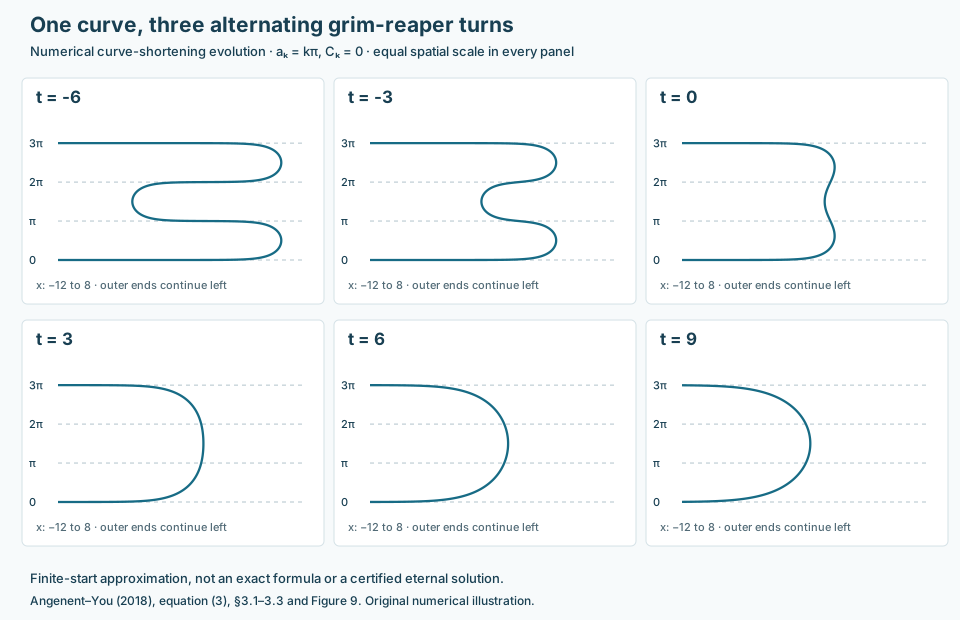
Source: [AY18], equation (3), Section 3.1 and Lemmas 3.8–3.10, pp. 2 and 8–13. The paper also constructs immersed ancient chains; those are not being labeled embedded by this selected case. The illustration uses $a_ k=k\pi $ and $C_ k=0$, so that the three model tips have horizontal velocities $-1,+1,-1$. It shows a numerical finite-start approximation: smoothly joined reapers at $t=-10$ are evolved by curve shortening, and slices from $t=-6$ to $t=9$ are displayed at the same spatial scale. The outer ends are truncated far outside the viewing window. The joins follow the construction in Section 3.2 and Figure 10, using the orientation of equation (3) and Figure 9. This computation is not a closed formula or a certified approximation of the eternal limit; the later shapes are numerical observations, not an additional asymptotic theorem. In particular, $t=0$ is not an extinction time.
The classification in [ChoiSeoSuZhao2026], Theorem 1.1, identifies graphical ancient trombones as the nonconvex embedded planar ancient flows with finite flow entropy, alongside the line, shrinking circle, paperclip and grim reaper. Here flow entropy means $\operatorname {Ent}[M]=\sup _ t\lambda (M_ t)<\infty $, not merely finite entropy of each slice. Corollary 1.5 records flow entropy $m+1$ for the $m$-reaper family; thus the selected $m=3$ case has flow entropy four. This does not identify the entropy or centered Gaussian area of an individual slice with four.
Comments
Comments are not enabled yet.