MCF-stack: Special Solutions of Mean Curvature Flow

§ 5.2 Purely rotating curve-shortening solitons (Halldórsson, 2010; Halldórsson, 2011; D. J. Altschuler–S. J. Altschuler–Angenent–Wu, 2012)3A1BA479B53D

Earliest recorded reference: (first arXiv submission).

Paper credits and chronology

Paper credits are chronological and include every author of the cited papers. They identify sources, not exclusive discovery credit. Background-only citations do not determine the date of this example. A classical example may predate the references recorded here.

  1. Halldórsson — 2010-07-09 (first arXiv submission).
  2. Halldórsson — 2011-06-22 (first arXiv submission).
  3. D. J. Altschuler–S. J. Altschuler–Angenent–Wu — 2012-07-17 (first arXiv submission).
3A1BA479B53D
999F58954ACB

Let $A$ be a nonzero skew-symmetric linear map on $\mathbb R^ n$, $n\geq 2$. For a unit vector $T$ write $P_ Tw=w-\langle w,T\rangle T$. Given $C(0)=p$ and $T(0)=q$ with $|q|=1$, solve

\[ C_ s=T,\qquad T_ s=P_ T(AC). \]

The solution is unique for these initial data and exists for every $s\in \mathbb R$: $|T|=1$ and $|C(s)|\leq |p|+|s|$ prevent finite-parameter blow-up. Thus it is a complete immersed curve of codimension $n-1$. Its associated eternal flow is

\[ X(s,t)=e^{tA}C(s),\qquad t\in \mathbb R, \qquad (X_ t)^\perp =X_{\ell \ell }, \]

where $\ell $ is arclength at time $t$. The exponential is an exact evolution law for the ODE-defined profile, not a closed formula for that profile. We exclude the stationary straight lines in $\ker A$.

Both ends satisfy $|C(s)|\to \infty $ as $s\to \pm \infty $; consequently the immersion is proper and noncompact, with domain $\mathbb R$ and two ends. Its distance from the origin has a unique minimum. In the plane, $A=\omega J$ with $J(x,y)=(-y,x)$ gives the rotating spiral family. The initial data $C(0)=0$, $T(0)=(1,0)$ give the usual centrally symmetric Yin–Yang example. A logarithmic spiral is not its exact profile; the purely rotating case has different far-field behavior from the expanding rotators in 5.3.

For $\mathbb R^3$, let $A(x,y,z)=\omega (-y,x,0)$, $\omega >0$. If $T_ z(0)\ne 0$, the identity

\[ z_ s(s)=z_ s(0)\exp \left(-\int _0^ s\langle AC,T\rangle \, d\sigma \right) \]

shows that $z$ is strictly monotone. The curve is therefore embedded and is a graph over an interval of the rotation axis. This interval can be bounded or a half-line; a finite endpoint is approached exponentially in arclength. If $T_ z(0)=0$, the curve stays in a plane perpendicular to that axis. More generally, the projection to $\ker A$ lies in a line, and any nonconstant such projection is injective. No blanket embeddedness assertion is made for profiles with constant kernel projection or for invertible $A$ in even dimensions.

Source: [AAAW13], Section 4.1, equation (27), Lemmas 5.4 and 6.3, PDF pp. 11–13, 15–20, and Section 7.1, p. 23. Initial-value uniqueness is not a uniqueness theorem for prescribed ends. No general curvature bound, stability theorem, or Gaussian-area or entropy value is recorded here. The figures integrate the profile equation with $\omega =1$: one spatial example has $p=(1,0,0)$, $q=(0,0,1)$; a second shows the planar Yin–Yang profile. Both are truncated numerical ODE curves with exact rotation in the time control. Planar classification (Halldórsson). Halldórsson classifies complete planar curves moving by Euclidean similarities in [Halldorsson2012]. The nontrivial motions are translation, dilation, rotation, or simultaneous rotation and dilation. The translator is the grim reaper (Example 3.1); the homothetic expanders are Example 4.3. The shrinking cases are linked from Example 2.11. A translation term in a motion with rotation or dilation can be absorbed by changing its center; see Section 2, PDF pp. 2–5.

Here is the common construction for the rotating families. Identify $\mathbb R^2$ with $\mathbb C$, fix $A\ne 0$, $B\in \mathbb R$, and use $T=e^{i\theta }$, $N=iT$, $\vec H=kN$. Solve globally in arclength

\[ u'=uv+A,\qquad v'=-u^2-B,\qquad \theta '=u,\qquad X=e^{i\theta }\frac{u+iv}{A-iB}. \]

Then $X'=T$, $k=u$, and $k=A\langle X,T\rangle +B\langle X,N\rangle $, equivalently $\vec H=(AiX+BX)^\perp $. The exact motion of this ODE-defined profile is

\[ X_ t=e^{iAt}X\quad (B=0),\qquad X_ t=\sqrt{1+2Bt}\, e^{\, iA\log (1+2Bt)/(2B)}X\quad (B\ne 0), \qquad 1+2Bt>0. \]

The time formula is explicit; the spatial profile generally is not.

For $B=0$ and fixed $A\ne 0$, Theorem 3.1 gives a one-parameter family, up to rotation, specified by the minimum distance $d\in [0,\infty )$ from the origin. One may take $X(0)=id$, $T(0)=1$, hence $(u(0),v(0))=(0,Ad)$. Every member is a complete properly embedded noncompact curve in $\mathbb R^2$, of codimension one and topology $\mathbb R$, with two ends. Each end winds infinitely often and escapes to infinity; its curvature tends to zero while its total absolute curvature is infinite. For $A>0$ the signed curvature changes sign once, so these curves are not globally convex. Reflection reverses $A$. The $d=0$ member is the centrally symmetric Yin–Yang soliton; other members need not have that symmetry. The evolution exists for all real time. The identity $|X|^2-2\theta /A=\text{constant}$ is exact, but is not a polar formula because $\theta $ is the tangent angle.

The product $X(\mathbb R)\times \mathbb R\subset \mathbb R^3$ is also an eternal rotating MCF solution, with the same angular speed. It is a complete properly embedded surface, of codimension one, genus zero, topology $\mathbb R^2$ and one end. Its principal curvatures are the planar curvature and zero. This product case is the $h=\infty $ case discussed in [Halldorsson2013], Section 4, PDF p. 7; it is not a finite-pitch helicoidal translator.

The classification and properness are in Theorem 3.1, Corollary 3.6 and Section 3, PDF pp. 5–7; Figures 8–9 supply visual references. No Gaussian-area value, entropy value, or flow-stability conclusion is recorded in these passages. The figure is a numerical finite arclength window of the ODE, with time and minimum-distance controls. The compact ancient curves in Example 5.10 are a different family.
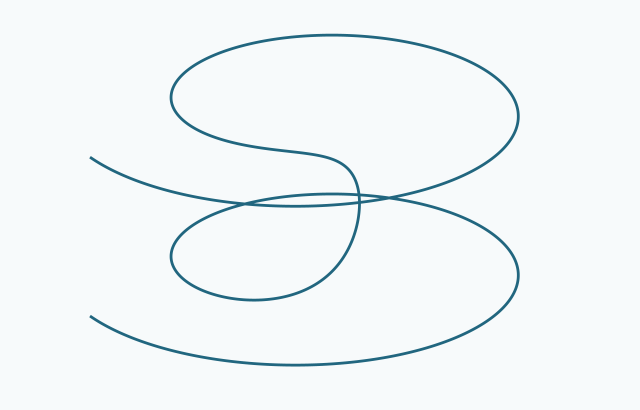
Purely rotating curve-shortening solitons. Spatial rotator with angular speed 1, C(0) = (1, 0, 0), T(0) = (0, 0, 1), and −24 ≤ s ≤ 24. The complete curve is embedded and proper by its monotone axial projection and escaping ends. The time control applies exact rigid rotation to this truncated numerical profile.
Numerical ODE curve. Spatial rotator with angular speed 1, C(0) = (1, 0, 0), T(0) = (0, 0, 1), and −24 ≤ s ≤ 24. The complete curve is embedded and proper by its monotone axial projection and escaping ends. The time control applies exact rigid rotation to this truncated numerical profile. Open drawing · Numerical references and credits

Numerical centrally symmetric planar Yin–Yang rotator, with two outward spiraling arms.
Numerical ODE curve. Planar Yin–Yang profile with C(0) = 0, T(0) = (1, 0), and angular speed 1; −24 ≤ s ≤ 24. Time applies exact rotation to a truncated numerical solution, not a logarithmic-spiral substitution. Open drawing · Numerical references and credits

Explore the planar Halldórsson classification

Numerical experiment. The spatial construction and finite-window limitations are stated beside the controls. The similarity time law is exact; numerical profiles are approximations.

Open full-page visualization ↗

Explore the interactive flow
Ambient space, topology, embeddedness and entropy

All profiles are complete proper curves with two ends. A nonzero kernel projection gives an embedding; the general even-dimensional case is not assigned that conclusion. Planar properties are sharpened by Halldórsson (2012); the spatial and higher-dimensional cases retain their own hypotheses.

Complete planar rotators, including Yin–Yang · Euclidean plane ℝ² · Embedded
Ambient space
Euclidean plane ℝ²
Topology
Noncompact line ℝ
Embeddedness
Embedded: Theorem 3.1 proves proper embeddedness for every minimum radius.
Compactness
Noncompact
Surface genus
Not a surface
Topological ends
2 intrinsic ends of the parameter manifold
Entropy
Not recorded: No value or bound recorded in the reviewed source passages; centered Gaussian area is not identified with entropy.
Gaussian area
Not recorded: No value or bound recorded in the reviewed source passages; centered Gaussian area is not identified with entropy.
Nonplanar rotators in R3 with nonzero axial tangent · Euclidean space ℝ³ · Embedded
Ambient space
Euclidean space ℝ³
Topology
Line R (immersed domain)
Embeddedness
Embedded: The axial coordinate is strictly monotone (Lemma 5.4), and both ends escape (Lemma 6.3): a proper embedding.
Compactness
Noncompact
Surface genus
Not a surface
Topological ends
Two ends of the parameter manifold R
Entropy
Not recorded: No entropy value or finiteness theorem is recorded for this general case.
Gaussian area
Not recorded: No centered Gaussian length value is recorded; it is not identified with entropy.
Rotators in R4 with invertible rotation map · Euclidean space ℝ⁴ · Not recorded
Ambient space
Euclidean space ℝ⁴
Topology
Line R (immersed domain)
Embeddedness
Not recorded: No general embeddedness theorem for the stated initial data is recorded in the reviewed source.
Compactness
Noncompact
Surface genus
Not a surface
Topological ends
Two ends of the parameter manifold R
Entropy
Not recorded: No entropy value or finiteness theorem is recorded for this general case.
Gaussian area
Not recorded: No centered Gaussian length value is recorded; it is not identified with entropy.
Rotators in R^n, n ≥ 5, with nonconstant kernel projection · Euclidean dimension ≥ 5 · Embedded
Ambient space
Euclidean dimension ≥ 5
Topology
Line R (immersed domain)
Embeddedness
Embedded: Projection onto a line in ker A is injective; properness follows from escaping ends.
Compactness
Noncompact
Surface genus
Not a surface
Topological ends
Two ends of the parameter manifold R
Entropy
Not recorded: No entropy value or finiteness theorem is recorded for this general case.
Gaussian area
Not recorded: No centered Gaussian length value is recorded; it is not identified with entropy.
Rotators in R^(2m), m ≥ 3, with invertible rotation map · Euclidean dimension ≥ 5 · Not recorded
Ambient space
Euclidean dimension ≥ 5
Topology
Line R (immersed domain)
Embeddedness
Not recorded: No general embeddedness theorem for the stated initial data is recorded in the reviewed source.
Compactness
Noncompact
Surface genus
Not a surface
Topological ends
Two ends of the parameter manifold R
Entropy
Not recorded: No entropy value or finiteness theorem is recorded for this general case.
Gaussian area
Not recorded: No centered Gaussian length value is recorded; it is not identified with entropy.
Rotating product surfaces · Euclidean space ℝ³ · Embedded
Ambient space
Euclidean space ℝ³
Topology
Plane ℝ² (curve × ℝ)
Embeddedness
Embedded: The product of a properly embedded rotating planar curve with ℝ is properly embedded.
Compactness
Noncompact
Surface genus
0
Topological ends
One end of the parameter plane
Entropy
Not recorded: No value or bound recorded in the reviewed source passages; centered Gaussian area is not identified with entropy.
Gaussian area
Not recorded: No value or bound recorded in the reviewed source passages; centered Gaussian area is not identified with entropy.

Compare examples by these properties →

References on this page

  1. [AAAW13] Dylan J. Altschuler, Steven J. Altschuler, Sigurd B. Angenent, and Lani F. Wu. The zoo of solitons for curve shortening in ℝⁿ. Nonlinearity, 26(5):1189–1226, 2013. Citations use arXiv v1, July 17, 2012, 39 pages; Sections 1–8 reviewed for the curve-soliton expansion; downloaded PDF has a later typesetting date on its title page. URL: https://arxiv.org/abs/1207.4051v1, doi:10.1088/0951-7715/26/5/1189.All uses in this project ↩ 1
  2. [Halldorsson2012] Höskuldur P. Halldórsson. Self-similar solutions to the curve shortening flow. Transactions of the American Mathematical Society, 364(10):5285–5309, 2012. URL: https://arxiv.org/abs/1007.1617v2, doi:10.1090/S0002-9947-2012-05632-7.All uses in this project ↩ 1
  3. [Halldorsson2013] Höskuldur P. Halldórsson. Helicoidal surfaces rotating/translating under the mean curvature flow. Geometriae Dedicata, 162:45–65, 2013. URL: https://arxiv.org/abs/1106.4583v3, doi:10.1007/s10711-012-9716-2.All uses in this project ↩ 1
Cite this page

Comments

Comments are not enabled yet.