1A2B6DF32B79
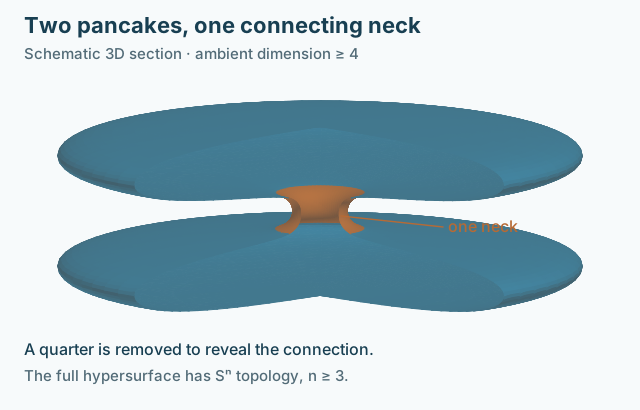
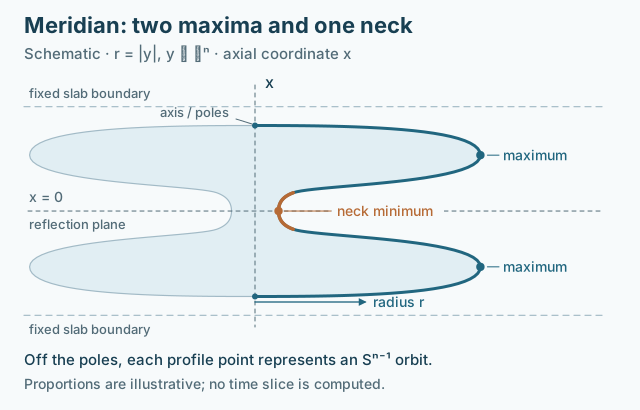
For each $n\geq 3$, Mramor–Yudowitz construct a smooth ancient flow of closed embedded hypersurfaces $M_ t^ n\subset \mathbb R^{n+1}$ for $t\in (-\infty ,0]$. The slices are nonconvex, contained in a fixed slab, and $O(n)\times O(1)$ invariant. Their rotational radius profile is a graph over the axis with two local maxima separated by one local minimum. Topologically this is two lobes joined by one neck, giving $S^ n$; compactness gives completeness, properness, and zero ends.
The endpoint $t=0$ is a regular chosen time, not an asserted extinction time. The theorem does not establish this construction for $n=2$, so the lowest ambient dimension is four. It also does not prove a precise backward decomposition into two separate ancient pancakes and a catenoid; the authors explicitly distinguish this motivation from their result. Existence uses a continuity and compactness argument. No closed formula, uniqueness, stability result, or uniform ancient entropy value is recorded. Each compact slice has finite entropy and Gaussian area.
Source: [MY26], Theorem 1.1, Figure 1, and Sections 2.2–3.1 of arXiv v3. To read the pictures, write a rotational slice as $(u(x,t)\omega ,x)$, where $\omega \in S^{n-1}$ and $a(t)<x<b(t)$ is the axial coordinate. The positive radius $u$ has two maxima and a central neck minimum; it vanishes at the two poles. The first picture shows a schematic three-dimensional linear section, with a removable display cutaway exposing the neck. The second shows the meridian and a fixed containing slab. These original drawings illustrate the geometry and symmetry, not a numerical time slice or a mean curvature flow in $\mathbb R^3$; their proportions are not asserted by the theorem.
Comments
Comments are not enabled yet.