23FC29A5131C
Fix $n\geq 2$, $\alpha >0$, and a nonzero skew-symmetric map $A$ on $\mathbb R^ n$. Solve the arclength initial-value problem
Here $P_ Tw=w-\langle w,T\rangle T$. Each point and unit tangent determine a unique solution on all of $\mathbb R$. It gives the flow
The spatial profile is defined by an ODE, while the displayed evolution law is exact. With $\alpha =1/2$, the profile is normalized at $t=0$ and the initial singular time is $t=-1$; shifting time by one puts its interval at positive times. Its curvature vector is $(C/2+AC)^\perp $, so in general this is not a pure self-expander satisfying $\mathbf H=C^\perp /2$.
These are complete proper noncompact immersed curves, of codimension $n-1$, with parameter manifold $\mathbb R$ and two ends. Their distance from the origin has exactly one minimum and tends to infinity on both ends. Orient either end outward and define $d\sigma /ds=|a|^{-1}$, where $a=(\alpha I+A)C$. For some nonzero vector $\Gamma $ depending on the end,
Thus each end is asymptotic to a generalized logarithmic spiral, with a decaying positional error. If its $\Gamma $ lies in $\ker A$, the comparison curve is a ray. This is an asymptotic formula, not an exact parametrization of the soliton. The curvature on these ends is $O(|C|^{-1})$, by the bounded quantity $|a|^2|C_{ss}|^2$ in the low-curvature region of the source proof.
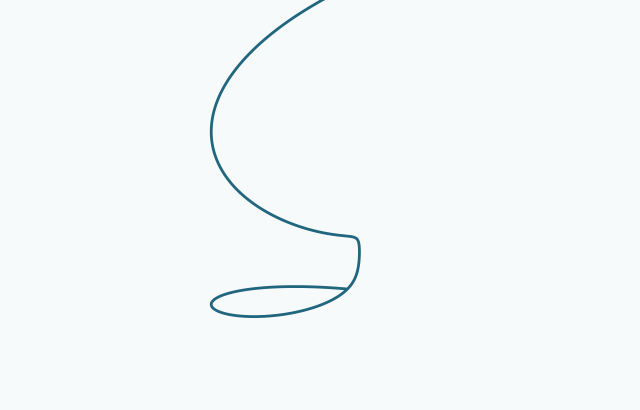
For the recorded mixed family require $P_ T(AC)$ not to vanish identically. The general construction is available in every $n\geq 2$. In dimensions at least three, embeddedness is not asserted for arbitrary initial data; the planar case is classified below. No uniqueness for a prescribed pair of asymptotic spirals is claimed. Pure dilation ($A=0$) reduces to planar corner smoothings already recorded in 4.3; those are not added again here. Source: [AAAW13], Section 4.2, Lemma 6.3, and Lemmas 7.6–7.7, PDF pp. 12–13, 19–20, and 28–30. No stability or entropy theorem is supplied by these passages. The numerical spatial illustration uses $\alpha =1/2$, $A(x,y,z)=(-y,x,0)$, $C(0)=(1,0,0)$, and $T(0)=(0,0,1)$, with a finite arclength window. Planar classification (Halldórsson). Let $A\ne 0$ and $B>0$ in the arclength system and exact time evolution of Example 5.2. For each fixed pair $(A,B)$, there is a one-parameter family, up to rotation, indexed by its minimum radius $d\geq 0$. Initial data $X(0)=id$, $T(0)=1$ give $(u(0),v(0))=(Bd,Ad)$. Positive dilation of the profile rescales both $A$ and $B$ by the inverse square of that dilation; after fixing a scale, the ratio of the two rates and the minimum radius give the two parameters in the source's description.
These are smooth complete properly embedded noncompact curves in $\mathbb R^2$, of dimension one and codimension one, with domain $\mathbb R$ and two ends. Both ends wind infinitely often around the center and tend to spatial infinity. The curvature vanishes at infinity but each end has infinite total absolute curvature. The signed curvature changes sign once; these are not convex curves. The $d=0$ member is centrally symmetric. With $r=|X|$, the source's precise directional asymptotic is
Thus the ends have the limiting direction of logarithmic spirals; this does not identify them with exact logarithmic spirals.
Their maximal similarity time interval containing zero is $-1/(2B)<t<\infty $, with scale $\sqrt{1+2Bt}$ and rotation angle $A\log (1+2Bt)/(2B)$. Recentring time at $-1/(2B)$ makes this an expanding flow for positive time. Because $A\ne 0$, it is not a homothetic self-expander satisfying $\vec H=X^\perp /2$, so it belongs to Other special flows. The spatial curves are ODE constructions, with uniqueness within the fixed-rate, fixed-minimum-distance classification up to rotation. Source: [Halldorsson2012], Theorem 3.1 and Corollary 3.11, PDF pp. 5–7, Figures 10–11. No Gaussian-area value, entropy value or flow-stability result is recorded there. The drawing integrates the ODE numerically and applies the exact similarity motion to the truncated profile.
Comments
Comments are not enabled yet.