MCF-stack: Special Solutions of Mean Curvature Flow

§ 5.4 Rotating and shrinking curve solitons (Halldórsson, 2010; D. J. Altschuler–S. J. Altschuler–Angenent–Wu, 2012)3C52DD1F2A4E

Earliest recorded reference: (first arXiv submission).

Paper credits and chronology

Paper credits are chronological and include every author of the cited papers. They identify sources, not exclusive discovery credit. Background-only citations do not determine the date of this example. A classical example may predate the references recorded here.

  1. Halldórsson — 2010-07-09 (first arXiv submission).
  2. D. J. Altschuler–S. J. Altschuler–Angenent–Wu — 2012-07-17 (first arXiv submission).
3C52DD1F2A4E
EF429B51A962

Let $n\geq 2$, $\alpha <0$, and $A\ne 0$ be skew-symmetric. The complete arclength profiles satisfy

\[ C_ s=T,\qquad T_ s=P_ T((\alpha I+A)C),\qquad |T|=1, \qquad P_ Tw=w-\langle w,T\rangle T. \]

For each initial point and unit tangent the ODE has a unique solution on $\mathbb R$, and its exact time evolution is

\[ X(s,t)=\sqrt{1+2\alpha t}\, \exp \left(\frac{\log (1+2\alpha t)}{2\alpha }A\right)C(s), \qquad t<-\frac1{2\alpha }. \]

We restrict to genuinely rotating profiles, meaning $P_ T(AC)$ is not identically zero. This removes the invariant shrinking circles and the nonrotating Abresch–Langer curves in $\ker A$. With $\alpha =-1/2$ the extinction time is $1$ and the equation is $\mathbf H=(-C/2+AC)^\perp $, not the pure shrinker equation. The profiles have dimension one and codimension $n-1$; no closed formula is claimed.

The quantity

\[ V(s)=e^{\alpha |C(s)|^2/2}\langle T,AC\rangle , \qquad V_ s=e^{\alpha |C|^2/2}|P_ T(AC)|^2 \]

is bounded and strictly increasing along a genuinely rotating solution. Its limits $V_-<V_+$ therefore exist, and at least one is nonzero. If $V_+\ne 0$, the forward limit set consists of invariant circles of radius $(-\alpha )^{-1/2}$ in one rotation-frequency eigenspace. If that eigenspace is two-dimensional, there is only one such circle and the end is asymptotic to it. The corresponding statement holds for the backward end. In particular, when all nonzero rotation frequencies are simple and $V_-<0<V_+$, both ends are asymptotic to circles, possibly in different eigenspaces. No unspecified meaning of “generic” is needed for this conditional statement.

At least one end has infinite arclength in a bounded region. Thus these profiles are nonproper complete immersions with noncompact parameter manifold $\mathbb R$ and two intrinsic ends; an end limiting to a circle is not a compact component. They have infinite centered Gaussian length and infinite entropy, since the Gaussian weight has a positive lower bound on a bounded tail. This direct observation concerns parametrized length, not the length of the limiting circle. Embeddedness of the full general family is not determined by a projection or by its end limits.

A concrete bounded spatial subfamily is obtained by taking $\alpha =-1/2$, $A(x,y,z)=\omega (-y,x,0)$, $\omega >0$, and initial data

\[ C(0)=(\sqrt2,0,0),\qquad T(0)=(0,0,1). \]

The whole curve stays on the sphere $|C|=\sqrt2$ because its initial tangent is tangent to that sphere. Here $V(0)=0$ and $V_ s(0)>0$, so both ends limit to the equatorial circle, with opposite orientations. It is not a closed curve or a homothetically shrinking circle. Under the time and radius change in [AAAW13], Lemma 3.2, it corresponds to intrinsic curve shortening by rotation on the unit sphere; the Euclidean flow catalogued here remains in $\mathbb R^3$. The same tangent-sphere construction works in $\mathbb R^ n$ for $n\geq 3$ with nontrivial tangential rotation.

There are also unbounded spiral ends. Put $a=(\alpha I+A)C$, $\mu =\langle a/|a|,T\rangle $, and $\nu =|a|^4(1-\mu ^2)$. For sufficiently large $K$ depending on $\alpha ,A$, Lemma 7.8 constructs initial tangents at sufficiently distant points for which the forward orbit remains in

\[ |a|\geq K,\qquad \nu \leq K,\qquad \mu <0. \]

Such an end satisfies, with $d\sigma /ds=|a|^{-1}$,

\[ C(\sigma )=e^{-\sigma (\alpha I+A)}\Gamma +O(e^{\alpha \sigma }), \qquad \Gamma \ne 0. \]

Choosing the initial point in the rotation range away from the kernel gives genuinely rotating examples. This is a topological shooting existence result, not a closed formula or a guarantee that a generic numerical initial tangent produces that end. The kernel-accumulation scenarios discussed at the end of the paper remain unresolved there and are not claimed as additional constructed examples.

Source: [AAAW13], Sections 4.2 and 6.3, Lemmas 7.7–7.8 and 8.1–8.5, PDF pp. 12–13, 22, 28–39. The illustrations integrate one nonspherical spatial initial-value problem and the stated spherical problem, with $\omega =1$. Both show finite windows, not certified asymptotic computations. No classification of embeddedness, uniqueness for end data, or dynamical stability is asserted. Planar classification (Halldórsson). Take $A\ne 0$, $B<0$ in the arclength system of Example 5.2. Exclude the circle of radius $R=1/\sqrt{-B}$, whose rotation changes only its parametrization. Theorem 4.1 of [Halldorsson2012], PDF pp. 8–11, distinguishes two types:

  • A one-parameter family of bounded curves with both intrinsic ends accumulating on the circle $|X|=R$. For fixed $A,B$, these are obtained by $(u(0),v(0))=(0,v_0)$ with $v_0\in \mathbb R$, up to rotation and the orientation redundancies of the ODE. The signed curvature changes sign once. The $v_0=0$ profile is centrally symmetric.

  • At least one comet spiral for each $A,B$. Its curvature has a constant strict sign. One end winds onto $|X|=R$ and the other winds out to infinity, with curvature tending to zero and infinite total absolute curvature. Along the outward end, the limiting unit direction relative to position is $(-B-iA)/\sqrt{A^2+B^2}$. The source proves existence, not uniqueness of the comet spiral.

In both cases the domain is $\mathbb R$: these are smooth complete, noncompact immersed curves of codimension one in $\mathbb R^2$, with two intrinsic ends. They are nonproper because a whole infinite-length end accumulates on a finite circle. Bounded image does not mean compact domain. The source notes self-intersecting members but does not give a complete embeddedness criterion. In particular, the questions and tentative captions in Figures 12–17 are not embeddedness proofs. Constant-sign curvature of a comet is local convexity, not a claim that it bounds an embedded convex set.

The exact motion of the ODE-defined profile is

\[ X_ t=\sqrt{1+2Bt}\, e^{\, iA\log (1+2Bt)/(2B)}X, \qquad -\infty <t<T=-1/(2B). \]

The bounded profiles collapse to the origin at $T$; the unbounded comet profiles are not compact extinction examples. Rotation is nonvacuous, so these are not homothetic shrinkers. A circular end contains infinite arclength in a compact region. Consequently every centered Gaussian integral and entropy is infinite at every regular time, when measured on the immersed domain. This is a direct consequence of the stated asymptotics, not a separate entropy theorem in the source.

For a transverse loop with interior angle $\eta \in (0,2\pi )$, Section 4 gives its time-zero enclosed area as $-(\pi +\eta )/(2B)$, larger than half the area of the limiting circle. The phase-plane sink used in the proof is an ODE statement; it does not assert stability under general curve-shortening perturbations. The illustrations are numerical ODE windows, with the dashed circle marking an asymptotic set rather than an additional component.
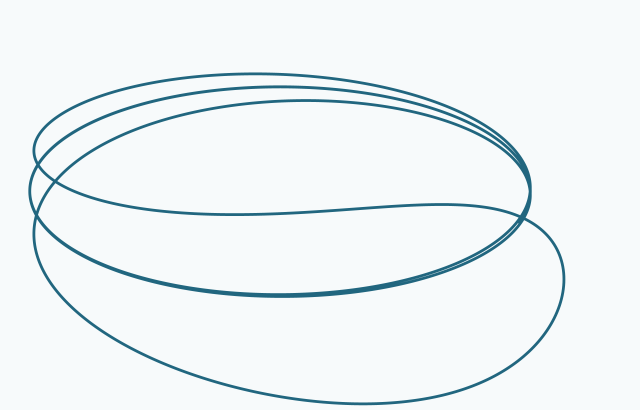
Rotating and shrinking curve solitons. Dilation coefficient α = −1/2 and angular coefficient ω = 1, with C(0) = (2, 0, 0), T(0) = (0, 0, 1), and −18 ≤ s ≤ 18. The finite ODE segment illustrates a nonspherical profile. Time t < 1 follows the exact rotation–dilation law. Neither finite sampling nor projected overlaps certify asymptotic behavior or embeddedness.
Numerical ODE curve. Dilation coefficient α = −1/2 and angular coefficient ω = 1, with C(0) = (2, 0, 0), T(0) = (0, 0, 1), and −18 ≤ s ≤ 18. The finite ODE segment illustrates a nonspherical profile. Time t < 1 follows the exact rotation–dilation law. Neither finite sampling nor projected overlaps certify asymptotic behavior or embeddedness. Open drawing · Numerical references and credits

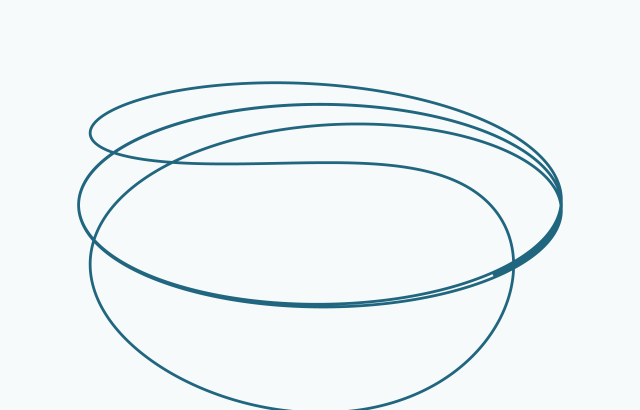
Numerical rotating and shrinking spatial curve on a sphere, approaching its equator from two sides.
Numerical ODE curve on an exact sphere. Tangent-sphere initial data C(0) = (√2, 0, 0), T(0) = (0, 0, 1), with α = −1/2 and ω = 1. The exact solution lies on the radius-√2 sphere at t = 0; the displayed numerical interval is −18 ≤ s ≤ 18. The two infinite ends accumulate on the equator. This is a noncompact immersed domain, not a closed curve. Open drawing · Numerical references and credits

Explore the planar Halldórsson classification

Numerical experiment. The spatial construction and finite-window limitations are stated beside the controls. The similarity time law is exact; numerical profiles are approximations.

Open full-page visualization ↗

Explore the interactive flow
Ambient space, topology, embeddedness and entropy

α < 0, P_T(AC) not identically zero. All recorded domains are complete, noncompact and nonproper; bounded image does not mean compact domain. The spherical subfamily is Euclidean flow, not a separate curved-ambient entry. End convergence to a single circle requires a two-dimensional frequency eigenspace. Unresolved kernel-limit scenarios are not existence claims. Planar properties are sharpened by Halldórsson (2012); the spatial and higher-dimensional cases retain their own hypotheses.

Bounded two-circular-end profiles · Euclidean plane ℝ² · Not recorded
Ambient space
Euclidean plane ℝ²
Topology
Noncompact line ℝ
Embeddedness
Not recorded: The source records self-intersecting members but no complete embeddedness classification; tentative figure captions do not prove embeddedness.
Compactness
Noncompact
Surface genus
Not a surface
Topological ends
2 intrinsic ends of the parameter manifold
Entropy
Exact formula: ∞ at every regular time, with arclength counted on the immersion: infinite length in a compact region makes every Gaussian integral diverge.
Gaussian area
Exact formula: ∞ at every regular time, with arclength counted on the immersion: infinite length in a compact region makes every Gaussian integral diverge.
Comet spirals · Euclidean plane ℝ² · Not recorded
Ambient space
Euclidean plane ℝ²
Topology
Noncompact line ℝ
Embeddedness
Not recorded: Existence is proved; uniqueness and a complete embeddedness criterion are not supplied. Some figures show crossings and others ask whether the curve is embedded.
Compactness
Noncompact
Surface genus
Not a surface
Topological ends
2 intrinsic ends of the parameter manifold
Entropy
Exact formula: ∞ at every regular time, with arclength counted on the immersion: infinite length in a compact region makes every Gaussian integral diverge.
Gaussian area
Exact formula: ∞ at every regular time, with arclength counted on the immersion: infinite length in a compact region makes every Gaussian integral diverge.
Genuinely rotating shrinking curves in R3 · Euclidean space ℝ³ · Not recorded
Ambient space
Euclidean space ℝ³
Topology
Line R (immersed domain)
Embeddedness
Not recorded: No general embeddedness theorem for the stated initial data is recorded in the reviewed source.
Compactness
Noncompact
Surface genus
Not a surface
Topological ends
Two intrinsic ends; at least one accumulates in a bounded region
Entropy
Exact formula: λ = +∞: already every positive-scale Gaussian integral diverges on a bounded infinite-length tail.
Gaussian area
Exact formula: F₀,₁ = +∞: infinite arclength in a bounded region (direct calculation).
Tangent-sphere rotating curves in R3 · Euclidean space ℝ³ · Not recorded
Ambient space
Euclidean space ℝ³
Topology
Line R (immersed domain)
Embeddedness
Not recorded: No general embeddedness theorem for the stated initial data is recorded in the reviewed source.
Compactness
Noncompact
Surface genus
Not a surface
Topological ends
Two intrinsic ends asymptotic to the equator, with opposite orientations
Entropy
Exact formula: λ = +∞: already every positive-scale Gaussian integral diverges on a bounded infinite-length tail.
Gaussian area
Exact formula: F₀,₁ = +∞: infinite arclength in a bounded region (direct calculation).
Genuinely rotating shrinking curves in R4 · Euclidean space ℝ⁴ · Not recorded
Ambient space
Euclidean space ℝ⁴
Topology
Line R (immersed domain)
Embeddedness
Not recorded: No general embeddedness theorem for the stated initial data is recorded in the reviewed source.
Compactness
Noncompact
Surface genus
Not a surface
Topological ends
Two ends of the parameter manifold R
Entropy
Exact formula: λ = +∞: already every positive-scale Gaussian integral diverges on a bounded infinite-length tail.
Gaussian area
Exact formula: F₀,₁ = +∞: infinite arclength in a bounded region (direct calculation).
Genuinely rotating shrinking curves in R^n, n ≥ 5 · Euclidean dimension ≥ 5 · Not recorded
Ambient space
Euclidean dimension ≥ 5
Topology
Line R (immersed domain)
Embeddedness
Not recorded: No general embeddedness theorem for the stated initial data is recorded in the reviewed source.
Compactness
Noncompact
Surface genus
Not a surface
Topological ends
Two ends of the parameter manifold R
Entropy
Exact formula: λ = +∞: already every positive-scale Gaussian integral diverges on a bounded infinite-length tail.
Gaussian area
Exact formula: F₀,₁ = +∞: infinite arclength in a bounded region (direct calculation).

Compare examples by these properties →

References on this page

  1. [AAAW13] Dylan J. Altschuler, Steven J. Altschuler, Sigurd B. Angenent, and Lani F. Wu. The zoo of solitons for curve shortening in ℝⁿ. Nonlinearity, 26(5):1189–1226, 2013. Citations use arXiv v1, July 17, 2012, 39 pages; Sections 1–8 reviewed for the curve-soliton expansion; downloaded PDF has a later typesetting date on its title page. URL: https://arxiv.org/abs/1207.4051v1, doi:10.1088/0951-7715/26/5/1189.All uses in this project ↩ 1 ↩ 2
  2. [Halldorsson2012] Höskuldur P. Halldórsson. Self-similar solutions to the curve shortening flow. Transactions of the American Mathematical Society, 364(10):5285–5309, 2012. URL: https://arxiv.org/abs/1007.1617v2, doi:10.1090/S0002-9947-2012-05632-7.All uses in this project ↩ 1
Cite this page

Comments

Comments are not enabled yet.