A50018836027
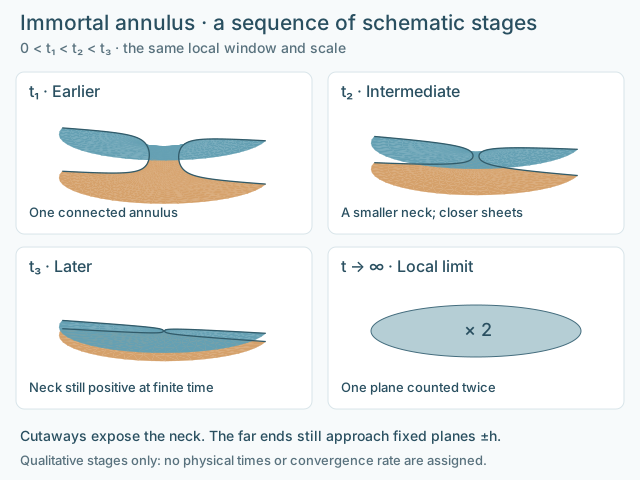
(Chen–Sun's noncompact multiplicity-two limit) Chen and Sun construct a nonstatic immortal mean curvature flow $M_ t\subset \mathbb R^3$, $t\in [0,\infty )$, smooth for $t>0$, of connected embedded rotational surfaces. It is also symmetric across the limiting plane. Each positive-time slice consists of two increasing radial graphs joined smoothly at a neck of radius $a(t)>0$:
This is a description of the constructed PDE solution, not an explicit formula for $f$. Away from the neck its upper graph satisfies
Near the neck, the inverse graph $\rho =u(z,t)$ instead satisfies
The proof selects a critical initial surface by interpolation among rotational surfaces in finite cylinders and then takes a limit as the cylinder radius tends to infinity. Its initial trace is locally Lipschitz; choosing any positive time as the initial time gives an entirely smooth immortal flow. No closed formula, canonical parameter value, or uniqueness of the constructed critical flow is supplied.
The two graphical ends and the smooth connecting neck give topology $S^1\times \mathbb R$: genus zero and two ends. Properness follows from the graphs escaping to infinite radius; the smooth connected surface is complete. It remains in a fixed slab, and the two ends stay asymptotic to their original parallel planes. The neck radius tends to zero only as $t\to \infty $. On compact regions the flow converges to the middle plane with multiplicity two; the two sheets converge smoothly away from the origin. The convergence is not uniform over the entire noncompact surface. This is an infinite-time limit of the unrescaled flow, not a multiplicity-two finite-time tangent flow of a closed embedded surface.
Source: [CS26R3], Theorems 1.1 and 4.13, Section 1.1, equation (2.5), Proposition 4.6 and Remark 4.7, and Appendix A, arXiv v3 PDF pp. 1, 3, 6, 23–24, and 27–28. The topology and properness statements above are direct consequences of the source's two-graph parametrization. The paper gives no exact entropy or fixed-center Gaussian-area value for this constructed family. The interactive picture compares ordered finite-time stages and a separate infinite-time limit at a fixed viewing scale. A cutaway exposes the connecting neck; the compressed radial profile records the fixed far-end heights. The illustrated shapes and stage spacing are schematic, not computed critical PDE time slices or an asserted convergence rate.
Comments
Comments are not enabled yet.