325F4A3220BC
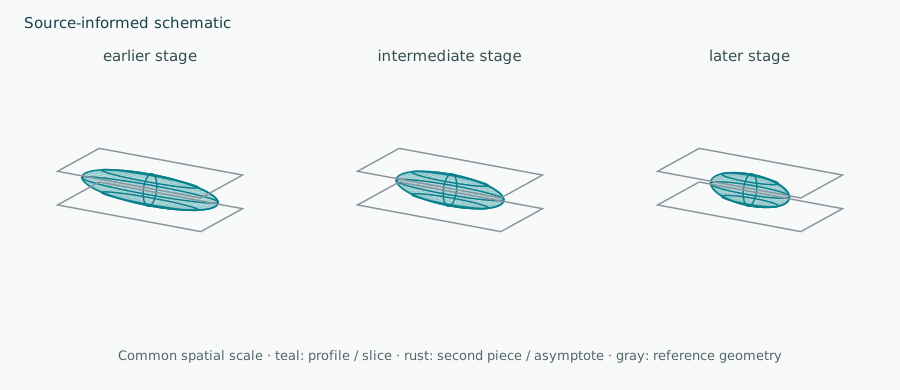
For each $n\ge 2$, Bourni–Langford–Tinaglia construct a compact strictly convex ancient hypersurface in $\mathbb R^{n+1}$ invariant under $O(1)\times O(n)$, contained in a slab of width $\pi $ and in no smaller slab. The smooth flow exists for $t<0$ and becomes extinct at the origin at $t=0$, after normalization. Each slice has topology $S^ n$ and is embedded, complete and proper. Backward in time, the two large faces approach the boundary hyperplanes of the slab, while appropriately translated edge regions approach grim hyperplanes. These are collapsed ancient solutions, distinct from the noncollapsed ancient ovals and from nonconvex stacked pancakes. The source constructs them by flowing rotated Angenent ovals and passing to a limit. Rotating a planar Angenent oval is not itself an exact higher-dimensional ancient solution. The picture therefore labels its rounded pancake profiles as schematics and marks the fixed slab walls and grim edge regions; it does not claim to compute the ancient limit. Compactness gives finite entropy at every fixed time, with no value asserted here.
Sources: [BourniLangfordTinaglia2017].
Comments
Comments are not enabled yet.