2CB973E94410
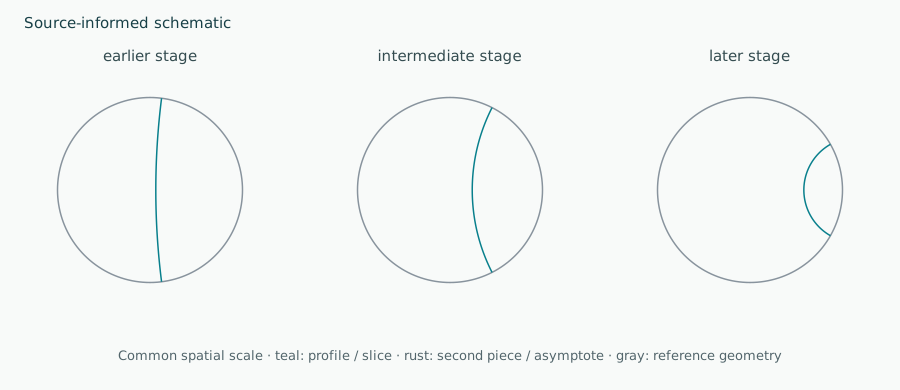
There is a convex ancient free-boundary curve-shortening flow in the unit disk, and corresponding rotational convex ancient hypersurface flows in the unit ball $B^{n+1}$, meeting the fixed boundary sphere orthogonally. The backward limit is an equatorial disk; forward the solution contracts to a point on the boundary sphere. The uniqueness statements of Bourni–Langford are within the convex ancient classes and normalizations of their theorems, not for all free-boundary ancient flows. The slices are compact embedded disks, smooth up to their moving boundary. Their boundary is constrained to the unit sphere, unlike a freely shrinking boundary under homothety. The maximal interval is ancient with a finite forward endpoint. For $n=1$ the topology is an interval; for $n=2$ it is a disk of genus zero. These are manifolds with boundary, so completeness means completeness as compact metric spaces, not geodesic completeness without boundary. The figure keeps the unit ball fixed and shows orthogonal contact in a meridian. Its circular-arc interpolation enforces contact geometry but is not asserted to solve the ancient PDE.
Sources: [BourniLangford2023, BourniLangford2025].
Comments
Comments are not enabled yet.