MCF-stack: Special Solutions of Mean Curvature Flow

§ 5.13 Minimal surfaces as stationary mean curvature flows (Chopp, 1993; Mantegazza, 2011)C9F0102B7272

Earliest recorded reference: (publication year).

Paper credits and chronology

Paper credits are chronological and include every author of the cited papers. They identify sources, not exclusive discovery credit. Background-only citations do not determine the date of this example. A classical example may predate the references recorded here.

  1. Chopp — 1993 (publication year).
  2. Mantegazza — 2011 (publication year).
C9F0102B7272
AC1C0D984A58

Every smooth minimal surface gives a static solution of mean curvature flow, and the same observation applies to minimal submanifolds in arbitrary codimension. Let $F_0:M^ n\to (N^{n+k},\bar g)$ be a smooth immersion without boundary, with $n\geq 2$, $k\geq 1$, and a fixed ambient metric. Write $\vec H$ for the trace of its second fundamental form. The time-independent family

\[ F(p,t)=F_0(p),\qquad p\in M,\quad t\in \mathbb R, \]

satisfies the geometric mean curvature flow equation precisely when $F_0$ is minimal:

\[ (\partial _ tF)^\perp =\vec H \quad \Longleftrightarrow \quad \vec H_{F_0}=0. \]

Thus every such minimal immersion is an eternal stationary flow; restricting time to $(-\infty ,T)$ also gives an ancient flow. No dilation, translation velocity, or preferred scale is required. Tangential reparametrizations can change the labels of points without changing the stationary geometry.

Minimality and the geometry of the time slices. For a compactly supported normal variation $V$, supported away from any boundary, the first variation of area is

\[ \delta \operatorname {Area}_{F_0}(V)=-\int _ M\langle \vec H,V\rangle \, d\mu . \]

For an infinite-area immersion this means the variation of area on a compact region containing the support. Minimality is therefore the critical-point equation for area. The first-variation argument and the stationary-flow observation are recorded for Euclidean hypersurfaces in [Man11], Proposition 1.2.1 and Sections 1.3–1.4, printed pp. 6–11 (supplied PDF pp. 19–24). The vector equation above gives the same conclusion in any fixed Riemannian ambient manifold.

The flow retains the topology, embeddedness or self-intersections, completeness, properness, symmetries, and ends of the chosen minimal immersion. None of these properties follows merely from $\vec H=0$. In particular, both embedded and nonembedded immersed examples are allowed, and an immersion is not automatically nonembedded. For a surface in $\mathbb R^3$, minimality gives principal curvatures $\kappa _1+\kappa _2=0$ and hence $K=-\kappa _1^2\leq 0$; it does not force the surface to be flat.

There is no positive-dimensional compact minimal immersion without boundary in Euclidean space. Indeed, for $F_0:M^ n\to \mathbb R^{n+k}$,

\[ \Delta _ M F_0=\vec H,\qquad \Delta _ M|F_0|^2=2n+2\langle F_0,\vec H\rangle . \]

If $\vec H=0$ and $M$ were compact without boundary, integration would give $0=2n\operatorname {Vol}(M)$. This obstruction is specific to Euclidean space. Minimal surfaces in curved ambient manifolds are stationary for MCF in that ambient metric and are recorded separately below; their Euclidean mean curvature after an ambient embedding need not vanish. A minimal surface with boundary is also stationary in its interior, but a boundary-value flow must impose compatible boundary conditions, such as keeping its boundary fixed.

Minimal graphs and affine planes. For a smooth hypersurface graph $F_0(x)=(x,u(x))$ over an open set $\Omega \subset \mathbb R^ n$, the stationary equation is the minimal-surface equation

\[ \operatorname {div}\left(\frac{Du}{\sqrt{1+|Du|^2}}\right)=0. \]

It is exactly the time-independent case of the graphical MCF equation

\[ u_ t=\sqrt{1+|Du|^2}\, \operatorname {div}\left(\frac{Du}{\sqrt{1+|Du|^2}}\right); \]

see [Man11], Exercise 1.3.8, printed pp. 10–11. This is an elliptic characterization, not a closed formula for all minimal surfaces.

An elementary exact example is any affine plane in $\mathbb R^3$:

\[ F(u,v,t)=p+u e_1+v e_2,\qquad (u,v)\in \mathbb R^2,\quad t\in \mathbb R, \]

where $p\in \mathbb R^3$ and $e_1,e_2$ are orthonormal. It is complete, properly embedded, flat, noncompact, and topologically $\mathbb R^2$, with genus zero and one end. Unlike a plane solving the normalized shrinker equation, a stationary affine plane need not pass through the origin.

The catenoid as an illustrated member of the class. For $a>0$ the exact parametrization

\[ X(\theta ,s,t)=a(\cosh s\cos \theta ,\cosh s\sin \theta ,s), \quad \theta \in \mathbb R/2\pi \mathbb Z,\quad s\in \mathbb R,\quad t\in \mathbb R, \]

is independent of time and has $\vec H=0$. It is therefore an eternal stationary mean curvature flow in $\mathbb R^3$.

Every time slice is a complete properly embedded noncompact rotational annulus, with two ends and a waist circle of radius $a$. Its metric and curvature are

\[ g=a^2\cosh ^2s(d\theta ^2+ds^2),\qquad K=-\frac1{a^2\cosh ^4s},\qquad \int K\, dA=-4\pi . \]

The metric follows by differentiation, and the conformal curvature formula gives $K$ and its integral. The complete catenoid is unstable for compactly supported area variations: for a test function $f(s)$ independent of $\theta $, its second variation is

\[ Q(f,f)=2\pi \int _{\mathbb R}\bigl ((f')^2-2\operatorname {sech}^2s\, f^2\bigr )\, ds. \]

Taking $f$ equal to one on $[-R,R]$, zero outside $[-2R,2R]$, and $|f'|\leq C/R$ makes this negative for large $R$. Each open half is a minimal graph over $r>a$, with $z=\pm a\operatorname {arcosh}(r/a)$, so it is stable for compactly supported variations in that half. These are minimal-area stability assertions, not a classification of dynamical stability under MCF. The supplied source also records the catenoid in [Man11], Remark 4.4.7, printed p. 105, supplied PDF p. 116. The interactive figure shows this particular minimal surface, with rotation and zoom on a fixed, truncated parameter window; it does not represent the full class of minimal surfaces. Chopp uses the bounded piece of this classical surface as a numerical benchmark in [ChoppMinimal1993], Section 4.1, pp. 86–87. In axial coordinates its exact profile is $r(z)=a\cosh (z/a)$, $-b\leq z\leq b$, with the two fixed boundary circles of radius $R=a\cosh (b/a)$. The test uses $a=0.4$ and $b\approx 0.277259$, giving $R\approx 0.5$. This is a fixed-boundary minimal-surface computation, not a new complete catenoid or a closed formula for the transient numerical evolution. The solver's artificial time and curvature conventions should not be identified with the normalized MCF time used elsewhere in this collection.

Stationarity, stability, and Gaussian quantities. Being a critical point of area does not mean being an area minimizer or even stable. For a two-sided minimal hypersurface in Euclidean space, the second variation for a compactly supported scalar normal variation $f$ is

\[ Q(f,f)=\int _ M\bigl (|\nabla f|^2-|A|^2f^2\bigr )\, d\mu . \]

An affine plane has $A=0$ and is stable for these variations, whereas the catenoid has the negative direction exhibited above. Both nevertheless remain exactly fixed under MCF when initialized at the minimal surface. Stability of perturbed flows requires its own hypotheses and is not asserted for this general class.

For a stationary Euclidean immersion, each Gaussian integral and its entropy are constant in time whenever defined, because the immersion itself is fixed. This does not identify centered Gaussian area with entropy or imply their finiteness for every minimal immersion. For the multiplicity-one affine plane $P$ above, direct Gaussian integration gives

\[ F_{x_0,\tau }(P)=\exp \left(-\frac{\operatorname {dist}(x_0,P)^2}{4\tau }\right), \qquad \lambda (P)=1,\qquad \tau >0. \]

Thus $F_{0,1}(P)=\exp (-\operatorname {dist}(0,P)^2/4)$ equals entropy only when $0\in P$. No value or uniform bound is recorded here for the general minimal-surface class. Euclidean Gaussian area and entropy are not assigned to intrinsic MCF in curved ambient manifolds. This entry concerns smooth minimal immersions; singular stationary varifolds require a weak-flow formulation and local mass hypotheses.

Further stationary examples in this collection include the special Lagrangian Lawlor necks in 5.28 and the Su–Wood products in 5.37. Their entries give the dimensions, parametrizations, and additional geometry of those particular families.
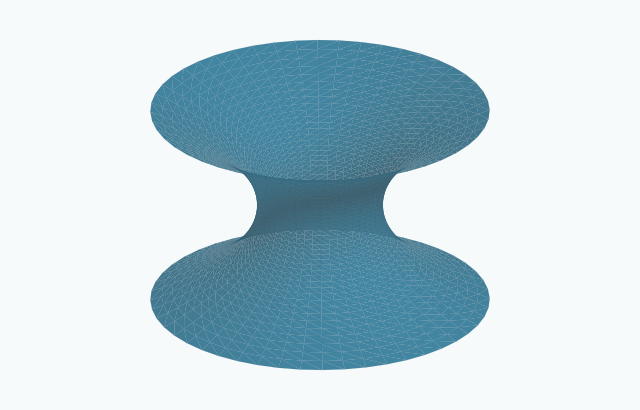
A truncated catenoid with a circular waist and two flaring ends, illustrating a stationary minimal surface.
Exact formula. An exact catenoid illustrates one member of the general class of stationary minimal surfaces. The waist radius is 1 and the displayed parameter window is |s| ≤ 1.65. Rotate or zoom this finite piece; the complete surface has two infinite ends and is independent of time. Open drawing · Numerical references and credits

Ambient space, topology, embeddedness and entropy

Every smooth minimal immersion in a fixed ambient metric gives a stationary flow for all real times. The cases below concern immersions without boundary. Completeness, properness, symmetry and stability depend on the chosen immersion; none is assumed for the general class. The catenoid is the illustrated example. Genus describes the parameter surface when orientable; the fixed-boundary numerical catenoid benchmark is discussed in the text.

Catenoid in ℝ³ (illustrated example) · Euclidean space ℝ³ · Embedded
Ambient space
Euclidean space ℝ³
Topology
Annulus S¹ × ℝ
Embeddedness
Embedded: Every stationary time slice is a properly embedded annulus.
Compactness
Noncompact
Surface genus
0
Topological ends
2
Entropy
Not recorded: Not recorded in this entry.
Gaussian area
Not recorded: Not recorded in this entry.
Affine planes in ℝ³ · Euclidean space ℝ³ · Embedded
Ambient space
Euclidean space ℝ³
Topology
ℝ²; complete and properly embedded
Embeddedness
Embedded: The stated affine parametrization is an embedding; multiple covers are not included in this case.
Compactness
Noncompact
Surface genus
0
Topological ends
1
Entropy
Exact formula: λ(P) = 1 for every multiplicity-one affine plane.
Gaussian area
Exact formula: F₀,₁(P) = exp(−dist(0,P)²/4); equals 1 exactly when the plane contains the origin.
General minimal surfaces in ℝᴺ, N ≥ 3 (codimension N − 2) · Euclidean space ℝ³; Euclidean space ℝ⁴; Euclidean dimension ≥ 5 · Depends on the construction
Ambient space
Euclidean space ℝ³; Euclidean space ℝ⁴; Euclidean dimension ≥ 5
Topology
The topology of the chosen minimal parameter manifold; completeness and properness are not assumed.
Embeddedness
Depends on the construction: The stationary flow is embedded exactly when the chosen minimal immersion is an embedding. Nonembedded immersions remain nonembedded; minimality alone does not decide this.
Compactness
Noncompact
Surface genus
Depends on the chosen orientable parameter surface; no single genus is assigned to this class.
Topological ends
Depends on the chosen minimal immersion; no common number is asserted.
Entropy
Not recorded: No value, uniform bound or general finiteness assertion is recorded.
Gaussian area
Not recorded: No value or general finiteness assertion is recorded; not identified with entropy.
Minimal submanifolds of dimension n ≥ 3 in ℝᴺ, N ≥ n + 1 · Euclidean space ℝ⁴; Euclidean dimension ≥ 5 · Depends on the construction
Ambient space
Euclidean space ℝ⁴; Euclidean dimension ≥ 5
Topology
The topology of the chosen minimal parameter manifold; completeness and properness are not assumed.
Embeddedness
Depends on the construction: The stationary flow is embedded exactly when the chosen minimal immersion is an embedding. Nonembedded immersions remain nonembedded; minimality alone does not decide this.
Compactness
Noncompact
Surface genus
Not a surface
Topological ends
Depends on the chosen minimal immersion; no common number is asserted.
Entropy
Not recorded: No value, uniform bound or general finiteness assertion is recorded.
Gaussian area
Not recorded: No value or general finiteness assertion is recorded; not identified with entropy.
Minimal surfaces in fixed Riemannian manifolds of dimension N ≥ 3 · Riemannian ambient manifold · Depends on the construction
Ambient space
Riemannian ambient manifold
Topology
The topology of the chosen minimal parameter manifold; completeness and properness are not assumed.
Embeddedness
Depends on the construction: The stationary flow is embedded exactly when the chosen minimal immersion is an embedding. Nonembedded immersions remain nonembedded; minimality alone does not decide this.
Compactness
Not specified for this subfamily
Surface genus
Depends on the chosen orientable parameter surface; no single genus is assigned to this class.
Topological ends
Depends on the chosen minimal immersion; no common number is asserted.
Entropy
Not applicable: Euclidean entropy is not assigned to intrinsic MCF in a curved ambient manifold.
Gaussian area
Not applicable: Euclidean Gaussian area is not assigned to intrinsic MCF in a curved ambient manifold.
Minimal submanifolds of dimension n ≥ 3 in fixed Riemannian manifolds of dimension N ≥ n + 1 · Riemannian ambient manifold · Depends on the construction
Ambient space
Riemannian ambient manifold
Topology
The topology of the chosen minimal parameter manifold; completeness and properness are not assumed.
Embeddedness
Depends on the construction: The stationary flow is embedded exactly when the chosen minimal immersion is an embedding. Nonembedded immersions remain nonembedded; minimality alone does not decide this.
Compactness
Not specified for this subfamily
Surface genus
Not a surface
Topological ends
Depends on the chosen minimal immersion; no common number is asserted.
Entropy
Not applicable: Euclidean entropy is not assigned to intrinsic MCF in a curved ambient manifold.
Gaussian area
Not applicable: Euclidean Gaussian area is not assigned to intrinsic MCF in a curved ambient manifold.

Compare examples by these properties →

References on this page

  1. [Man11] Carlo Mantegazza. Lecture Notes on Mean Curvature Flow. Volume 290 of Progress in Mathematics. Birkhäuser, 2011. Citations use supplied corrected 2012 printing; Remark 4.4.7 on printed p. 105 is PDF p. 116. URL: https://doi.org/10.1007/978-3-0348-0145-4, doi:10.1007/978-3-0348-0145-4.All uses in this project ↩ 1 ↩ 2 ↩ 3
  2. [ChoppMinimal1993] David L. Chopp. Computing minimal surfaces via level set curvature flow. Journal of Computational Physics, 106(1):77–91, 1993. Fixed-boundary numerical minimal surfaces; the catenoid test is in Section 4.1, pp. 86–87. URL: https://doi.org/10.1006/jcph.1993.1092, doi:10.1006/jcph.1993.1092.All uses in this project ↩ 1
Cite this page

Comments

Comments are not enabled yet.