MCF-stack: Special Solutions of Mean Curvature Flow

§ 5.22 Non-self-similar ancient doughnuts1E48CF8C9E56

Earliest recorded reference: (first arXiv submission).

Paper credits and chronology

Paper credits are chronological and include every author of the cited papers. They identify sources, not exclusive discovery credit. Background-only citations do not determine the date of this example. A classical example may predate the references recorded here.

  1. Bourni–Langford–Mramor — 2019-11-13 (first arXiv submission).
1E48CF8C9E56
7A6AD2F58C6E

For each $n\ge 2$, Bourni–Langford–Mramor construct a closed embedded rotational ancient flow with topology $S^1\times S^{n-1}$ in $\mathbb R^{n+1}$ that is not a soliton. It is obtained by perturbing a shrinking doughnut inward and taking an ancient limit. In rescaled coordinates the backward limit is a shrinking doughnut; the finite-time evolution is not a family of homothetic copies of that limit. The source explains that the flow develops a circle of neck-pinch singularities at the forward endpoint. The regular slices are compact, complete and proper. The flow is not mean convex for all ancient times, but becomes mean convex before the final circle of neck pinches. In dimension two their genus is one and they have no ends. For the construction based on the Drugan–Nguyen doughnut, entropy is strictly less than two, by the input entropy bound and monotonicity. No exact entropy value, closed parametrization or uniqueness of the ancient solution is claimed. The figure distinguishes the rescaled backward shrinker profile from the later thin tube around a circle. Its evolving tube outline is a geometric schematic, not a generic torus mislabeled as the Angenent torus or a numerical solution of the ancient PDE.

Sources: [BourniLangfordMramor2020].
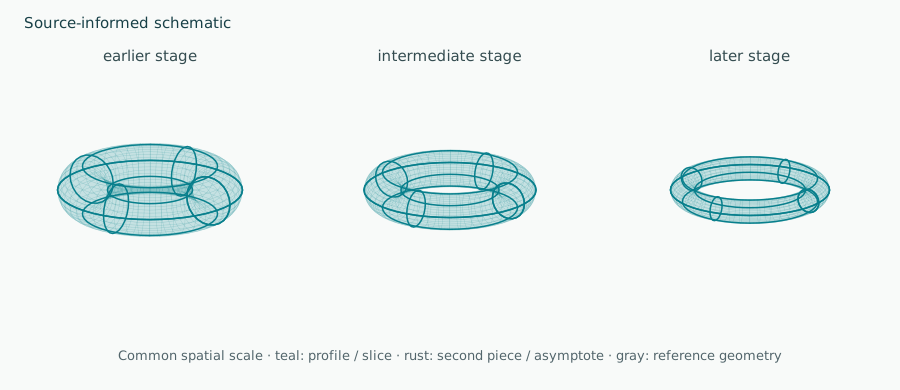
Non-self-similar ancient doughnuts. The backward shrinking-doughnut model and a later circular neck pinch are shown on fixed axes. Tube profiles interpolate the qualitative geometry only; neither a certified shrinker nor an ancient PDE trajectory is claimed.
Source-informed schematic. The backward shrinking-doughnut model and a later circular neck pinch are shown on fixed axes. Tube profiles interpolate the qualitative geometry only; neither a certified shrinker nor an ancient PDE trajectory is claimed. Open drawing · Numerical references and credits

Ambient space, topology, embeddedness and entropy

Source construction and dimension restrictions are stated on the reading page. Illustrations have their own accuracy labels.

Ancient torus surface in ℝ³ · Euclidean space ℝ³ · Embedded
Ambient space
Euclidean space ℝ³
Topology
S¹ × S¹
Embeddedness
Embedded: The cited construction gives an embedding for this case.
Compactness
Compact
Surface genus
Genus one.
Topological ends
No ends (compact parameter manifold).
Entropy
Proved bound or relation: λ(M_t) < 2 for the construction based on the Drugan–Nguyen shrinker; no exact value.
Gaussian area
Proved bound or relation: F₀,₁(M_t) ≤ λ(M_t) < 2 for the specified construction; not identified with entropy.
n ≥ 3 · Euclidean space ℝ⁴; Euclidean dimension ≥ 5 · Embedded
Ambient space
Euclidean space ℝ⁴; Euclidean dimension ≥ 5
Topology
S¹ × Sⁿ⁻¹
Embeddedness
Embedded: The cited construction gives an embedding for this case.
Compactness
Compact
Surface genus
Not a smooth surface; surface genus is inapplicable.
Topological ends
No ends (compact parameter manifold).
Entropy
Proved bound or relation: λ(M_t) < 2 for the construction based on the Drugan–Nguyen shrinker; no exact value.
Gaussian area
Proved bound or relation: F₀,₁(M_t) ≤ λ(M_t) < 2 for the specified construction; not identified with entropy.

Compare examples by these properties →

References on this page

  1. [BourniLangfordMramor2020] Theodora Bourni, Mathew Langford, and Alexander Mramor. On the construction of closed nonconvex nonsoliton ancient mean curvature flows. International Mathematics Research Notices, 2021:757–768, 2020. URL: https://arxiv.org/abs/1911.05641, arXiv:1911.05641, doi:10.1093/imrn/rnaa063.All uses in this project ↩ 1
Cite this page

Comments

Comments are not enabled yet.