MCF-stack: Special Solutions of Mean Curvature Flow

§ 5.23 Ancient pancakes with polyhedral asymptoticsAD25A77F6BAA

Earliest recorded reference: (first arXiv submission).

Paper credits and chronology

Paper credits are chronological and include every author of the cited papers. They identify sources, not exclusive discovery credit. Background-only citations do not determine the date of this example. A classical example may predate the references recorded here.

  1. Bourni–Langford–Tinaglia — 2020-06-29 (first arXiv submission).
AD25A77F6BAA
8C2928E390C8

For a bounded regular circumscribed polytope $P\subset \mathbb R^ n$, and separately for a bounded circumscribed simplex, Bourni–Langford–Tinaglia construct a compact convex ancient hypersurface in the slab $(-\pi /2,\pi /2)\times \mathbb R^ n$. The facets of $P$ are tangent to the unit sphere with the source's orientation; the regular-polytope theorem assumes its stated symmetry. The construction does not establish existence for every arbitrary polytope. The solution's linear-scale backward limit, or squash-down, is $P$. The slices are embedded, complete and proper, topologically $S^ n$, and inherit the prescribed symmetries. Extinction can be normalized to $t=0$. A triangular example in $\mathbb R^3$ already differs from a rotational pancake; higher-dimensional simplices give further examples. The shrinking polytope is an asymptotic descriptor, not the smooth MCF hypersurface at a finite time. The picture shows rounded faces, fixed slab width, and the separate polyhedral limiting outline. Compact slice entropy is finite, but no numeric value or uniqueness theorem is supplied.

Sources: [BourniLangfordTinaglia2022].
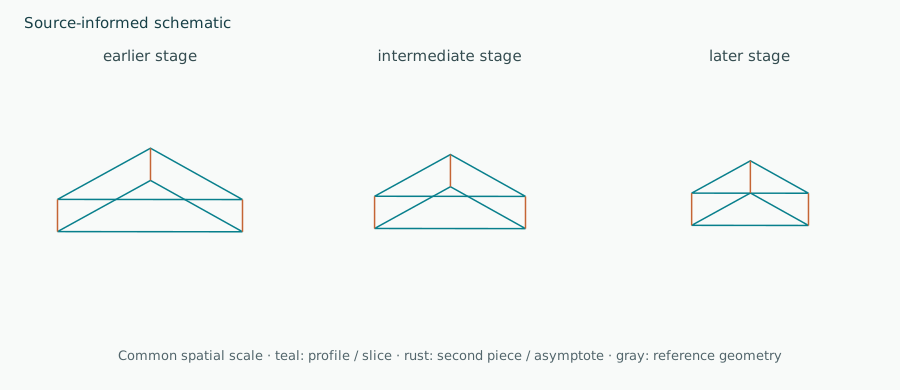
Ancient pancakes with polyhedral asymptotics. Rounded triangular pancake schematic, with its circumscribed squash-down shown separately. Successive stages change the in-plane size while retaining the slab; these are not exact MCF time slices.
Source-informed schematic. Rounded triangular pancake schematic, with its circumscribed squash-down shown separately. Successive stages change the in-plane size while retaining the slab; these are not exact MCF time slices. Open drawing · Numerical references and credits

Ambient space, topology, embeddedness and entropy

Source construction and dimension restrictions are stated on the reading page. Illustrations have their own accuracy labels.

n = 2, polygonal squash-down · Euclidean space ℝ³ · Embedded
Ambient space
Euclidean space ℝ³
Topology
S²
Embeddedness
Embedded: The cited construction gives an embedding for this case.
Compactness
Compact
Surface genus
Genus zero.
Topological ends
No ends (compact parameter manifold).
Entropy
Finite; value not recorded: Finite on each stated smooth slice; no numerical value or uniform time bound is recorded.
Gaussian area
Finite; value not recorded: Finite on each stated smooth slice; no numerical value or uniform time bound is recorded.
n ≥ 3 · Euclidean space ℝ⁴; Euclidean dimension ≥ 5 · Embedded
Ambient space
Euclidean space ℝ⁴; Euclidean dimension ≥ 5
Topology
Sⁿ
Embeddedness
Embedded: The cited construction gives an embedding for this case.
Compactness
Compact
Surface genus
Not a smooth surface; surface genus is inapplicable.
Topological ends
No ends (compact parameter manifold).
Entropy
Finite; value not recorded: Finite on each stated smooth slice; no numerical value or uniform time bound is recorded.
Gaussian area
Finite; value not recorded: Finite on each stated smooth slice; no numerical value or uniform time bound is recorded.

Compare examples by these properties →

References on this page

  1. [BourniLangfordTinaglia2022] Theodora Bourni, Mat Langford, and Giuseppe Tinaglia. The atomic structure of ancient grain boundaries. Geometry & Topology, 26:1849–1905, 2022. URL: https://arxiv.org/abs/2006.16338, arXiv:2006.16338, doi:10.2140/gt.2022.26.1849.All uses in this project ↩ 1
Cite this page

Comments

Comments are not enabled yet.