225751B3C7E8
(Chen–Sun's product-manifold construction) For each $n\geq 2$, there is a smooth connected embedded immortal mean curvature flow of compact hypersurfaces in the product manifold
where $S^ n$ has unit round radius. The flow is defined for all $t\geq 0$ and is nonstatic. Its hypersurface dimension is $n$ and its codimension in this ambient manifold is one. The construction stays in the smaller band $|y|\leq 1/(2n)$, so the same flow is contained in $S^ n\times \mathbb R$; it can also be placed in the closed product $S^ n\times (\mathbb R/4\mathbb Z)$ without changing the metric near the flow. There is no free boundary on $y=\pm 1$.
The solution is invariant under rotations of the sphere about its polar axis, reflection $y\mapsto -y$, and reflection across the sphere's equator. A closed profile $\sigma \mapsto (x(\sigma ,t),y(\sigma ,t))$ in $(0,\pi )\times \mathbb R$ generates it by
The profile avoids both axes at every finite time, so this parametrization directly gives topology $S^1\times S^{n-1}$. Thus for $n=2$ the surfaces are genus-one tori with no ends. All slices are complete and proper by compactness. This is a topological deduction from the construction, not an assertion that the source states a separate topology theorem.
No closed time-dependent profile is supplied. Its upper half can be described using the solution of
with an inverse graph near each neck, governed by
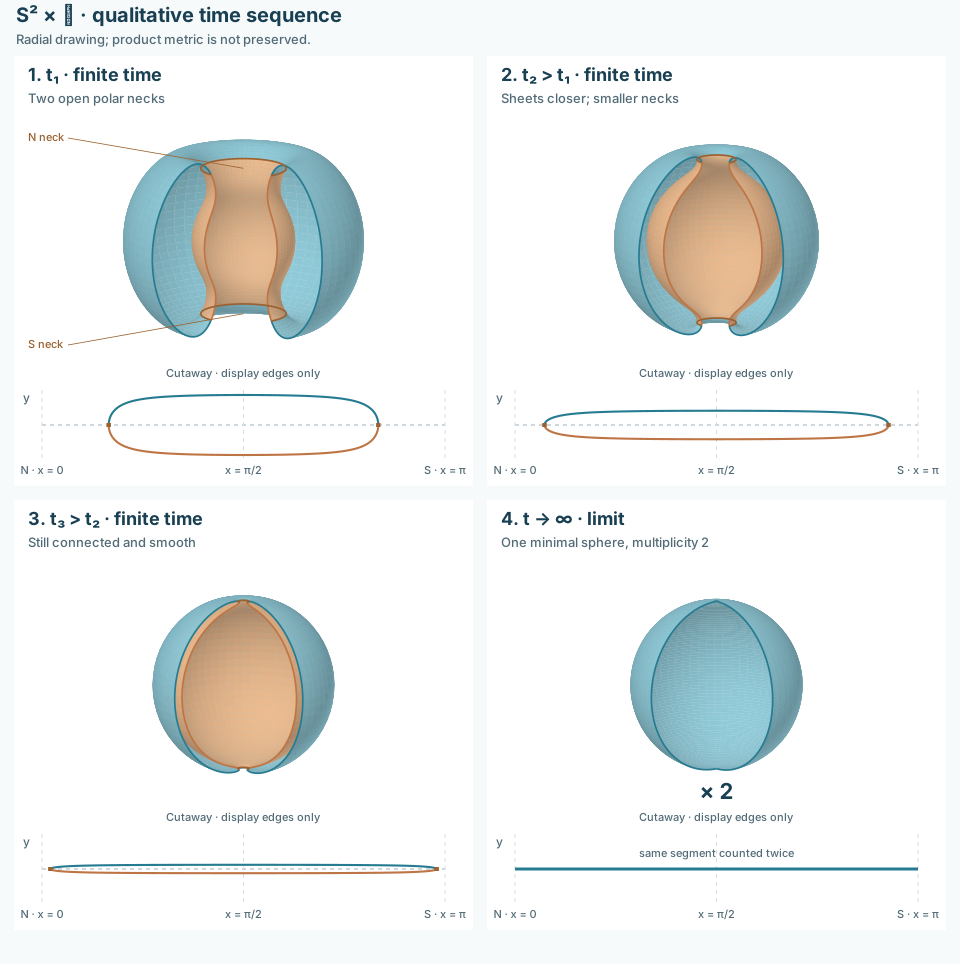
An interpolation argument selects an immortal solution. As $t\to \infty $, it converges to the stable minimal slice $S^ n\times \{ 0\} $ with multiplicity two. Away from the north and south poles, the two sheets converge smoothly; the two necks collapse only at infinite time.
Source: [CS25Man], Theorems 1.1, 3.12, and 3.17, Section 2.1, Definition 3.10 and Lemma 3.11, and Section 3.3, arXiv v2 PDF pp. 1–4 and 11–15. Euclidean Gaussian area and Colding–Minicozzi entropy are not assigned to this intrinsic manifold flow; the cited paper gives no such invariant for these examples. In particular, its isometric embedding into $\mathbb R^{n+2}$ is not an unforced Euclidean mean curvature flow. The picture pairs three ordered finite-time stages with the infinite-time limit and their orbit-space profiles. In the $n=2$ drawing, the coordinate map $(p,y)\mapsto (1+2y)p$, for $p\in S^2$, displays the two sheets as inner and outer shells joined through both polar necks. This map is not an isometry: the radial separation illustrates the product coordinate, not a Euclidean MCF. A display cutaway exposes the inner sheet; its cut edges are not boundaries of the compact surface. The illustrated profiles are smooth schematic loops, not computed solutions or an asserted asymptotic formula. The stage slider assigns no physical times or decay rates. At every finite stage both neck circles remain positive, whereas the separate limit view shows one sphere with multiplicity two.
Comments
Comments are not enabled yet.